

By Emmanuel Thomas l Friday, Oct. 16, 2026
ABUJA — As the global community marks World Food Day, the presidential candidate of the Nigeria Democratic Congress (NDC), Mr. Peter Obi, has urged the Federal Government to immediately declare a national emergency on hunger, warning that poverty and severe food insecurity have reached crisis levels across the country.
In a statement issued to commemorate the day, Obi expressed deep concern over the living conditions of millions of Nigerian families struggling to secure daily meals despite the nation’s vast agricultural potential.
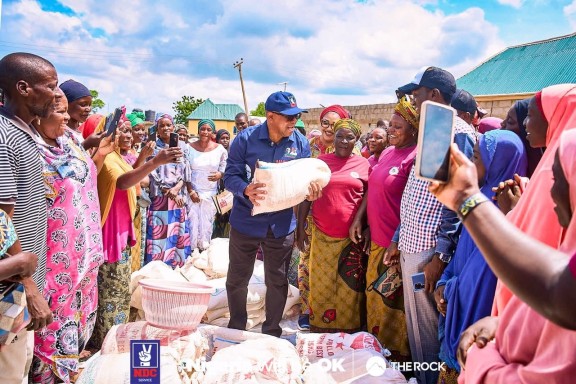
Reflecting on his interaction with local food producers during International Rural Women’s Day, the former Anambra State governor stated that the government must urgently confront insecurity and soaring food inflation with decisive action and compassion.
”Today, as the world marks World Food Day, Nigerians are confronting a painful reality: hunger, poverty, and insecurity continue to affect millions of families across the country,” Obi said. “What has become clear to me is that hunger in the country must be declared a national emergency.”
Deteriorating Hunger Index and Insecurity
Placing Nigeria’s food crisis into sharp focus, Obi pointed to international indices tracking global hunger trends. He noted that Nigeria’s standing on the Global Hunger Index (GHI) has slipped to 117th out of 125 countries, down from its 109th position in 2023 when the current administration took office.
He added that data from the Food and Agriculture Organisation (FAO) paints a grim picture, estimating that approximately 36 million Nigerians are projected to face acute hunger this year.

Obi lamented that the widespread food shortage remains a direct consequence of unaddressed insecurity, which has forced millions of rural farmers off their lands.
”The tragedy is even more painful because Nigeria has vast, arable, and fertile land. Yet about 60 percent remains uncultivated, providing forest hideouts for terrorist organisations and other non-state actors,” he observed.
Nigeria’s agricultural sector has faced compounding pressures over recent years. Skyrocketing inflation, soaring fuel costs following subsidy removals, and widespread insecurity in key agricultural hubs across the Middle Belt and Northern regions have combined to drive food inflation to historical peaks.
The loss of active farming population to displacement, coupled with banditry and farmer-herder clashes, has drastically reduced national crop yields.
Consequently, humanitarian agencies and developmental institutions like the FAO and the World Food Programme (WFP) have repeatedly raised alarms over expanding food insecurity hotspots across West Africa, with Nigeria among the most impacted.
Obi Promises Targeted Agricultural Reforms
Outlining his vision under an NDC-led administration, Obi promised comprehensive reforms aimed at restoring national security and revitalizing the agricultural value chain.
He assured that critical interventions would be deployed directly to real farmers to rebuild domestic food production and lower market prices.
”The fight against hunger must be treated as a national emergency. Under our leadership, we will secure the country and return our hardworking farmers to their farms. They will receive targeted grants, subsidies, and other forms of support,” Obi declared.
”On World Food Day, the message is clear: Nigerians deserve a country where no family goes to bed hungry, farmers can work without fear, and poverty and insecurity are confronted with urgency and compassion. Together, we can build a Nigeria where no one goes to bed hungry and every farmer can work in peace and dignity,” he concluded.
