

By Our CORRESPONDENT
KYIV, Ukraine — In one of the most sprawling and coordinated aerial assaults in recent months, Russia unleashed a massive wave of more than 700 missiles and attack drones overnight, striking residential areas and critical infrastructure across nearly a dozen Ukrainian regions.
The coordinated strike left at least 13 people dead, dozens injured, and several others missing under the rubble of a shattered apartment building, according to Ukrainian officials.
The sheer scale of the bombardment prompted a renewed, urgent appeal from President Volodymyr Zelensky, who warned that Ukraine’s European neighbors remain deeply vulnerable without a robust, continental anti-ballistic missile defense system.
The overnight assault, which deployed a sophisticated mix of 656 attack drones and 73 missiles—including ballistic, cruise, and anti-ship projectiles—appeared designed to overwhelm Ukraine’s air defense networks by striking multiple targets simultaneously from north to south.
”A large-scale attack and an absolutely clear statement from Russia: if Ukraine is not protected from ballistic and other missile strikes, these attacks will continue,” Mr. Zelensky said in a statement on Tuesday.
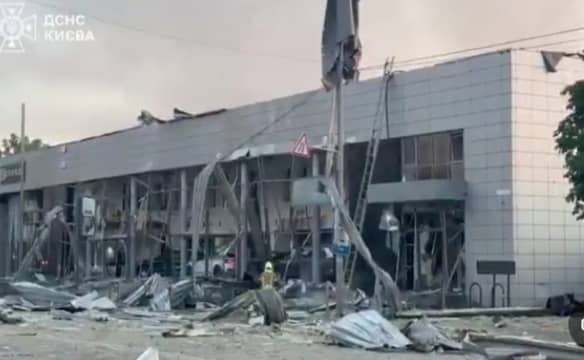
While air defense teams managed to intercept a significant portion of the incoming barrage, several high-velocity missiles breached the shield, with the primary strike targeting the capital. In Kyiv, the thunder of explosions shook residents awake in the early morning hours. Shrapnel and direct hits damaged dozens of residential buildings and purely civilian infrastructure across the city.
Emergency officials confirmed that four people were killed in the capital. By midday, 38 wounded residents remained hospitalized in Kyiv receiving critical care, as more than 500 emergency personnel worked to clear burning debris and stabilize damaged structures.
The most severe loss of life occurred southeast of the capital in the city of Dnipro, where a missile tore through a four-story apartment building, completely demolishing a section of the structure. Local authorities reported that nine people were killed in the Dnipro strike, including a child.
Rescue workers, navigating unstable mounds of concrete and twisted metal, pulled 35 injured residents from the ruins. As evening approached, the fate of six missing tenants remained unknown. Mr. Zelensky vowed that search and rescue teams would continue digging “for as long as necessary” to find survivors.
Beyond civilian housing, the Russian military heavily targeted Ukraine’s fragile energy sector. Strikes were recorded against energy facilities in the Kharkiv region and critical infrastructure within Kharkiv city itself, leading to localized power outages.

Additional strikes targeted infrastructure in the Mykolaiv, Zaporizhzhia, Poltava, Sumy, Chernihiv, and Khmelnytskyi regions, demonstrating a deliberate strategy to degrade the country’s power grid ahead of changing seasonal demands.
The intensity of the attack has reignited an intense debate over Western military aid timelines.
For months, Ukrainian officials have warned that their stockpiles of air defense ammunition, particularly interceptor missiles for the American-made Patriot system, are running dangerously low due to the continuous volume of Russian attacks.
Mr. Zelensky used the aftermath of the tragedy to pressure international allies for immediate logistical support, framing the security of Ukraine as inherently tied to the security of Western Europe.
”Europe needs its own anti-ballistic defense so that this war can finally be brought to an end,” Mr. Zelensky stated, adding that “assistance from the United States in supplying missiles for Patriot systems is absolutely necessary.”
While expressing gratitude to Ukrainian civilians for adhering to air raid alerts—a practice officials credit with preventing a much higher death toll—the Ukrainian leadership made it clear that passive defense measures are no longer enough to deter Moscow’s strategy of aerial exhaustion.
As local municipalities begin the grim task of repairing broken grids and burying the dead, the focus shifts back to Washington and Brussels, where leaders face mounting pressure to accelerate the delivery of advanced anti-missile systems before the next barrage arrives.
