

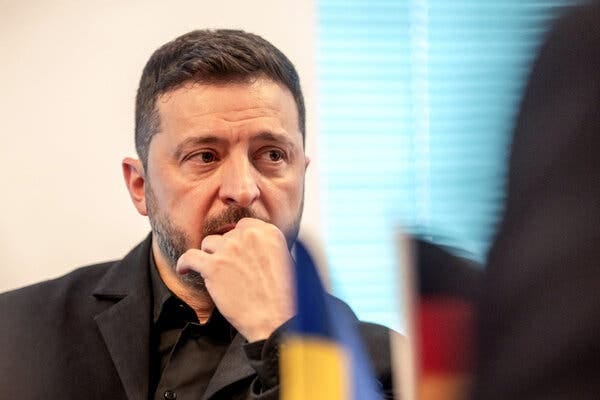
By SCM Foreign Desk
KYIV, Ukraine — In a major wartime shake-up, President Volodymyr Zelensky has dismissed his reform-minded Defense Minister, Mykhailo Fedorov, after only six months in office.
The sudden removal of one of Ukraine’s most popular political figures underscores a widening rift within the country’s leadership and a tactical shift away from high-tech battlefield solutions toward aggressive troop mobilization.
Lawmakers in Kyiv confirmed that Interior Minister Ihor Klymenko is tipped to assume the defense portfolio, a move that must be formally approved by parliament. Klymenko, a veteran police general, is known for his strict, uncompromising enforcement of conscription laws as Ukraine struggles to replenish its front lines.
Mr. Fedorov, who previously earned international acclaim as Ukraine’s Minister of Digital Transformation, was appointed to the defense post in January 2026. He was tasked with modernizing a lumbering military bureaucracy and scaling up asymmetric drone warfare.
During his brief six-month tenure, Fedorov’s team successfully:
Deactivated Russian access to SpaceX’s Starlink terminals, degrading Moscow’s drone coordination.
Overhauled military procurement, saving billions in state funds through open tenders for long-range weaponry.
Launched the “logistics lockdown” campaign, utilizing advanced interceptor and deep-strike drones to isolate occupied Crimea.
Yet, the very qualities that made Fedorov a favorite of tech-forward military units—his focus on decentralized, innovative solutions—brought him into direct conflict with traditionalist forces.
According to government officials and military analysts, the root of Fedorov’s departure lies in a growing conflict with Ukraine’s Commander-in-Chief, Oleksandr Syrskyi, as well as mounting pressure over mobilization.
While Fedorov championed “asymmetry” and technological supremacy, the military leadership has faced the starker, physical reality of holding a thousand-kilometer front line with dwindling manpower.

”Zelensky is prioritizing someone who can deliver boots on the ground,” a lawmaker from the governing Servant of the People party said, speaking on condition of anonymity.
“Fedorov was brilliant with technology, but the administration feels the pressing challenge of 2026 is raw manpower and strict military discipline.”
Confirming his exit on social media, Fedorov acknowledged both his achievements and the friction they caused, noting that while his team had revolutionized drone acquisition, he had been unable to fully transform the ministry “in accordance with NATO standards and common sense”.
The expected nomination of Ihor Klymenko represents a stark contrast in style and substance. As Minister of Internal Affairs, Klymenko oversaw the National Police and draft enforcement operations.
His ministry has been the tip of the spear in carrying out controversial, increasingly aggressive mobilization drives.
While Fedorov’s reforms were designed to attract recruits through tech-focused roles and career incentives, Klymenko’s expected mandate is direct and systemic: enforce conscription, streamline draft offices, and ensure combat units are fully staffed.
For President Zelensky, the political gamble is immense. Fedorov remains highly popular among the public and Western allies. By replacing him with a hardline enforcer like Klymenko, Zelensky is signaling to both his domestic audience and international partners that Ukraine is preparing for a grueling, highly disciplined phase of the war where manpower takes priority over all else.
A vote in the Verkhovna Rada, Ukraine’s parliament, is scheduled for July 16 to confirm Klymenko’s appointment.
