

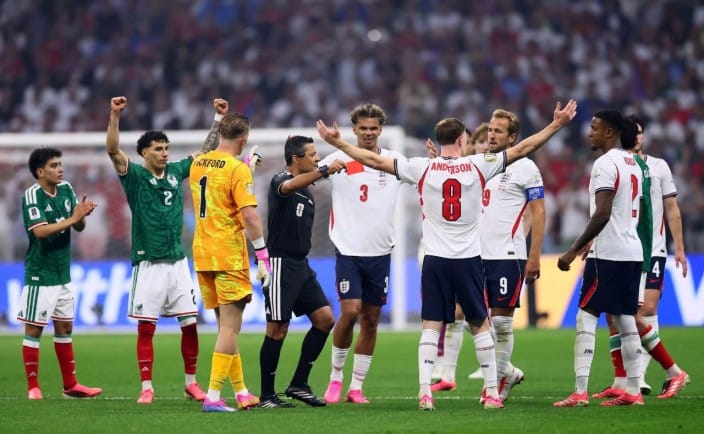
By Our Special Correspondent at the Mexico City Stadium
They are still singing it now. Long after the thunderstorm cleared, long after the thunderous Mexican fans filed out into the Mexico City night, and long after Thomas Tuchel’s throat had grown hoarse from shouting instructions at an altitude that makes lesser men wilt.
“Football’s Coming Home” echoed through the rafters of the iconic Azteca stage, a hauntingly beautiful, defiant melody left behind by an England squad that simply refused to break.
This was not just a football match; it was an unrelenting, high-octane opera played out at more than seven thousand feet above sea level.
It was a chaotic, beautiful mess that had everything—two quickfire goals from a generational English phenomenon, a catastrophic red card to a young defender, two penalties that frayed nerves on opposite sides of the Atlantic, and a co-host nation throwing an entire stadium’s worth of passion at eleven men in white. When the dust finally settled, England stood tall with a 3-2 victory, booking their tickets to Miami for a blockbuster quarter-final clash against Norway.
The evening started with a literal storm, as severe weather delayed the kickoff by an hour, turning the anticipation into a pressure cooker. When the referee finally blew his whistle, Mexico, backed by a raucous, sea of green supporters, flew out of the blocks.
England looked sluggish, suffocated by the aggressive Mexican press and the thin air. Declan Rice, usually the unshakeable anchor of the midfield, found himself caught out in the very first minute, picking up a tactical yellow card after a clumsy challenge to break up a dangerous attack.
But big games belong to big players. And right now, there is no bigger player on this planet than Jude Bellingham.
Against the absolute run of play, England’s stars engineered a moment of pure gold. In the thirty-sixth minute, Jordan Pickford, who had already pulled off a world-class save to deny a booming Raúl Jiménez header, collected the ball and threw an accurate pass to Rice.
The Arsenal midfielder drove deep, feeding Bukayo Saka on the right wing. Saka, with the coolness that has defined his tournament, clipped an inviting, pinpoint cross into the box. Rising like a colossus among the Mexican defenders, Bellingham met it with a ferocious diving header that left goalkeeper Raúl Rangel grasping at thin air.
Before the home crowd could even finish wiping the shock from their eyes, Bellingham did it again. Just two minutes later, Anthony Gordon and Elliot Anderson harried the Mexican midfield into a loose turnover.

The ball broke to Harry Kane. The skipper looked up, slid a perfectly weighted, low cross across the face of goal, and there was Bellingham, sliding in to turn it home. With that goal, Bellingham became the first player since Diego Maradona in 1986 to score twice in a World Cup match at this historic venue. The Azteca belonged to Birmingham’s finest.
Yet, Mexico refused to die. In the forty-second minute, Julián Quiñones capitalised on England’s failure to clear a set-piece, crashing an unstoppable, laser-focused shot past Pickford from close range to make it 2-1 before the interval.
The second half brought the kind of adversity that usually breaks English hearts. In the fifty-fourth minute, Jarell Quansah went in too hard on Jesús Gallardo. A straight red card was brandished. Reduced to ten men with more than thirty-five minutes left on the clock, Tuchel immediately reacted, sacrifice the attacking flair of Saka for the veteran defensive steel of John Stones.
But just as the Mexican fans smelled blood, England struck back with a ruthless counter. Anthony Gordon darted into the box and was wiped out by Rangel.
Up stepped the captain. Harry Kane, carrying the hopes of a nation, calmly struck his sixth goal of the tournament from twelve yards out, rifling his penalty good in the sixtieth minute to restore a two-goal cushion.
The drama, however, was far from over. Ten minutes later, Kane went from hero to villain in the eyes of the referee, committing a foul on Brian Gutiérrez in the box. Following a tense VAR review, Mexico were awarded a penalty of their own, and veteran marksman Raúl Jiménez made no mistake, burying it past Pickford in the sixty-ninth minute.
What followed was twenty minutes of pure defensive heroism. Marc Guéhi and Nico O’Reilly both entered the referee’s book with yellow cards as England fought tooth and nail to defend their box. Jordan Henderson came off the bench to add experience, picking up a late stoppage-time yellow card of his own as the game dissolved into a series of frantic aerial battles and tactical fouls.
The final statistics told the story of an absolute battle. Mexico dominated possession with fifty-six percent of the ball compared to England’s forty-four percent, unleashing fourteen shots with six hitting the target. England, working with ten men for the final third of the match, were model models of efficiency, scoring three goals from just five shots on target out of nine total attempts.
The match was heavily disrupted by discipline, featuring a total of seven yellow cards—five for England and two for Mexico—along side Quansah’s crucial red card. Mexico won eight corners to England’s three, reflecting their late pressure, but Tuchel’s men stood resolute.
When the final whistle blew, the ten men in white collapsed to the turf in exhaustion and ecstasy. They had survived the altitude, the referee, the red card, and the co-hosts. The Three Lions are rolling on.
