

By SCM Technology Writer
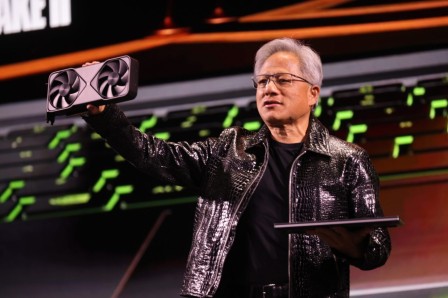
TAIPEI — In a move that marks the most radical shakeup of the personal computer industry in generations, Nvidia has officially thrown down the gauntlet for the future of desktop and mobile computing. At the Computex trade show in Taipei, CEO Jensen Huang unveiled the Nvidia RTX Spark, a consumer-class “superchip” engineered from the ground up to sever the umbilical cord connecting modern artificial intelligence to remote cloud servers.
The ambition behind the silicon is clear: to move computing past the era of manual application launching and drag it into a new, autonomous age of agentic AI.
“The PC is being reinvented,” Huang declared during his keynote presentation. “For forty years, you launched apps. Click. Type. With RTX Spark and Microsoft Windows, you ask—and the PC does the work.”
Data Center DNA in a 14mm Chassis
The RTX Spark is not just an incremental upgrade or a beefed-up graphic card; it is a complete Windows-on-Arm system-on-a-chip (SoC) manufactured on TSMC’s cutting-edge 3-nanometer process.
To achieve the immense horsepower required to execute complex AI reasoning locally, Nvidia paired a high-performance 20-core Arm CPU (co-designed with MediaTek) with a formidable Blackwell-architecture GPU boasting 6,144 CUDA cores.
Crucially, the chip brings data-center level structural engineering to the consumer ecosystem.
By linking the CPU and GPU via Nvidia’s proprietary NVLink-C2C interconnect, the system achieves a massive 300 GB/s of memory bandwidth.
Combined with configurations supporting up to 128GB of unified memory, the hardware breaks down the traditional visual memory limits that have historically choked local machines.
The practical payload of this architectural marriage is staggering.
The RTX Spark delivers 1 petaflop of local AI computing performance. According to Nvidia, this is enough localized power to run highly advanced 120-billion-parameter large language models locally, with context windows stretching up to a massive one million tokens.
Eliminating the Cloud Dependencies
The underlying philosophy driving the RTX Spark is the immediate decentralization of AI. Up until now, using state-of-the-art generative tools or AI agents required sending private user data over the internet to remote server farms.
This infrastructure comes with noticeable network latency, subscription-based financial models, and glaring data privacy concerns for enterprise workers.
By transitioning these heavy computing tasks to the local machine, users can run complex data processing, code debugging, and media creation entirely offline.
Software giants are already moving to capitalize on the shift. Adobe announced it is rebuilding the core rendering engines of flagship applications like Photoshop and Premiere from scratch specifically for the Spark architecture, targeting a 2x performance jump in on-device AI tools like Generative Fill.
Furthermore, Nvidia is debuting its OpenShell runtime alongside the hardware. Integrated tightly with new native Microsoft Windows 11 security frameworks, OpenShell acts as a local sandbox, allowing personal AI agents to safely read on-screen content, look through local file systems, and execute complex workflows without any data ever leaving the physical hardware.

A High-Stakes Battle for the PC Market
This launch marks a historic pivot for Nvidia, representing its first major, direct assault on the consumer PC processor crown since its ill-fated Microsoft Surface RT experiment over a decade ago.
Now acting from a position of absolute financial dominance driven by its enterprise data center monopoly, Nvidia is stepping into a brutally competitive arena to trade blows with Intel’s Panther Lake, AMD’s Strix Halo, Apple’s M-series silicon, and Qualcomm’s Snapdragon X platform.
To sweeten the deal for traditional power users, Nvidia has ensured that the move to Arm architecture does not compromise standard PC pastimes.
The RTX Spark features full support for DLSS 4.5 frame generation, delivering 1440p AAA gaming at over 100 frames per second. Crucially, Nvidia has coordinated with major anti-cheat providers like Easy Anti-Cheat and BattlEye, resolving the software compatibility issues that hobbled early attempts at Windows-on-Arm gaming devices.
The hardware rollout is scaling rapidly. Laptops as thin as 14mm and compact mini-desktops are slated to hit the premium consumer market this fall. Hardware giants including Dell, HP, Lenovo, ASUS, and MSI have already committed to initial designs, spearheaded by Microsoft’s endorsement of the chip inside its upcoming flagship Surface Laptop Ultra.
As the industry looks toward the end of the year, one thing is abundantly clear: the definition of what a personal computer is supposed to do has irrevocably shifted. The local AI era has officially broken ground, and there is no going back.
For the past decade, consumer PCs have largely acted as interfaces to massive data centers. When you generate an image or prompt a large language model (LLM), that data travels over the internet to a server farm packed with thousands of industrial enterprise GPUs, processes the request, and beams the result back down to your screen.
This pipeline requires massive cloud infrastructure, relies entirely on a constant internet connection, and presents persistent data privacy risks.
By introducing the RTX Spark Superchip, Nvidia is aiming to bypass this server dependency entirely. It brings enterprise-grade data center architecture—specifically its “Blackwell” graphics architecture and ultra-fast system-on-a-chip (SoC) interconnects—directly down to consumer devices.
This enables true “edge computing” where multi-billion-parameter AI models can live, think, and react entirely on the local device, off the grid, and out of the cloud.
