

By SCM Foreign Desk
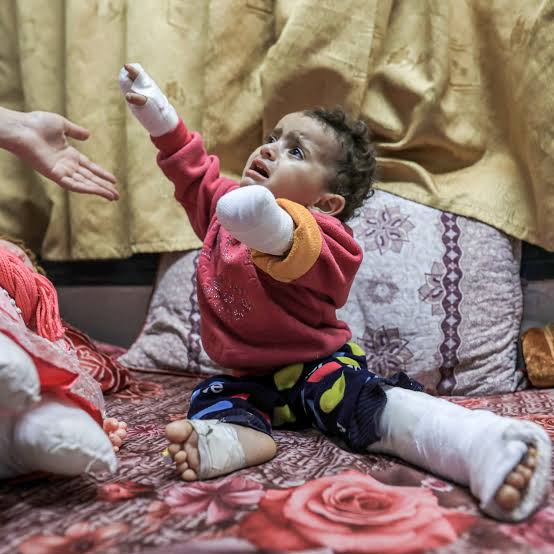
KHAN YOUNIS — He has lived for just fifty days, but baby Mohammad Ahmad Al-Khatib has already seen the absolute worst of human warfare.
Lying inside a crowded, sweltering intensive care unit at the Nasser Hospital in Khan Younis, southern Gaza, the infant is fighting a minute-by-minute battle for survival.
Tube-fed, heavily sedated, and surrounded by the constant beep of failing medical monitors, Mohammad is recovering from a trauma no adult should ever have to endure.
Following a devastating blast that struck his family home, the tiny infant suffered life-altering injuries that forced surgeons to perform a catastrophic amputation.
Mohammad’s father, Suhail Al-Khatib, sits by the plastic cot in a state of absolute shock. The same shrapnel that tore through his 50-day-old son killed Mohammad’s mother while she was actively breastfeeding him.
Now, doctors warn that without immediate, highly specialized medical evacuation out of the blockaded strip, Mohammad faces losing his left hand too. The bones are shattered, and the threat of gangrene looms in a hospital starved of basic antibiotics.
But Mohammad is not an isolated tragedy. His critical condition has become deeply emblematic of a much wider, horrific humanitarian catastrophe targeting the youngest residents of the Gaza Strip.
According to data compiled by the Gaza Health Ministry and corroborated by international aid agencies like Save the Children, around 6,000 distinct amputation cases have been officially recorded since the latest escalation of violence began.
The most disturbing aspect of this data is the age of the victims. Children account for roughly a quarter of all amputees. This means approximately 1,500 children have been left permanently disabled.
According to the United Nations, Gaza now holds the grim distinction of recording the highest rate of child amputees per capita anywhere in the world.
British-Palestinian blast surgeon Dr. Ghassan Abu-Sittah, who spent weeks operating in Gaza’s overwhelmed theatres, warned that the conflict is fundamentally “redefining war injuries.” Paediatric surgeons are routinely forced to perform traumatic amputations on babies who have not even learned to walk yet.

Medical experts warn that this will severely disrupt their neurological development, as their brains have not yet developed the coordination required to comprehend a missing limb.
The crisis is heavily compounded by the systematic destruction of Gaza’s healthcare infrastructure. Doctors at Nasser Hospital describe a daily nightmare where operations, including complex limb removals, are sometimes performed without proper anesthesia, clean water, or sterile surgical tools.
International disability charity Humanity & Inclusion reports that there are fewer than ten active prosthetics and orthotics technicians left working in the entire Gaza Strip.
The region’s only dedicated limb reconstruction and rehabilitation centre was rendered completely non-functional following heavy military raids.
Furthermore, paediatric amputations require an incredibly complex, lifelong care plan. Because a child’s bones and muscles are constantly growing, their stumps change shape rapidly.
Unlike an adult, a growing child requires their prosthetic limb to be surgically adjusted or completely replaced as often as every six months to prevent agonizing bone overgrowth and permanent spinal deformities.
In the current state of total siege, providing that level of continuous care is practically impossible.
As baby Mohammad fights for his next breath in the intensive care ward, humanitarian organizations are issuing an urgent plea to the international community.
Without a sustained, immediate opening of medical corridors to evacuate wounded children to specialized hospitals abroad, thousands of young Palestinians face a future defined not just by the trauma of war, but by permanent, painful, and entirely preventable physical deformation.
You can learn more about this ongoing medical crisis by watching this news broadcast on Gaza’s amputations, which features detailed interviews and on-the-ground reports regarding the thousands of wounded civilians requiring urgent long-term rehabilitation.
