


Admin I Thursday, Sept 25, 2025
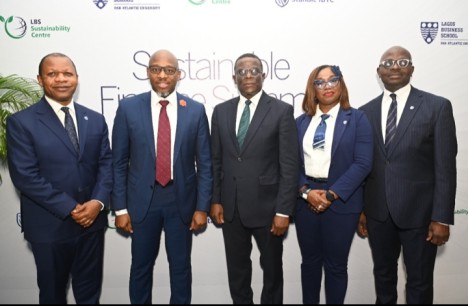
VICTORIA ISLAND, Lagos — The Stanbic IBTC Holdings Sustainable Finance Summit 2.0, held in collaboration with the Lagos Business School Sustainability Centre (LBSSC), concluded with a strong focus on using technology to combat climate change. The event underscored the critical role of AI-powered tools and digital innovation in reshaping Nigeria’s financial landscape towards sustainability.
Forging a Path for Climate-Smart Finance
The hybrid summit, themed “Financing Resilience: Digital Innovation and AI for Climate Smart Communities,” drew over 3,000 participants, including financial professionals, tech innovators, and policymakers from Nigeria and abroad.
The event served as a platform for unveiling new AI-powered climate risk assessment tools being developed by leading Nigerian fintech companies, positioning the nation at the forefront of sustainable finance in Africa.
Kunle Adedeji, Acting Chief Executive of Stanbic IBTC Holdings, highlighted the summit’s success as a validation of Nigeria’s potential to lead in this sector.
“We have witnessed remarkable collaboration… resulting in concrete commitments and actionable solutions,” he stated, reinforcing the institution’s role as a key driver of climate-smart financial solutions.
Tangible Outcomes and Future-Focused Dialogue
The summit provided significant value across multiple sectors. Wole Adeniyi, Chief Executive of Stanbic IBTC Bank, noted that financial professionals gained practical insights into implementing AI-driven ESG (Environmental, Social, and Governance) assessment tools.
For technology innovators, the event was a gateway to funding, with several startups securing follow-up meetings with potential investors. Regulators also participated in policy dialogues, gaining exposure to global best practices.
Bunmi Dayo-Olagunju, Deputy Chief Executive of Stanbic IBTC Bank, emphasized the power of digitization in managing climate risks. She highlighted how AI and machine learning facilitate predictive modeling for scenarios like floods and droughts, enabling more precise risk management.
She called for collective action—from the government, businesses, and civil society—to combat climate risks and ensure a sustainable future.
The event’s keynote speaker, Segun Ajayi, Country Director of Oracle Nigeria, articulated a hopeful vision for Africa. He emphasized that AI could transform the continent’s image from one of high risk to one of high potential, particularly in fostering a climate-resilient economy.
His call for collaboration among governments, the private sector, and technology providers underscored the need for a unified approach to harness AI’s power ethically and effectively.
Academic-Industry Synergy
The collaboration between Stanbic IBTC and the Lagos Business School Sustainability Centre was central to the summit’s success. Prof Kemi Ogunyemi, of the Lagos Business School, stressed the importance of this synergy, stating, “The success of the Stanbic IBTC Sustainable Finance Summit 2.0 highlights the collective potential of diverse stakeholders coming together to drive innovation.”
The event reinforced Stanbic IBTC’s position as a leader in sustainable finance, demonstrating the powerful impact of combining academic research with industry-driven solutions to address pressing climate challenges.