

Admin I Friday, May 30, 2025
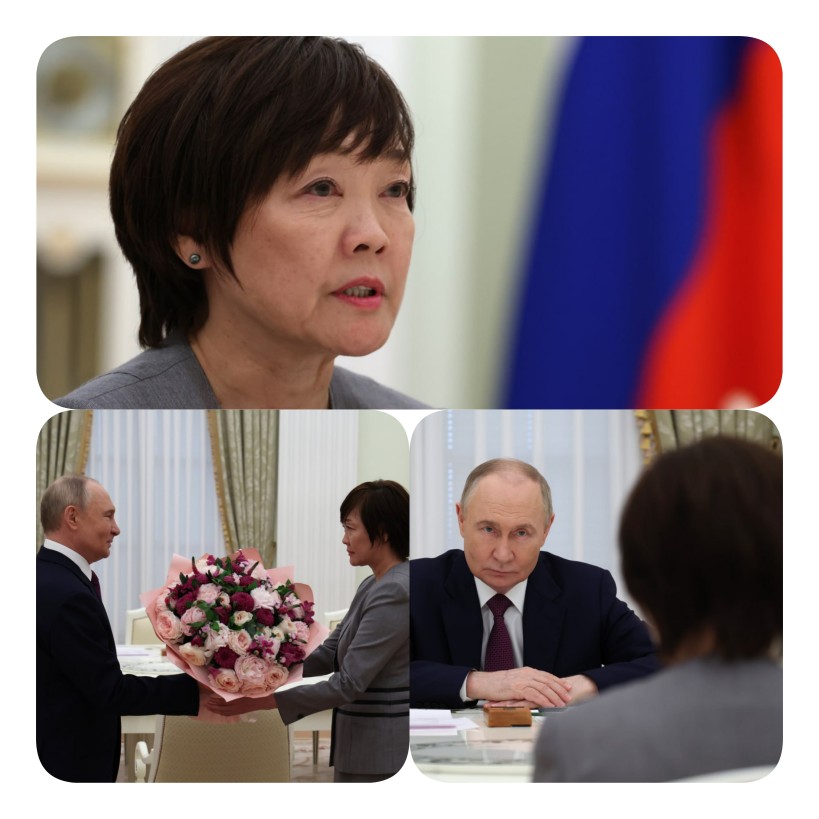
KREMLIN – President of Russia, Vladimir Putin has received Akie Abe, the widow of former Japanese Prime Minister, Shinzo Abe.
Shinzo Abe was assassinated in July 2022 in Nara City.
While receiving her, Putin said her husband was a good friend of Russia and himself.
“Your husband greatly contributed to promoting relations between Russia and Japan. I also had very good personal relations with him”, Putin said.
On July 8, 2022, Japan, a nation long unaccustomed to political violence and gun crime, was plunged into shock and grief by the assassination of its former Prime Minister, Shinzo Abe.
Abe, Japan’s longest-serving prime minister and a towering figure in conservative politics, was fatally shot while delivering a campaign speech in Nara City, an act that sent reverberations across the globe.
The incident unfolded in broad daylight outside Yamato-Saidaiji Station. Abe was speaking in support of a Liberal Democratic Party (LDP) candidate for the House of Councillors election when he was approached from behind by a lone assailant.
The attacker, later identified as 41-year-old Tetsuya Yamagami, fired two shots from a homemade firearm. Despite immediate medical attention and being airlifted to Nara Medical University Hospital, Abe succumbed to his injuries, pronounced dead hours later due to massive blood loss.
The assassination was particularly jarring for Japan, a country with some of the strictest gun control laws in the world and an extremely low rate of gun violence.
The rudimentary nature of the weapon used—a double-barreled device made of plumbing pipes taped to a wooden mount—highlighted the determination of the assassin and the vulnerability even high-profile figures can face.
The Motive: A Grudge Against a Religious Group

Tetsuya Yamagami was apprehended at the scene. His motive, as revealed in subsequent investigations and his own statements, was not primarily political.
Yamagami harbored a deep-seated grudge against the Unification Church (now officially known as the Family Federation for World Peace and Unification), alleging that his mother’s extensive donations to the group had bankrupted his family and ruined his life.
He claimed he targeted Abe due to the former Prime Minister’s perceived ties and support for the religious organization.
This revelation brought significant scrutiny upon the Unification Church and its connections to Japanese political figures, particularly within the LDP. Media reports and public outcry led to revelations of various LDP members having links to the organization, prompting calls for greater transparency and ethical accountability within Japan’s political landscape.
The Immediate Aftermath and Enduring Legacy
The assassination sparked an outpouring of condolences from world leaders and a profound sense of sorrow within Japan. Security measures for politicians were immediately heightened, and while campaigning was briefly suspended, the scheduled House of Councillors election proceeded.
The LDP, buoyed by a sympathy vote and the public’s defiance against violence, secured a strong victory.
Abe’s death left a significant void in Japanese politics. Even after stepping down as Prime Minister in 2020, he remained an influential figure, leading the largest faction within the LDP and continuing to advocate for his long-held policy goals, most notably the revision of Japan’s pacifist constitution.
His legacy, often referred to as “Abenomics” for his economic stimulus policies, and his assertive foreign policy that aimed to strengthen Japan’s global standing, particularly within the Indo-Pacific, became subjects of renewed examination.
While some of his objectives, like constitutional revision, remained unfulfilled during his lifetime, his successors have largely committed to continuing many of his strategic initiatives.
The assassination of Shinzo Abe stands as a somber and unprecedented event in modern Japanese history, forcing a nation to confront uncomfortable truths about extremism, the impact of religious organizations, and the ever-present challenge of ensuring the safety of its public figures.
It served as a stark reminder that even in seemingly peaceful societies, the specter of violence can emerge with devastating consequences.
