

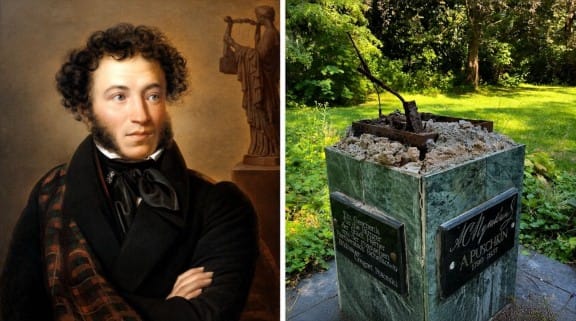
Outrage as Sneaky Thieves Snatch £50k Statue of Russia’s ‘Shakespeare’ from German Town—and Spark a Major Diplomatic Storm
BY SCM REPORTER
BERLIN — A BRAZEN thief has sparked an international diplomatic incident after pulling off a shocking night-time heist to steal a prized statue of Russia’s most famous poet from a German town.
The bronze monument of literary legend Alexander Pushkin—often described as Russia’s answer to William Shakespeare—was ripped from its plinth by mystery crooks, leaving local authorities baffled and the Kremlin absolutely furious.
Embarrassed German police admit they have “no active leads” on who targeted the monument, which has stood for years as a quiet symbol of reconciliation between the two nations following the horrors of World War II.
Now, the bizarre theft has blown the fragile relationship between Berlin and Moscow wide open.
A spokesman for the Russian Embassy in Berlin launched a blistering attack over the security lapse, revealing diplomats are feeling “utterly dismayed” by the targeted raid.
In a sharply-worded official statement, the embassy lashed out at the “sacrilege” of the crime, warning that the statue was not just a chunk of metal, but a vital symbol of “cultural ties and historical friendship” between the Russian and German people.
”This is a direct assault on our shared history,” an embassy official warned. “We demand a full and immediate investigation to bring these perpetrators to justice and return Pushkin to his rightful place.”
But with tensions between Russia and the West currently at an all-time, ice-cold high, local residents are left asking a terrifying question: Who would do such a thing?
While German detectives are publicly treating the incident as a standard high-value theft, intelligence experts whisper that the snatching of the bronze poet may be part of a much darker, highly coordinated underworld plot.
Remarkably, this isn’t the first time Alexander Pushkin has been targeted by international crooks. Over the last few years, Europe has been rocked by an unprecedented, multi-million-pound “Pushkin Crime Spree.”
An elite, organized network of thieves has been systematically ransacking national libraries across the continent, including prestigious institutions in France, Poland, Germany, and Switzerland.

Their bizarre target? Rare, 19th-century first-edition books written by Pushkin.
In those sophisticated library heists, slick crooks posed as innocent academics to gain access to the priceless texts, photographed them, and later swapped the real masterpieces with near-perfect counterfeit copies.
The European police agency Europol has already linked those thefts to an organized crime group that has stolen over 170 rare books worth a staggering £2.1 million.
Shockingly, investigators revealed that many of the stolen literary treasures were later smuggled across borders and sold off at shadowy auction houses in Moscow and St. Petersburg.
However, investigators are refusing to rule out a political motive for the latest German bronze heist.
Ever since the outbreak of the war in Ukraine, symbols of Russian culture have become highly volatile targets across Europe.
While Pushkin died way back in 1837 after a dramatic, fatal gun duel, modern critics argue his historical writings are being used by the current Kremlin regime as a symbol of Russian imperial dominance.
Hundreds of Pushkin monuments have already been aggressively torn down or defaced across Ukraine as part of a furious “de-Russification” campaign.
Whether the German statue was taken by greedy metal thieves looking to melt it down for a quick buck, patriotic political activists making a radical statement, or a rogue art collector operating on the black market, the hunt is now officially on.
A German police source confirmed: “Forensic teams have combed the area, and we are urgently reviewing CCTV footage. We are appealing to anyone who saw anything suspicious to come forward immediately.”
But until the bronze bard is found, a heavy cloud of suspicion hangs over Germany—and relations with Moscow have just grown a whole lot colder.
