

By SCM Correspondent
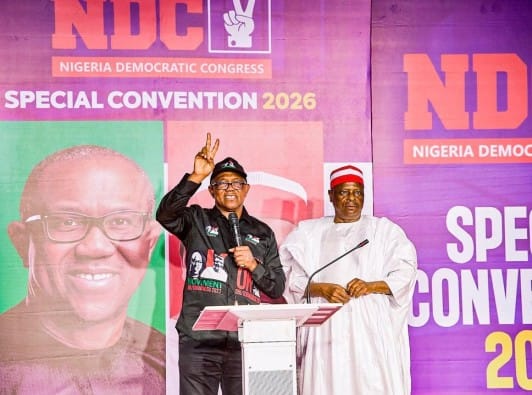
ABUJA — The New Democratic Congress (NDC) has officially ratified the former Governor of Anambra State, Mr. Peter Obi, as its presidential candidate for the upcoming general elections.
In a decisive move aimed at building a formidable national coalition, Obi has also announced the former Governor of Kano State, Senator Rabiu Musa Kwankwaso, as his vice-presidential running mate.
Addressing party delegates and supporters shortly after his ratification, Obi outlined a governance vision centered on inclusivity, national unity, and a deliberate departure from the zero-sum politics that has traditionally characterized the Nigerian political landscape.
In a striking departure from typical campaign rhetoric, the newly minted NDC flagbearer promised that his administration would actively foster a healthy environment for political rivals rather than attempting to suppress them.
”Our government will work with the opposition. We will encourage them,” Obi declared, emphasizing that vibrant dissent is vital for national growth.
He further pledged that an NDC-led presidency would remain strictly accountable to the Nigerian electorate, promising a transparent administration that shifts power back to ordinary citizens.

”We will ensure a people-centered democracy that supports opposition parties,” Obi added, arguing that accountability cannot exist in a political system where alternative voices are stifled.
The political marriage between Peter Obi and Rabiu Kwankwaso on the NDC platform represents a massive strategic alignment ahead of the polls.
Both figures command distinct, highly passionate followings across different geopolitical zones in Nigeria.
Obi, immensely popular among the youth and urban demographics for his frugal economic philosophy and focus on production-led growth, heavily complements Kwankwaso, whose formidable Kwankwasiyya movement dominates the political landscape of Kano and large swaths of the Northwest.
Political analysts view this ticket as an deliberate attempt to bridge Nigeria’s complex north-south political divide. By combining Obi’s southern appeal with Kwankwaso’s northern grassroots structure, the NDC is positioning itself as a powerful third force capable of challenging the dominance of the traditional ruling parties.
Furthermore, Obi’s explicit promise to “encourage the opposition” is a calculated message designed to appeal to moderate voters who are weary of partisan gridlock.
Observers note that if the NDC can successfully translate the individual momentum of both candidates into a unified national structure, this ticket could radically alter the dynamics of the presidential race.
