

By SCM Business Correspondent
LONDON / NEW YORK — Global energy markets were thrown into fresh turmoil on Monday after US President Donald Trump announced that Washington would reinstate a unilateral naval blockade against Iranian shipping.
In a series of highly charged statements, the US leader also proposed a mandatory 20 per cent fee on all cargo transiting the Strait of Hormuz—the world’s most vital maritime oil chokepoint.
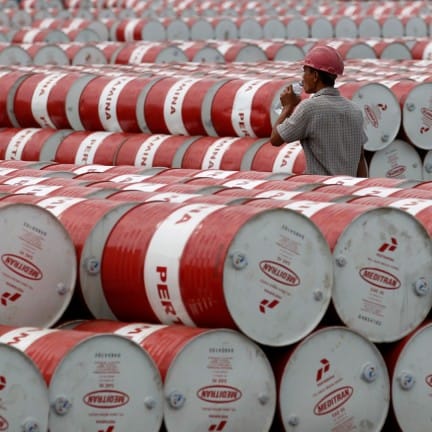
The aggressive policy pivot triggered an immediate, aggressive reaction in energy pits. West Texas Intermediate (WTI), the US benchmark, surged by roughly 9 per cent on the news, while Brent crude, the global marker, leapt by nearly 10 per cent to settle at $83.30 a barrel—its highest level in a month.
The sudden escalation has reignited fears of a prolonged inflationary shock, sending waves of anxiety through equity and bond markets alike.
Writing on his social media platform, Truth Social, the US President declared that the US would assume direct oversight of the strategic passage.
”The Hormuz Strait is OPEN, and will remain OPEN, with or without Iran,” Trump wrote. “We are reinstating… THE IRANIAN BLOCKADE, so named because it is only stopping Iran’s ships or customers from entering or leaving.”
More controversial still was the President’s demand that international shippers reimburse the US military for patrolling the region.
”The U.S.A. will be, from this point forward, known as ‘THE GUARDIAN OF THE HORMUZ STRAIT’, but as such, and as a matter of FAIRNESS, will be reimbursed, at the rate of 20% on all cargo shipped, for any and all costs necessary to do the job of providing safety and security.”
The proposed 20 per cent toll is unprecedented in modern maritime law and drew immediate, sharp pushback from the International Maritime Organization (IMO).
A spokesperson for the United Nations body stated there was “no legal basis” to enforce mandatory transit fees through an international strait.

Analysts warned that if implemented, the levy would add roughly $16 per barrel of crude at current market prices, or roughly $32 million in overhead for every supertanker navigating the route.
Market Repercussions: Bonds and Tech Hit
The shockwave from the announcement extended far beyond oil terminals:
Sovereign Debt Sell-Off: Concerns that resurgent fuel prices will choke off central bank efforts to lower interest rates triggered a sell-off in sovereign debt.
The US 10-year Treasury yield climbed 0.05 percentage points to 4.61 per cent.
Equities Retreat: Wall Street’s main indexes closed lower, led by a 1.6 per cent drop in the tech-heavy Nasdaq Composite as investors trimmed exposure to high-flying artificial intelligence stocks.
Equities Safe Havens: Energy giants bucked the trend, with supermajors BP and Shell both closing higher as crude prices advanced.
The dramatic escalation marks the effective collapse of a fragile, US-negotiated interim agreement signed in June.
That memorandum had briefly paused months of heavy military friction that began in late February when US and Israeli forces targeted sites in Iran, causing a near-total shutdown of the Strait.
During the peak of that spring conflict, Brent spiked to nearly $128 a barrel.
Under the June agreement, Trump had temporarily lifted restrictions on Iranian ports in exchange for a 60-day guarantee of unhindered, charge-free vessel passage.
However, a series of tit-for-tat military exchanges over the weekend—including US airstrikes on over 140 targets in Iran and retaliatory strikes by the Islamic Revolutionary Guard Corps (IRGC)—prompted the administration to abandon the agreement entirely.
With the domestic political calendar looming large, Trump has reportedly grown frustrated with the slow pace of normalising global energy flows. Elevated pump prices continue to weigh heavily on his approval ratings ahead of the crucial November US midterm elections.
Whether the administration can realistically enforce a unilateral tariff on global shipping without triggering a full-scale shooting war remains the central, high-stakes question hanging over the global economy.
