

By BLAISE UDUNZE I Monday, Oct. 19, 2026
LAGOS, Nigeria – What makes Nigeria’s fiscal situation particularly troubling is the contradiction between the government’s growing financial obligations and citizens’ expectations that public revenue should translate into tangible value. Nigeria’s fiscal story appears to exhibit “voodoo” trends.
A nation cannot borrow its way to prosperity if the cost of borrowing steadily consumes the resources required to build prosperity

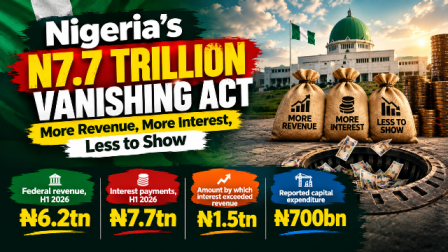
In just the first six months of 2026, the Federal Government spent an alarming N7.7 trillion on interest payments alone, against total collected revenue of N6.2 trillion. This has left most Nigerians bewildered, as creditors were paid more in interest than the country collected in revenue—leaving a N1.5 trillion deficit before accounting for any other basic responsibilities of government.
Yet, an even more disturbing figure lies elsewhere. In a striking twist, while interest payments hit N7.7 trillion, capital expenditure dropped to about N700 billion from N2.2 trillion in the same period of 2025, according to the World Bank’s October 2026 Nigeria Development Update.
The contrast is brutal: the interest bill was roughly 11 times reported capital expenditure. In a country struggling with severe infrastructure deficits, expensive electricity, inadequate public services, and businesses fighting to remain productive, this raises a question the government cannot afford to evade: What does fiscal stability mean when the cost of servicing yesterday’s borrowing threatens to extinguish investment in tomorrow’s economy?
To be clear, these figures do not prove that debt interest alone caused capital expenditure to fall, nor does every reduction in public investment automatically represent waste. But the gap is far too significant to be buried beneath reassuring claims about improved revenue collection or a narrowing fiscal deficit.
Nigeria’s revenue increased from N3.6 trillion in the first half of 2025 to N6.2 trillion in the first half of 2026—an impressive jump of approximately 72 percent. While this reflects substantial progress, interest payments simultaneously rose from N5.6 trillion to N7.7 trillion, a 37.5 percent increase. The government may be collecting more revenue, but the rising cost of servicing its debt continues to eat into earnings, leaving little room to meet other pressing needs.
For every N100 collected in federal revenue, approximately N124 went toward interest. This does not mean Nigeria is insolvent, nor that interest payments are the sole claim on public finances. It does, however, expose a severe imbalance between the government’s revenue capacity and its debt obligations.
When a government’s financial obligations grow so large that its capacity to invest becomes severely constrained, the consequences extend far beyond the Treasury.
They manifest as unfinished roads, unreliable power grids, diminished public services, and a business environment where private firms must absorb costs that productive public investment should have reduced.
The real scandal is not simply that Nigeria owes money; it is that the country must now answer a harder question: Are its borrowing decisions building an economy capable of carrying this debt, or are the costs of past and present borrowing progressively eroding the resources needed to build that economy?
Borrowing, in itself, is not inherently irresponsible. Governments routinely use loans to finance critical infrastructure and other productive assets that create jobs, strengthen economic capacity, and generate the tax base needed to repay debt.
The danger emerges when total public debt—now standing at N166.79 trillion—accumulates without commensurate growth in the economy’s ability to service it, or when the returns on borrowed funds remain opaque. At that point, debt ceases to be a financing tool and becomes a growing tax on future generations.
Nigeria’s fiscal numbers demand that this reality be confronted without sentiment or political convenience.
One encouraging note in the World Bank’s assessment is that the Federal Government’s fiscal deficit narrowed from N11 trillion in the first half of 2025 to N9.9 trillion in the same period of 2026. However, the World Bank explicitly warned that a sharp contraction in capital spending and fewer capital-intensive projects were major factors behind this apparent fiscal improvement.
That qualification deserves far more scrutiny than it has received in broader conversations about economic reform.
A smaller budget deficit typically indicates stronger public finances when driven by higher revenues, expenditure efficiency, and reduced borrowing needs. The interpretation changes entirely when that “improvement” is purchased through a steep contraction in productive capital investment.
Delayed road projects leave businesses paying more to transport goods. Deficient electricity infrastructure forces manufacturers to spend heavily on costly alternative power. Poor transport networks inflate agricultural distribution costs, while underinvestment in healthcare and education weakens human capital and workforce productivity. These consequences add up, slow growth, and ultimately undermine the exact revenue base the government needs to reduce its dependence on borrowing.
The point is not that every naira allocated to capital expenditure must be spent regardless of project quality. Nigeria has a duty to eliminate wasteful contracts, abandoned projects, inflated costs, and politically motivated spending. But cutting productive investment is a poor substitute for fixing a broken fiscal system.
The government must clarify whether the drop in capital spending stems from revenue shortfalls, shifting policy priorities, or a deliberate austerity drive to narrow the deficit. It must also disclose which projects were halted, what contractor liabilities remain unpaid, and how these cuts will impact long-term economic growth. Without full transparency, a narrower deficit remains an incomplete—and potentially misleading—metric of progress.
It would be inaccurate to suggest nothing has improved. Revenue grew substantially between the first halves of 2025 and 2026, supported by stronger corporate income tax, higher independent revenues, and improved oil receipts. These gains matter; when a country boosts domestic revenue mobilization, it is better positioned to fund public services and reduce debt reliance.
Yet, the persistence of an interest bill that exceeds total federal revenue underscores how difficult it is to convert revenue gains into actual fiscal breathing room.

Nigeria’s challenge is not merely whether it can collect more money, but whether that revenue can sustainably cover obligations while leaving sufficient funds for essential public services and development.
Addressing this requires a close look at the composition and reliability of public revenue. How much of the improvement comes from recurring tax receipts versus volatile oil prices or one-off inflows? Are independent revenues being collected consistently? Are state-owned enterprises remitting what they owe? Are tax exemptions, revenue leakages, and poor compliance costing the government money it could collect without burdening compliant taxpayers?
Temporary revenue windfalls cannot safely support permanent spending commitments, nor can the government rely indefinitely on favorable oil market conditions to service fixed debt obligations.
A sustainable fiscal strategy must expand the tax net, plug leakages, and foster business growth. Tax policy should be fair, predictable, and designed to strengthen the productive capacity of the economy—not merely extract more from an already strained private sector.
The rising cost of domestic borrowing is another critical piece of the puzzle. The World Bank pointed to elevated domestic borrowing costs as a key driver of the interest bill. When Treasury bills and government bonds offer attractive, risk-adjusted returns, banks and institutional investors naturally tilt their portfolios toward government debt. Under certain conditions, this crowds out the private sector, making credit more expensive and harder to obtain for businesses.
While government securities provide legitimate investment opportunities and support public liquidity, a healthy balance must be maintained. In an economy where businesses already battle high operating costs and structural bottlenecks, expensive credit can make otherwise viable investments commercially non-viable—driving small and medium-sized enterprises out of business.
When productive firms cannot access affordable credit, their capacity to expand output, hire workers, and generate taxable income is crippled. If the government simultaneously fails to fund the infrastructure required to lower operating costs, the economy suffers a double blow: expensive private production and expensive public financing.
This is the vicious cycle Nigeria must break. Higher borrowing costs lead to higher interest bills, leaving less money for infrastructure, which depresses business productivity and lowers future revenue collection.
The solution is not to force interest rates down artificially while ignoring inflation, but to tackle the structural drivers of expensive borrowing.
This requires restoring confidence in public finances, reining in non-essential borrowing, improving debt management, and aligning fiscal policy more closely with monetary policy while preserving the independence of the Central Bank of Nigeria (CBN).
Perhaps the central question Nigeria has yet to answer is simple: What has the country actually gained from all the money it has borrowed over the years?
The absolute size of public debt does not, on its own, determine whether borrowing was prudent. A nation can carry high debt levels and thrive if borrowed funds finance productive infrastructure that expands economic output and future revenues. Conversely, a nation with lower debt can struggle if funds are misallocated or wasted.
Nigeria urgently needs a transparent, public audit of the relationship between borrowed funds and completed capital projects. For major debt-financed infrastructure, citizens should be able to track the amounts borrowed, original project costs, funds released, completion status, and actual economic returns delivered. Where projects stall or suffer massive cost overruns, authorities should be held accountable.
If borrowing is justified on the grounds that it expands economic capacity, the government must show the evidence. If a railway line is funded, what are the measurable gains in freight efficiency? If power infrastructure receives funding, has electricity reliability improved? If agricultural projects are financed, what is the impact on crop yields and distribution costs? The same standard of accountability must apply to the massive road projects undertaken by the Ministry of Works.
While not every public project yields direct financial dividends, citizens deserve a credible account of the economic and social returns that justified incurring the debt in the first place. Without this, successive administrations will continue to inherit heavy repayment liabilities while citizens look in vain for the assets created.
The Federal Government and the National Assembly must move beyond viewing budget approvals, revenue targets, and borrowing authorizations as accomplishments in themselves. A budget is merely a plan; revenue is a resource; borrowing is a financing decision. None of them represent an economic achievement until transformed into completed projects, functional public services, and improved living standards.
The government should publish detailed, regular updates breaking down earnings, interest payments, fresh borrowings, and actual capital releases.
The Ministry of Finance, the Debt Management Office (DMO), and the Budget Office of the Federation should provide a full accounting of how the N7.7 trillion interest bill was incurred—detailing the split between domestic and external debt, maturity profiles, and upcoming refinancing costs.
For its part, the National Assembly must move past acting as a rubber stamp for executive borrowing requests. Lawmakers must rigorously evaluate the purpose, terms, risks, and expected returns of proposed loans, extending their oversight to project execution and performance verification.
Nigeria’s economic outlook retains grounds for cautious optimism. The World Bank reported real GDP growth of 4.2 percent in the first half of 2026, up from 3.9 percent and 3.5 percent in the corresponding periods of 2025 and 2024. Macroeconomic stability is essential, as persistent volatility discourages investment and erodes household purchasing power.
However, economic growth and fiscal stability are not ends in themselves. Their true value lies in the tangible opportunities they create for citizens and businesses. An economy can record headline GDP growth while leaving firms paralyzed by infrastructure deficits and high production costs.
Nigeria must avoid celebrating revenue growth while ignoring the crushing cost of debt service, or praising a lower deficit achieved by gutting capital investment. Reform must be evaluated by its holistic impact on the real economy.
Ultimately, Nigeria’s N7.7 trillion interest bill is not just an accounting issue for government economists—it directly impacts the allocation of national resources and the economic future of its citizens. Every naira tied up in interest carries a massive opportunity cost. The responsibility of leadership is to manage these competing demands without sacrificing the foundations of future growth.
Nigeria cannot simply stop borrowing or ignore its obligations. But it cannot continue down a path where debt service systematically consumes the resources required to build a prosperous nation. The Federal Government must answer with concrete evidence, not rhetoric, why interest payments eclipsed total revenue in early 2026, why capital spending was severely slashed, and what tangible value Nigerians have received from their rising national debt.
NB: Blaise, a journalist and PR professional, writes from Lagos and can be reached via: [email protected]
