

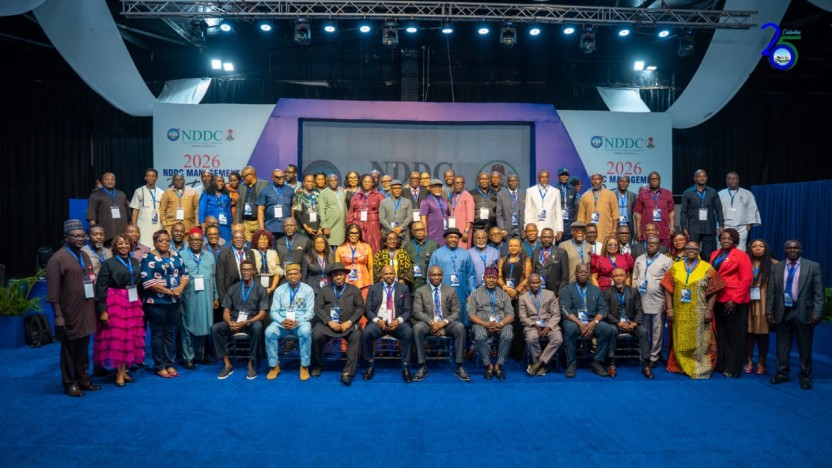
- The NDDC Managing Director, Dr Samuel Ogbuku (middle), the Executive Director of Finance and Administration, Alabo Boma Iyaye; the Executive Director, Corporate Services, Otunba Ifedayo Abegunde, surrounded by other Directors of the Commission, during the 2026 NDDC Management Retreat in Owerri, Imo State
Emmanuel Thomas l Thursday, February 12.26
OWERRI – The Niger Delta Development Commission (NDDC) has officially moved to a new governance structure, signaling a hard pivot away from historical inefficiencies toward a “transformation-first” era.
Managing Director, Dr. Samuel Ogbuku, confirmed the shift during the high-stakes 2026 NDDC Management Retreat held at the Landmark Events Centre in Owerri, Imo State.
The two-day summit, themed “Consolidating Performance and Repositioning the Commission for Strategic Impact in 2026,” brought together the Commission’s top brass to align on a rigorous new playbook.
The KPMG Factor
At the heart of this reform is a comprehensive Governance Advisory Report authored by global consultancy firm KPMG.
Ogbuku emphasized that the report is not just a document but a “tool for a new institutional culture.”
The strategy aims to bridge the gap between mere transactions and meaningful regional transformation.
By adopting KPMG’s recommendations, the NDDC is tightening its Standard Operating Procedures (SOPs) and enforcing a stricter code of conduct to ensure transparency in a region often starved of it.

”We must be deliberate in avoiding the mistakes of the past,” Ogbuku told the Governing Board and Directors.
“This retreat is a catalyst for innovation and mutual accountability. We are reinforcing our ethical standards to ensure our actions align with the public’s expectations.”
The retreat saw full attendance from the Commission’s executive wing, including:
Alabo Boma Iyaye (Finance and Administration) Dr. Victor Antai (Projects)
Otunba Ifedayo Abegunde (Corporate Services).
Dr. Patterson Ogon, Director of Planning, Research and Statistics, noted that the 2026 agenda is rooted in “measurable impact.”
He argued that the new framework would clarify roles and responsibilities, ensuring that project delivery is no longer hampered by poor coordination.
The reform isn’t just about paperwork; it’s about people. Dr. Dada Joseph Olugbenga of the Administrative Staff College of Nigeria (ASCON) challenged the management to focus on “team alignment.”
He urged the Commission to move beyond siloed operations and embrace a robust engagement strategy to tackle the unique challenges of the Niger Delta.
As the NDDC closes its retreat, the message is clear: the Commission is betting on sound ethics and corporate governance to redefine its legacy in 2026.
