

By SCM Tech Writer
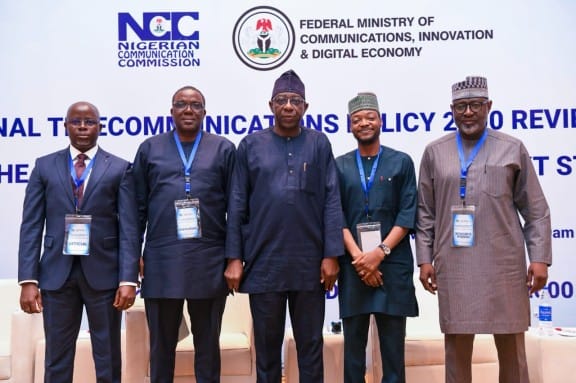
ABUJA – In a major move to align Nigeria’s digital economy with modern global standards, the Nigerian Communications Commission (NCC) has concluded a critical two-day Stakeholder Workshop aimed at reviewing and updating the long-standing National Telecommunications Policy (NTP) of 2000.
The industry regulator announced that the comprehensive review is part of a deliberate effort to phase out the 2000 policy document, which has governed the sector for over two decades but lacks provisions for today’s rapidly changing digital landscape.
The apex telecom regulator has subsequently thrown open the doors for public participation, calling on industry players, tech innovators, consumer advocacy groups, and the general public to submit policy proposals to help shape the nation’s new digital architecture.
According to a statement from the Commission, interested parties and stakeholders are requested to forward their detailed policy memoranda and inputs to [email protected].
Speaking at the conclusion of the strategy session in Abuja, officials of the Commission emphasized that the initiative is designed to transition the country from a traditional telecommunications framework into a more dynamic and inclusive digital economy.
”Help us co-create a robust regulatory framework for Nigeria’s digital future,” the regulatory body urged the public, stressing that collective input is vital to capturing the nuances of contemporary technological advancements.
The proposed policy overhaul seeks to address modern realities that were non-existent or in their infancy when the original policy was drafted 26 years ago.
These include the massive deployment of fifth-generation (5G) networks, the rise of Artificial Intelligence (AI), internet of things (IoT) applications, cybersecurity frameworks, data privacy, and the widening digital divide in rural areas.
The current National Telecommunications Policy (NTP) was formulated in the year 2000 under the administration of former President Olusegun Obasanjo.
At the time, Nigeria’s telecommunications sector was severely underdeveloped. The nation relied almost entirely on the state-owned Nigerian Telecommunications Limited (NITEL), which provided fewer than 500,000 active connected telephone lines for a population of over 120 million people. Getting a phone line was an expensive luxury reserved strictly for the elite.

The launch of the NTP 2000 changed everything. It laid the groundwork for the historic Digital Mobile Licence (DML) auctions in January 2001, which officially ushered in the Global System for Mobile Communications (GSM) revolution.
The policy democratized access to communication, leading to the entry of private telecom giants like MTN, Econet (now Airtel), and later Globacom and Etisalat (now 9mobile).
Over the last two decades, the NTP 2000 successfully transformed the sector, growing active phone lines from under half a million to over 200 million, while turning telecommunications into one of the largest contributors to Nigeria’s Gross Domestic Product (GDP).
However, while the 2000 policy was exceptionally successful in driving voice telephony and initial mobile internet penetration, industry experts have long argued that it has outlived its structural usefulness.
The original document was built for an era of “telecoms” (voice calls and basic text messaging), whereas the world has since shifted to an era of “digital convergence”—where cloud computing, fintech, digital infrastructure, and high-speed broadband drive the economy.
Previous attempts to harmonize and review the country’s national policies resulted in documents like the National Digital Economy Policy and Strategy (NDEPS 2020-2030) and various National Broadband Plans. However, updating the core foundational text—the NTP—remained an outstanding regulatory hurdle.
With the conclusion of this two-day workshop, the NCC aims to bridge this policy gap completely.
The new framework is expected to focus aggressively on lowering broadband costs, enhancing the quality of service (QoS) across networks, providing legal protections for critical national infrastructure, and fostering an environment where tech startups can scale seamlessly.
Industry analysts have praised the NCC’s inclusive approach in calling for public submissions, noting that a policy co-created by stakeholders is far more likely to attract foreign direct investment and ensure long-term regulatory stability.
Members of the public and tech community have been urged to utilize the provided submission window to ensure their specific sector challenges and aspirations are captured in what will become the new blueprint for Nigeria’s digital space.
