

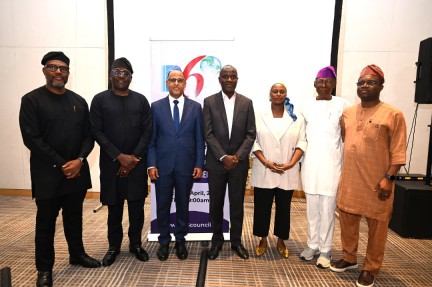
- L-R: Tony Emoekpere, Council Member, National Internet Protocol Version 6 (IPv6); Engr. Abraham Oshadami, Executive Commissioner Technical Services, Nigerian Communications Commission, NCC; Mr. Muhammed Rudman, National President, IPv6 Council; Dr. Aminu Maida, Executive Vice Chairman/CEO,NCC; Barr. Rimini Makama, Executive Commissioner Stakeholder Management, NCC; Dr. Chris Uwaje, National Vice President, IPv6 Council; Mr. Adesola Akinsanya, President, National Internet Registration Association, NIRA/ Council Member, during the Inauguration of the National Internet Protocol Version 6, (IPv6) Council Members, at the Marriott Hotel, Ikeja, Lagos State on the 23rd April 2026
By Our Correspondent
LAGOS, Nigeria – In a strategic move to fortify Nigeria’s digital infrastructure and address the dwindling resources of the older internet protocol, the Nigerian Communications Commission (NCC) has officially inaugurated the National Internet Protocol Version 6 (IPv6) Council.
The high-profile inauguration, held on Thursday at the Marriott Hotel in Ikeja, Lagos, brought together the nation’s foremost telecommunications regulators and tech industry leaders. The council is expected to spearhead the country’s migration from the exhausted IPv4 to the more robust and secure IPv6 standard.
Speaking at the event, the Executive Vice Chairman and CEO of the NCC, Dr. Aminu Maida, emphasized that the transition is no longer a matter of choice but a necessity for national development.
He noted that the new council would provide the strategic roadmap required to ensure Nigeria remains competitive in the global digital economy.
The leadership of the newly formed council includes Mr. Muhammed Rudman as National President and the “Oracle” of the Nigerian IT industry, Dr. Chris Uwaje, as National Vice President.
The NCC’s leadership was out in full force to support the initiative, with Engr. Abraham Oshadami, Executive Commissioner (Technical Services), and Barr. Rimini Makama, Executive Commissioner (Stakeholder Management), present to underscore the commission’s commitment to the transition.

In his remarks, Mr. Muhammed Rudman expressed optimism about the council’s mandate, stating that the adoption of IPv6 is critical for the expansion of the Internet of Things (IoT), 5G deployment, and enhanced cybersecurity across the federation.
The council also draws expertise from across the ecosystem, including Mr. Adesola Akinsanya, President of the Nigeria Internet Registration Association (NiRA), and Tony Emoekpere, both of whom will serve as council members.
What is IPv6?
Internet Protocol version 6 (IPv6) is the most recent version of the Internet Protocol (IP), the communications protocol that provides an identification and location system for computers on networks and routes traffic across the Internet.
The older version, IPv4, uses a 32-bit addressing scheme which supports approximately 4.3 billion devices. With the explosion of smartphones and smart devices, these addresses have virtually run out.
Capacity: IPv6 uses a 128-bit address, providing a virtually infinite number of IP addresses (3.4 \times 10^{38}).
Security & Efficiency: IPv6 was designed with end-to-end encryption in mind and offers more efficient routing and packet processing than its predecessor.
While global giants like the US, China, and India have made significant strides in IPv6 adoption, many African nations have lagged.
The inauguration of this council by the NCC signals a shift toward proactive digital sovereignty, ensuring that Nigerian businesses and consumers do not face connectivity bottlenecks as the world moves away from IPv4.
