

By SCM Foreign Desk
TEHRAN — In a sharp escalation of rhetoric that threatens to derail fragile Middle East peace talks, Iran’s chief negotiator warned on Sunday that Tehran will not agree to any comprehensive deal with the United States, declaring that Washington “is not to be trusted” and accusing it of violating the terms of a shaky regional ceasefire.
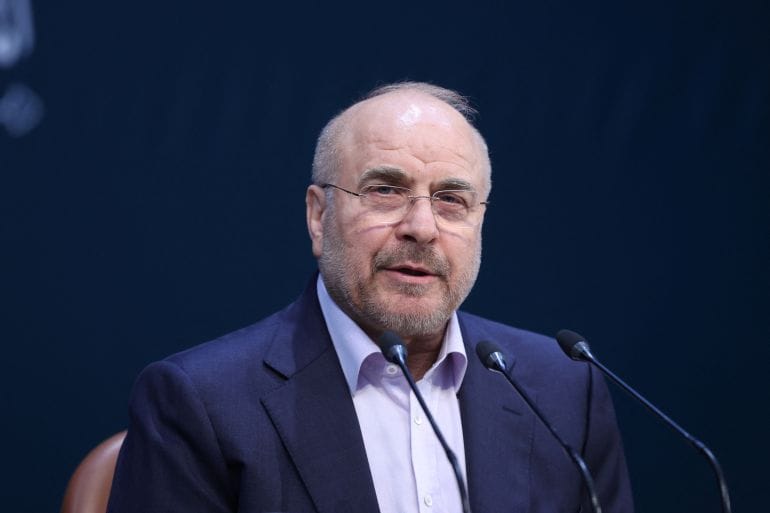
The comments, made by Mohammad Bagher Ghalibaf, the powerful Speaker of Iran’s Parliament who has emerged as the country’s central diplomatic broker, underscore the immense friction hampering indirect negotiations between Washington and Tehran.
The two adversaries have been trading framework proposals to end a devastating regional conflict that erupted earlier this year.
”We will not approve any agreement until we are certain that the rights of the Iranian people have been upheld,” Mr. Ghalibaf said in a video broadcast on state television and subsequently circulated on his personal social media accounts.
He added bluntly that Iranian negotiators “neither trust the enemy’s words nor its promises.”
Mr. Ghalibaf drew a direct line between the stalled diplomatic track and ongoing military actions in the Mediterranean and Levant.
He pointed to what he characterized as a U.S. naval blockade and continuing Israeli operations in Lebanon as definitive proof of American bad faith.
”The naval blockade and escalation of war crimes in Lebanon by the genocidal Zionist regime are clear evidence of U.S.
noncompliance with the ceasefire,” Mr. Ghalibaf asserted. Closing his remarks with an ominous warning aimed at Washington and its allies, he remarked: “Every choice has a price, and the bill comes due. It will all fall into place.”
The sudden hardening of Iran’s public stance comes at a deeply precarious moment. The region has been gripped by an unprecedented war that broke out on February 28, 2026, drawing the United States and Israel into direct conflict with Iran and its network of regional proxies, including Hezbollah.
The conflict fundamentally reshaped Iran’s political landscape following the deaths of several top Iranian leaders, including former Supreme Leader Ali Khamenei, in joint U.S.-Israeli strikes in mid-March.

Following a fragile, broader ceasefire brokered on April 8, Mr. Ghalibaf—acting with the backing of the newly elevated Supreme Leader Mojtaba Khamenei and President Masoud Pezeshkian—assumed the mantle of chief strategic negotiator.
In April, he led an Iranian delegation to historic face-to-face talks with a U.S. delegation led by Vice President J.D. Vance in Islamabad, Pakistan.
However, the “neither war nor peace” status quo has steadily unraveled. Central to Iran’s grievances is a stringent naval blockade imposed by the United States on April 13 following a collapse of secondary talks.
The U.S. military has intercepted dozens of vessels attempting to transit to and from Iranian ports, an operation U.S. officials say is vital to preventing the replenishment of advanced weaponry, but which Western analysts estimate is costing the crippled Iranian economy upward of $500 million daily.
Furthermore, a localized mid-April ceasefire meant to halt fighting between Israel and Hezbollah in Lebanon has effectively collapsed. Israeli forces launched more than 120 airstrikes across Lebanon last week, stating they were targeting resilient pockets of Hezbollah infrastructure.
Tehran views these ongoing bombardments as a proxy operation greenlit by Washington.
Diplomats in Doha and Muscat had recently reported progress on a temporary 60-day window to extend the ceasefire and launch broader negotiations regarding Iran’s highly enriched uranium stockpiles.
Under the tentative framework, Iran was seeking immediate sanctions relief and the unfreezing of $12 billion in assets currently held abroad in exchange for easing its grip on commercial shipping through the strategic Strait of Hormuz.
Yet, Mr. Ghalibaf’s recent statements indicate that the domestic political costs of a compromise may be growing too high for Tehran’s remaining leadership. In separate comments to hardline factions, Mr. Ghalibaf suggested that negotiations were merely a mechanism to force Washington to accept realities on the ground, writing online that Iran “takes concessions not through talks, but with missiles.”
With the U.S. Treasury Department imposing fresh sanctions on Iran’s oil export apparatus over the weekend, and Mr. Ghalibaf warning of a “crushing” response if full conflict resumes, the diplomatic window to formalize a lasting peace appears to be closing rapidly.
