

By Emmanuel Thomas l Tuesday, July 21, 2026
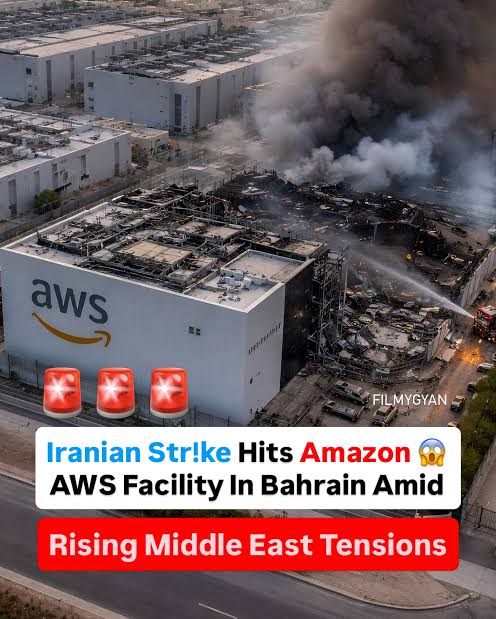
MANAMA, Bahrain — Iran’s Islamic Revolutionary Guard Corps claimed on Tuesday that its aerospace forces had launched multiple cruise missiles at Amazon’s central data infrastructure in Bahrain, marking a significant and sharp expansion of Tehran’s military targets to include major American commercial and technological assets in the Gulf.
In a statement carried by Iranian state news outlets as part of its ongoing military campaign, the IRGC said the strike successfully destroyed key server and computing facilities belonging to the U.S. tech giant. The Guard explicitly framed the barrage as a direct response to recent American military strikes targeting civilian and industrial infrastructure in Darkhovin, near Iran’s southwestern city of Ahvaz.
Neither the United States military, the government of Bahrain, nor Amazon Web Services immediately confirmed the extent of the damage. However, the announcement immediately sent shockwaves through the global technology and financial sectors, underscoring how non-military commercial cloud hubs have become central targets in modern hybrid warfare.
”In response to the U.S. military’s attack on civilian facilities and infrastructure under construction in Darkhovin, we used multiple cruise missiles to attack and destroy the infrastructure of an Amazon data center in Bahrain,” the IRGC statement read.
A Retaliatory Spiral over Nuclear Facilities
The strike on Amazon’s infrastructure comes amid an intense exchange of firepower between Washington and Tehran. Just twenty-four hours earlier, Iranian officials reported that U.S. airstrikes had struck the Darkhovin site, where Iran has been constructing a 360-megawatt light-water nuclear power reactor. While Washington has maintained that its regional operations target Iranian military assets and launch facilities, Tehran condemned the Darkhovin bombardment as an unprovoked assault on non-military civilian energy projects.
The retaliatory strike on Amazon represents a calculated pivot by Iranian military planners. Rather than confining its response strictly to U.S. military installations such as airbases and naval radar posts in the region, the IRGC demonstrated its willingness to target high-value civilian computing hubs that underpin Western commercial presence in the Middle East.
Military analysts noted that cruise missiles, which travel at low altitudes to evade traditional radar defense batteries, pose a distinct challenge to point-defense systems surrounding critical infrastructure nodes in small Gulf nations like Bahrain.
Vulnerability of Gulf Cloud Nodes
Amazon Web Services (AWS) opened its Middle East hub in Bahrain in 2019, designating it as the ME-South-1 region. The complex serves as a critical backbone for commercial banks, telecommunications providers, multinational enterprises, and local government entities across the Gulf Cooperation Council (GCC).

Cloud facilities rely on immense electrical grids, cooling networks, and fiber-optic interlinks. Even localized structural damage from a kinetic missile impact can cause cascading service degradations, force emergency traffic rerouting, or compromise localized data availability across an entire geographic region.
The incident highlights a growing strategic dilemma for global tech firms:
Dual-Use Perception: Adversaries increasingly view western hyperscale cloud providers as extensions of U.S. state power, particularly when those networks host sensitive governmental or logistics workloads.
Physical Vulnerability: Data centers feature fixed, geographically public locations that are difficult to harden entirely against sustained missile or long-range drone strikes.
Redundancy Limits: While cloud architectures use multi-facility “Availability Zones” to mitigate outages, physical destruction of primary fiber and power hubs can severely disrupt localized latency and throughput.
Bahrain, home to the U.S. Navy’s Fifth Fleet, has found itself repeatedly caught in the crosshairs of regional confrontation. Air defense sirens have sounded frequently in Manama as interceptors attempt to engage incoming Iranian projectiles.
The strike on Amazon’s data center marks a significant escalation in the scope of targets selected by Tehran. Cybersecurity experts and defense analysts warn that targeting physical digital infrastructure could set a dangerous precedent, threatening the stability of global financial data networks and international commerce reliant on cloud availability.
As tension flares across the waterway, global shipping companies and tech conglomerates are bracing for prolonged instability. U.S. Central Command (CENTCOM) stated that its forces remain positioned to protect critical maritime routes and regional stability, but the extension of kinetic strikes to commercial digital infrastructure signals that the front lines of the conflict are expanding into uncharted territory.
