

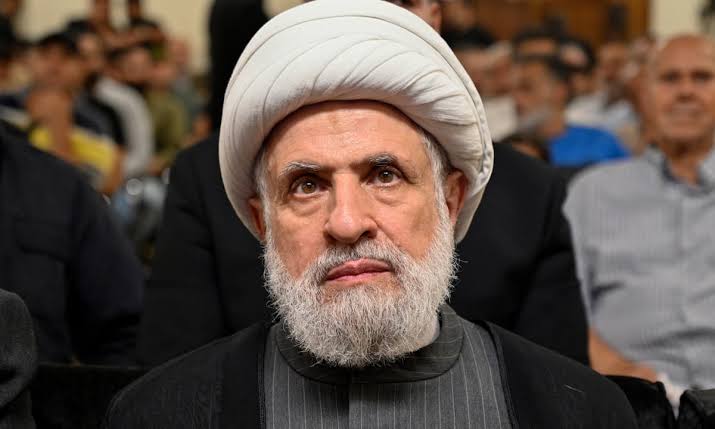
By International Desk I Monday, August 10, 2026
BEIRUT, Lebanon — The Lebanese resistant forces, Hezbollah issued a stern warning to Lebanese authorities on Sunday, demanding an immediate end to direct negotiations with Israel after the Israeli Foreign Ministry published an official map depicting parts of occupied southern Lebanon as territory belonging to the Israeli state.
In a official statement, Hezbollah said the map—published on the Israeli Foreign Ministry’s Arabic-language social media accounts—provided “undeniable confirmation” of Israel’s long-standing ambitions regarding Lebanon’s territory, natural resources, and sovereign capabilities.
The group argued that Israel’s participation in diplomatic talks was merely a deceptive maneuver designed to buy time while altering realities on the ground.
”The ‘Israeli’ enemy’s Foreign Ministry published a map today incorporating the occupied southern Lebanon into its illegitimate entity,” Hezbollah said in the statement.
“These are ambitions which it has not abandoned and will never abandon. Its entry into direct negotiations with the Lebanese authority is nothing but a blatant attempt to gain time and impose new facts on the ground.”
Though the graphic was subsequently removed from the Foreign Ministry’s primary X account following widespread outcry, it remained accessible on other official digital channels, intensifying political friction across a region already on edge. Lebanese government officials have faced mounting pressure from domestic opposition and armed factions to respond decisively to what many in Beirut view as a direct provocation.
Scathing Rebukes for Beirut’s Government
Hezbollah’s declaration was directed as much at the Lebanese government as it was at Tel Aviv. The group leveled sharp criticism at Lebanese state authorities, accusing them of surrendering national leverage and offering “free gifts” to Israel by continuing direct talks despite ongoing military operations in the south.
”The Lebanese authority bears full responsibility due to its insistence on pursuing the path of concessions,” the statement declared. Hezbollah urged the government to conduct a comprehensive course correction, halt direct talks immediately, and convene an emergency session of the Higher Defense Council
Furthermore, the group insisted that Beirut file an urgent complaint with the United Nations Security Council, dismissing any prior pledges made during diplomatic exchanges as void in light of the official publication. “Even if this authority has given a pledge to its enemy not to pursue it in international forums, there is no longer any justification for ignoring the reality of the ‘Israeli’ enemy’s ambitions in Lebanon,” the statement added.
Calling on the broader Lebanese public across sectarian lines to unite, Hezbollah warned that Israeli territorial aims extend far beyond border villages: “National responsibility dictates uniting efforts and positions in confronting the occupation… realizing that the enemy’s ambitions are not confined to southern Lebanon, but rather target Lebanon as a whole.”
The fallout over the map comes against the backdrop of fragile political negotiations mediated by the United States. Negotiators from Beirut and Tel Aviv recently completed a seventh round of direct talks in Rome, centered on implementing a security framework established earlier in the summer.
That agreement was intended to establish mechanisms for Israeli troop withdrawals alongside security arrangements along the Blue Line border.
However, the political process has been fraught from its inception. Hezbollah’s leadership has repeatedly denounced the diplomatic framework as a violation of the Lebanese Constitution, which formally forbids negotiations with Israel. Prime Minister and parliamentary leaders in Beirut have faced a delicate balancing act, attempting to secure an Israeli pullout through international diplomacy while facing intense domestic criticism from resistance factions who argue that diplomacy without armed leverage guarantees submission.
Simultaneously, conditions on the ground in southern Lebanon remain severe. Israeli forces have maintained physical positions across several border zones, advancing past initial line markers during operations over the past year.
According to Lebanese Health Ministry figures, months of cross-border skirmishes and military strikes have resulted in over 4,300 deaths and widespread displacement across southern towns. Lebanese authorities have also accused Israeli forces of utilizing scorched-earth military tactics, including land leveling and clearing forested areas, further worsening local devastation.
The publication—and subsequent partial deletion—of the controversy-inducing map has threatened to sink the current round of talks entirely. With Lebanese political figures privately suggesting that upcoming negotiation sessions may be suspended until Tel Aviv offers an official clarification regarding Lebanon’s international borders, the dispute highlights how deeply mistrust remains rooted on both sides of the border.
The Intentional Map published by Israel, deleted
The publication of an official Israeli map incorporating parts of southern Lebanon, combined with Hezbollah’s fierce political counteroffensive, introduces severe destabilizing pressures into the U.S.-brokered direct talks between Beirut and Tel Aviv. While Washington has invested significant diplomatic capital into establishing a durable security framework, this flare-up hits the core structural vulnerabilities of the negotiation track.

Here is how these dynamics actively impact the peace process across key dimensions:
1. Political Paralysis for the Lebanese Authority
The Lebanese negotiating team—led by caretaker state officials—operates under fragile domestic legitimacy. In Lebanon’s complex sectarian system, engaging in direct talks with Israel is legally questionable under Lebanese law and politically dangerous without cross-factional consensus.
Erosion of Cover: The graphic directly feeds Hezbollah’s argument that diplomacy is a trap designed to legitimize territorial theft.
Inability to Yield: Beirut can no longer afford to offer concessions on border demarcation or security guarantees along the Blue Line without triggering a severe political crisis at home. State negotiators must now demand explicit Israeli territorial reaffirmations before resuming formal sessions, stalling procedural momentum.
2. Hardening of Hezbollah’s Dual Strategy
Hezbollah’s public rebuke serves two operational goals: delegitimizing state-led diplomacy and signaling that armed resistance remains Lebanon’s only viable deterrent.
Delegitimizing the U.S. Mediator: By framing the talks as a “humiliating path of concessions,” Hezbollah pressures the Lebanese government to abandon Washington’s mediation framework altogether.
Justifying Continued Hostilities: The group uses the map to argue that Israel’s security demands (such as buffer zones or military disengagement rules) are pretexts for permanent annexation. This strengthens Hezbollah’s rationale for maintaining its arsenal and continuing cross-border operations regardless of any paper agreements Beirut might sign.
3. Destruction of Strategic Trust in Israel’s Intentions
For direct or U.S.-mediated negotiations to succeed, both parties must operate under the baseline assumption that the end state is a mutually recognized border.
Mixed Signals from Tel Aviv: Even if the map was an uncoordinated diplomatic or communications error, its release by an official state organ validated Lebanon’s worst expectations regarding Israeli expansionism.
Subversion of Negotiations: Lebanese factions now interpret Israel’s diplomatic participation in venues like Rome not as a search for peace, but as a deliberate tactic to buy time to alter facts on the ground through military presence and land alterations.
4. Washington’s Mediation Dilemma
The U.S. diplomatic team faces a significant derailment of its regional strategy.
Shift to Damage Control: Rather than advancing high-level discussions on troop withdrawal timelines, disarming protocols, or joint monitoring mechanisms, American diplomats must now pivot to baseline damage control.
Requirement for Clarification: To save the negotiation track, Washington will likely have to press Tel Aviv for an unequivocal public statement reaffirming Lebanon’s sovereign international borders—a demand that may face political resistance from right-wing elements within Israel’s governing coalition.
The map controversy strips the Lebanese government of the political capital required to participate in direct negotiations. By handing Hezbollah a powerful narrative to rally national sentiment around sovereignty, the incident severely undermines Washington’s diplomatic framework.
Unless U.S. mediators secure explicit territorial guarantees from Israel, the talks risk collapsing into indefinite suspension, leaving the border governed by military friction rather than negotiated diplomacy.
