

By SCM Staff Writer
LONDON — A prominent hardline Iranian lawmaker has launched a blistering rhetorical assault on the United States, accusing Washington of possessing a “satanic mentality” driven by arrogance, while insisting that Tehran was forced into its current, economically crippling blockade of the Strait of Hormuz.
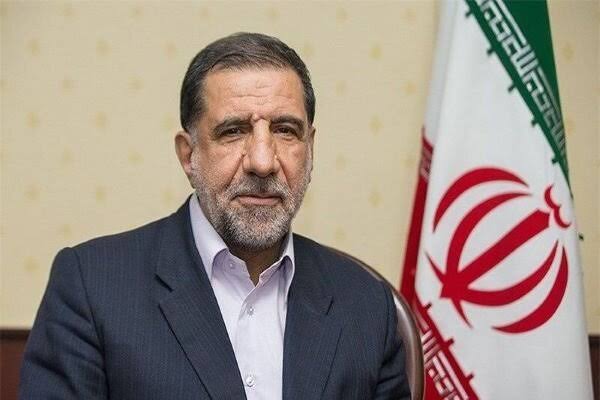
The remarks by Esmaeil Kowsari, a influential member of the Iranian Parliament’s National Security and Foreign Policy Committee and a former commander in the Islamic Revolutionary Guard Corps (IRGC), came during an interview broadcast by the Russian state-backed network RT.
The comments highlight the deep ideological chasm and intense bitterness that continue to stall backchannel peace negotiations mediated by Pakistan.
”The United States has a satanic mentality,” Mr. Kowsari said, according to a transcript of the interview. “This satanic mindset is all about arrogance, pride, and wanting everything for themselves.”
He added that both Washington and Israel “must answer to the world” for initiating the military campaign that devastated much of Iran’s military infrastructure earlier this spring.
A central focus of Mr. Kowsari’s interview was the ongoing crisis in the Strait of Hormuz, the narrow maritime chokepoint through which roughly 20 percent of the world’s petroleum liquids pass.
The effective closure of the strait by Iranian mining, drone strikes, and ship seizures since March has triggered a global energy emergency, sending Brent crude prices soaring and threatening severe supply disruptions ahead of the peak summer demand season.
Deflecting international condemnation over the blockade, which has drawn sharp rebukes from European leaders and Asian energy consumers alike, Mr. Kowsari claimed that Western powers had brought the crisis upon themselves.
”We never wanted the Strait of Hormuz to be closed,” Mr. Kowsari said. “They brought this trouble upon themselves.”
The lawmaker framed Iran’s aggressive maritime stance as an inescapable defensive reaction to the heavy-handed policies of the United States. He argued that American efforts to isolate Iran run counter to global economic realities.
“This is impossible in a world where, in the end, everyone wants to connect and interact with each other,” he said.

The current war erupted on February 28, 2026, when the United States and Israel launched Operation Epic Fury—a massive, coordinated wave of airstrikes targeting Iranian nuclear facilities, missile bases, and command centers.
The opening salvos resulted in the assassination of Iran’s Supreme Leader, Ayatollah Ali Khamenei, throwing the Islamic Republic into political turbulence and precipitating a direct regional war.
Tehran retaliated with massive ballistic missile and drone barrages aimed at Israeli cities and U.S. military bases located across the Persian Gulf, including installations in Kuwait, the United Arab Emirates, and Qatar.
While a fragile, multi-week ceasefire brokered in Islamabad temporarily halted large-scale airstrikes in April, the conflict has since devolved into a high-stakes naval war of attrition. President Donald J. Trump has deployed a heavy U.S. naval presence to enforce an airtight blockade of Iranian ports, demanding that Tehran permanently dismantle its nuclear ambitions and allow unconditional passage through the Strait of Hormuz.
Iran, conversely, has refused to reopen the waterway until Washington lifts its naval blockade, withdraws its forces from West Asia, and pays billions of dollars in war reparations.
Western diplomats view Mr. Kowsari’s fierce rhetoric as a sign of a hardening consensus within Tehran’s political elite, which is increasingly dominated by IRGC commanders following the internal political fallout of the war. Just this week, French President Emmanuel Macron and other G7 leaders publicly urged both Washington and Tehran to reach an immediate compromise, warning that a prolonged closure of the strait could plunge the global economy into a severe recession.
Despite ongoing efforts by international mediators to pass revisions of a memorandum of understanding back and forth between President Trump and Iranian officials, Mr. Kowsari expressed deep skepticism that diplomacy would yield fruit.
He noted that while Iran’s armed forces maintain absolute operational control over the shores of the strait, Washington’s ultimate goals remain rooted in regime change—a position that makes genuine compromise nearly impossible.
”We have not reached a final agreement,” Mr. Kowsari stated in separate remarks to local media, reinforcing his televised assertions. “And we know they will not achieve any result.”
For now, as both sides dig in, the strategic waters of the Persian Gulf remain empty of commercial tankers, and the risk of a secondary flashpoint growing out of the stalemate remains dangerously high.
