

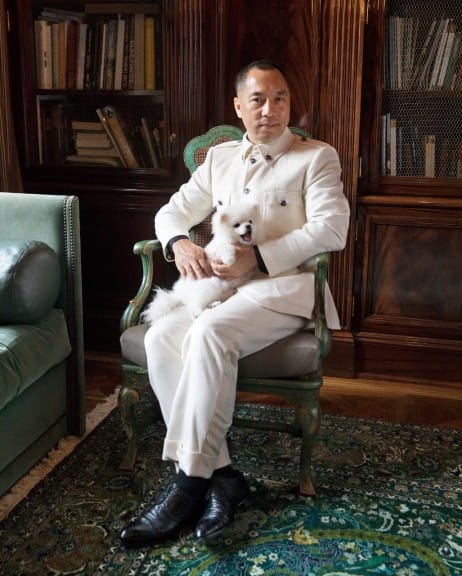
By Our Foreign Desk
NEW YORK — Guo Wengui, the flamboyant Chinese real estate tycoon who fled his homeland to reinvent himself as a fierce, social-media-savvy critic of the Chinese Communist Party, was sentenced on Monday to 30 years in a U.S. federal prison for orchestrating a massive, billion-dollar fraud scheme.
The sentence, handed down by Judge Analisa Torres in a Manhattan federal courtroom packed with Guo’s remaining loyalists, brings a stunning conclusion to a case that uniquely intersected global geopolitics, right-wing American populism, and high-stakes financial crime.
Judge Torres also ordered Guo, 50s, who is also known as Miles Guo and Ho Wan Kwok, to forfeit $889 million in restitution. In a searing rebuke, the judge stated that Guo had systematically “preyed on those seeking to bring democracy to China,” using their political anxieties and trust to fund a jaw-droppingly lavish lifestyle.
”Rather than being satisfied with the many legitimate opportunities afforded to him, Guo exploited the trust that thousands had placed in him for his own greed,” said U.S. Attorney Sean S. Buckley following the sentencing. “Today’s sentence shows that fame and wealth do not place you above the law.”
Federal prosecutors demonstrated during a grueling seven-week trial that between 2018 and 2023, Guo raised more than $1 billion from hundreds of thousands of online followers worldwide.
Operating through entities he controlled—including GTV Media Group, the Himalaya Farm Alliance, and a cryptocurrency venture called the Himalaya Exchange—Guo promised outsized financial returns and a safe haven for assets away from Beijing’s reach.
Instead of investing the funds, prosecutors proved Guo used the money as a personal piggy bank.
The illicit proceeds financed a 50,000-square-foot New Jersey mansion, a $37 million luxury superyacht, a $1 million Lamborghini, and a sprawling penthouse overlooking Central Park at the Sherry-Netherland hotel on Fifth Avenue.
During the trial, victims testified about losing their life savings, with many expressing deep shame and emotional ruin. Judge Torres noted that Guo has remained “entirely unrepentant,” incredibly maintaining that his actions caused no loss, while actively calling on his remaining base to harass critics who spoke out against him.
Guo’s spectacular fall in New York is the final chapter of an extraordinary decade-long odyssey. Once ranked among China’s wealthiest men, Guo built an immense fortune as a prominent real estate developer in Beijing.
However, his empire crumbled in 2014 when he became a primary target of Chinese President Xi Jinping’s sweeping anti-corruption crackdown.
Accused by Beijing of bribery, kidnapping, and rape—charges he consistently denied as politically motivated fabrications—Guo fled the country.
He arrived in the United States in 2017, formally seeking political asylum and exploiting lax verification gaps in the U.S. immigration system to establish a powerful American foothold.

Safely ensconced in Manhattan, Guo swiftly built a massive online brand. He styled himself as a freedom-fighting whistleblower, using unverified stream-of-consciousness videos to allege deep-seated corruption within the highest echelons of the Chinese Communist Party (CCP). For thousands of Chinese diaspora members deeply distrustful of Beijing, Guo became a messianic figure.
His anti-CCP stance also made him a natural ally for prominent figures in American right-wing politics. Most notably, Guo formed a tight partnership with Steve Bannon, the former chief strategist to Donald Trump.
Together, the two launched political and media ventures, including the “New Federal State of China,” an initiative aimed at overthrowing the ruling Chinese government.
The depth of their alliance was vividly illustrated in August 2020, when federal agents arrested Bannon on fraud charges while he was lounging aboard Guo’s luxury yacht off the coast of Connecticut.
Throughout the legal proceedings, Guo’s defense attorneys aggressively leaned into the geopolitical backdrop, painting their client as the victim of a “grand, pervasive, and life-threatening” operation by the Chinese government.
They argued that Beijing had weaponized American legal and political institutions to silence a prominent dissident, and asserted that a lengthy sentence would only validate China’s global smear campaigns.
Guo’s lawyers further stated that he flaunted his extreme wealth not out of greed, but as a deliberate political stunt to “tweak” and embarrass China’s leaders. They also pointed out that Guo bore permanent physical scars from torture he suffered during earlier detentions in China.
Even on the morning of his sentencing, drama trailed the former tycoon. Guo protested his treatment in detention, claiming he had to be hospitalized hours prior due to severe illness, an account prosecutors dismissed as malingering.
Standing before the judge, Guo offered only a brief defense of his actions, stating through an interpreter: “The reason I came to the U.S. was to destroy the CCP.”
But the court remained unmoved by his ideological defense, focusing strictly on the financial wreckage left in his wake.
As federal marshals led the grey-haired former billionaire out of the courtroom to begin his three-decade sentence, his supporters broke out into cheers and applause—a final, surreal display of devotion for a man the U.S. government has officially branded a master con artist.
