

By SCM Business Desk I June 29, 2026
WASHINGTON — For the third consecutive year, global efforts to eliminate the practice of burning off excess natural gas have faltered. In 2025, oil and gas operations worldwide flared an estimated 167 billion cubic meters of natural gas, according to data released in the World Bank’s 2026 Global Gas Flaring Tracker.
The wasted fuel, valued at roughly $54 billion, represents the highest level of atmospheric flaring observed since 2019. The surge underscores a widening gap between international climate commitments and the operational realities of energy production.
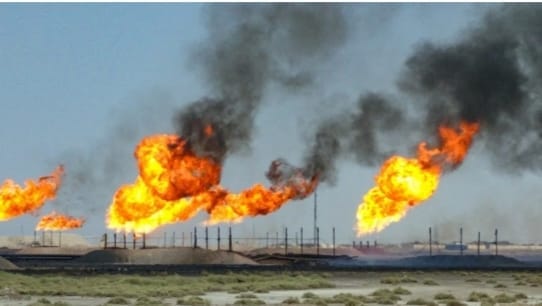
Gas flaring occurs during oil extraction when associated natural gas comes to the surface. Lacking the infrastructure to capture, store, or transport it to market, oil companies routinely ignite the gas at the wellhead, releasing a toxic mix of carbon dioxide, methane, and black carbon directly into the atmosphere.
Climate scientists point out that the ongoing spike is particularly damaging because flaring is not always efficient. When flares fail to burn completely, they release raw methane—a greenhouse gas that is over 80 times more potent at trapping heat than carbon dioxide over a 20-year timeline.
What frustrates policy experts and environmental economists most is that the surge is entirely avoidable. The technology required to capture and utilize this gas exists, ranging from small-scale power generation at the well site to modern pipeline systems and liquefied natural gas (LNG) compression plants. Instead, billions of dollars of a finite energy resource are being burned away simply as a matter of industrial convenience.
”The tools to end routine flaring exist,” the World Bank report notes, emphasizing that the primary obstacles preventing progress are not technical, but structural.
According to the data, the ongoing crisis is driven by a critical deficit in three key areas: strict regulatory enforcement, available capital for green infrastructure, and the physical pipeline networks needed to transport captured gas to consumers.

Without coordinated international pressure and heavier penalties for operators, the World Bank warns that the financial and environmental toll will continue to climb, pushing global emission targets further out of reach.
To fully appreciate the scope of this news piece, it is helpful to understand the economic and environmental underpinnings of the flaring crisis:
Why It Happens: Natural gas is often a byproduct of oil drilling. In remote or under-developed oil fields, building pipelines to transport this “associated gas” to cities or power plants is expensive. Companies often choose the cheapest operational route: burning it off to maintain pressure and safety at the oil rig.
The Economic Waste: The $54 billion lost in 2025 is not just an abstract figure. That volume of gas (167 billion cubic meters) could comfortably power millions of homes or satisfy the entire annual energy demands of several European nations, highlighting a massive economic inefficiency during a time of global energy volatility.
The “Zero Routine Flaring” Initiative: The World Bank previously launched an initiative to eliminate routine flaring by 2030, a pledge signed by dozens of oil companies and governments. The 2025 surge shows that despite public pledges, real-world execution is falling drastically behind schedule due to a lack of local enforcement and high upfront infrastructure costs.
