

MemBy SCM Reporter
TUNIS, Tunisia — Four international humanitarian volunteers arrived safely in the Tunisian capital on Tuesday, marking the first breakthrough in the high-stakes diplomatic standoff over a Gaza-bound aid convoy that was aggressively dismantled by a powerful Libyan militia exactly one month ago.
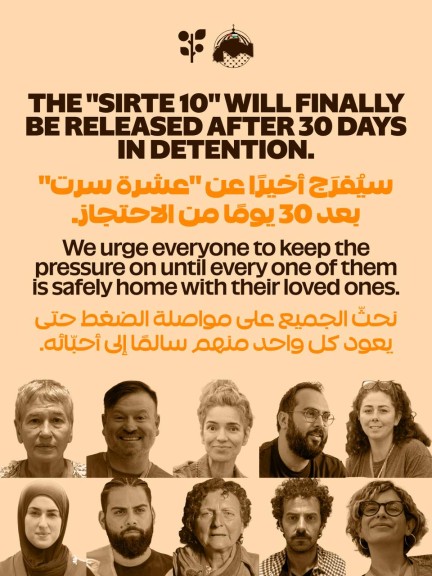
The four activists—Achraf Khoja of Tunisia, Domenico Centrone and Leonarda Alberizia of Italy, and Matias Rodriguez of Uruguay—were part of a 10-member negotiating delegation from the “Global Sumud Land Convoy.”
The remaining six volunteers, representing several countries including the United States, Spain, Poland, and Argentina, are expected to be released within the next 24 hours, according to organizers and diplomatic sources in North Africa.
”We have received formal confirmation that all 10 volunteers kidnapped from our humanitarian convoy are in the process of being released,” the Global Sumud Coalition said in a statement. “We urge everyone to keep the pressure on until every one of them is safely home with their loved ones.”
The crisis began in mid-May when the civilian humanitarian mission launched an ambitious overland journey to break the blockade on the Gaza Strip.
Comprising more than 200 international doctors, engineers, and human rights observers from 25 countries, the convoy was transporting seven ambulances, 20 mobile homes, and 10 aid trucks laden with critical medical supplies and food.
The convoy’s progress ground to a halt near the strategic coastal city of Sirte, along the heavily militarized “5+5″ line that splits political control between eastern and western Libya.
For days, the volunteers remained encamped in the desert, forced to ration water as local factions stalled their transit toward Egypt and the Rafah border crossing.
On May 24, a delegation of 10 unarmed volunteers approached an eastern security checkpoint in a clearly marked ambulance, believing they had been invited in good faith to negotiate safe passage.
Instead, they were intercepted by an armed group affiliated with the self-proclaimed Libyan Arab Armed Forces (LAAF), a powerful military faction led by Field Marshal Khalifa Haftar that commands the de facto authority in eastern Libya.

According to witnesses, the volunteers were forced into unmarked white vans and flown to a detention facility in Benghazi, where they were held for days under conditions that human rights organizations, including Amnesty International, classified as enforced disappearance.
The day after the arrests, unidentified armed men descended upon the remaining convoy encampment near Sirte.
Organizers reported that the camp was violently destroyed, and participants were physically assaulted before being forcibly escorted by militias all the way back to Tripoli, effectively collapsing the multi-nation relief mission.
While authorities in Benghazi initially claimed the activists had entered the region without proper authorization, international pressure mounted swiftly.
The detainees, whose ages range from 30 to 70, launched a multi-day hunger strike in early June to protest their arbitrary detention, a lack of translation services, and restricted access to legal counsel and vital medical supplies.
The relief of the initial releases on Tuesday was tempered by the organizers’ broader message of ongoing global solidarity. In their statement welcoming the volunteers to Tunis, Global Sumud organizers explicitly linked the plight of their team to systemic detentions worldwide.
”As we welcome this news, we also remember the nearly 10,000 Palestinian political prisoners, our four detained Tunisian organizers, and the tens of thousands held unjustly in detention centers around the world,” the coalition stated. “No one is free until all of us are free.”
For Libya, the incident highlights the volatile reality confronting international aid operations in a fractured nation where overlapping heavily-armed militias dictate foreign policy on the ground.
For the returning volunteers, the journey home is a bittersweet conclusion to a mission that fell hundreds of miles short of its destination.
