

By Tech & Defense Correspondent
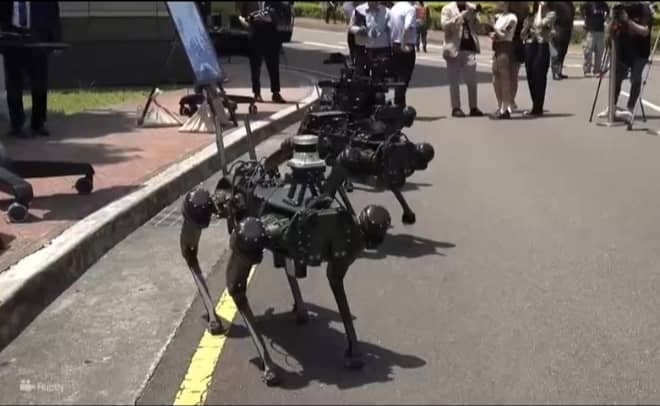
The militarization of quadrupedal unmanned ground vehicles (Q-UGVs)—often colloquially referred to as “robot dogs”—has officially entered the high-stakes arena of the Taiwan Strait. In a move that highlights the rapidly shifting landscape of cross-strait defense tactics, Taipei has unveiled a new fleet of armed robot dogs specifically tasked with maritime and coastal defense.
The introduction of these autonomous platforms marks a significant evolutionary step in Taiwan’s “asymmetric warfare” strategy. Facing a massive numerical disadvantage against the People’s Liberation Army (PLA), Taiwan is increasingly relying on cutting-edge, unmanned technology to multiply its force capabilities without risking human lives on the front lines.
The Tech Under the Hood: The Vision 60 Platform
At the core of Taiwan’s new robotic defense force is the Vision 60 Q-UGV, designed by Philadelphia-based Ghost Robotics. Unlike wheeled or tracked drones, which frequently struggle on irregular terrain, these mid-sized, high-endurance quadrupedal robots excel in unstructured environments.
Key Capabilities & Specifications:
All-Weather Operability: The Vision 60 is designed to operate in rain, mud, and dust, making it highly suitable for the harsh, unpredictable conditions of Taiwan’s coastlines.
Advanced Navigation: Equipped with proprietary blind-locomotion algorithms, the robot can navigate complex surfaces—such as rocky beaches, concrete harbor barriers, and sand—even if its optical sensors are obscured or blinded.
Tactical Use Cases: Armed variants deployed by Taiwan are configured for autonomous harbor patrols, littoral (coastal) tracking, and perimeter defense around critical maritime infrastructure.
By mounting thermal optics, advanced radar, and light weaponry onto these stable four-legged chassis, Taiwan has created a mobile sensor and engagement node capable of persistent, low-visibility patrolling.

The deployment has immediately escalated the ongoing war of words between Washington, Taipei, and Beijing. The core of the political friction lies in the origin of the hardware. While customized and armed locally, the reliance on an American tech provider directly implicates US technology transfers in the cross-strait standoff.
Beijing has reacted with predictable fury.
The Chinese Ministry of National Defense issued a stern rebuke, stating that Washington’s continued tech transfers and defense cooperation with Taipei are “only pushing the Taiwan Strait closer to a flashpoint.” Beijing views any foreign military assistance to the island as an infringement on its sovereignty and a violation of historical diplomatic agreements.
However, the reality on the ground reflects a different calculus.
Facing recruitment shortages and the constant threat of a surprise amphibious blockading action, Taiwan’s defense planners view automation not as a luxury, but as an existential necessity.
The deployment of weaponized Vision 60 units raises critical questions about the future of automated defense. While these robots are currently intended for perimeter patrols and target tracking, the line between passive surveillance and autonomous engagement is thinning.
As Beijing continues to modernize its military and practice encirclement drills around the island, Taiwan’s robotic dogs represent the vanguard of a broader trend: the defense of the island will not just be fought by soldiers, but by silicon, algorithms, and remotely operated platforms designed to hold the line at all costs.
