



By our Science Desk
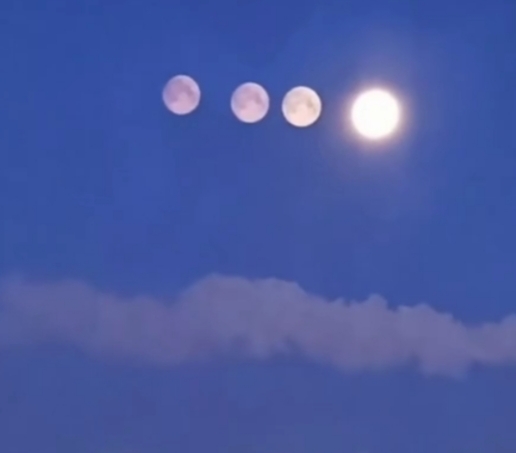
ST. PETERSBURG — Frozen locals were left rubbing their eyes this week after looking up to find not one, but four moons hanging over the Russian skyline.
The eerie sight transformed the historic city of St. Petersburg into something straight out of a sci-fi blockbuster.
While some panicked residents feared a “Star Wars” style invasion, others hailed the glowing quad-squad as a celestial omen.
But hold your horses on the alien theories.
Experts say this wasn’t a glitch in the universe, but a rare atmospheric trick known as a paraselene—or “Moondogs.”
The Science of the Sight
The spectacle occurs when the temperature plummets and the air fills with millions of tiny, hexagonal ice crystals.
As the moonlight hits these frozen prisms at just the right angle, the light bends and refracts, creating “ghost” images of the moon on either side of the real deal.
“It was absolutely freezing, but you forgot the cold the moment you looked up,” said one witness. “It looked like the sky was breaking.”
What are ‘Moondogs’?
While they look like something from another dimension, paraselenae are the nighttime cousins of “Sundogs.”
The Cause: High-altitude cirrus clouds containing ice crystals act like a giant lens.
The Look: Usually appears as a bright spot or “halo” around the moon, often 22 degrees away from the actual lunar disk.
The Rarity: Because moonlight is much dimmer than sunlight, Moondogs are significantly rarer and harder to spot than their daytime counterparts.