

By Our Chief Sports Reporter in Atlanta
THANK HEAVENS for Harry Kane. Thank heavens for his lethal, unyielding right foot, and thank heavens that when the Three Lions completely lose their heads on the grandest stage of all, our Captain Fantastic still knows exactly where the back of the net is.
For seventy-four agonizing, hair-pulling minutes in the sweltering heat of the Atlanta Stadium, Thomas Tuchel’s England looked destined for the scrapheap.
We were staring down the barrel of the most embarrassing, catastrophic World Cup exit since Iceland froze us out in 2016. The Democratic Republic of Congo—playing in their first-ever World Cup knockout game—had us trapped in a nightmare of our own making.
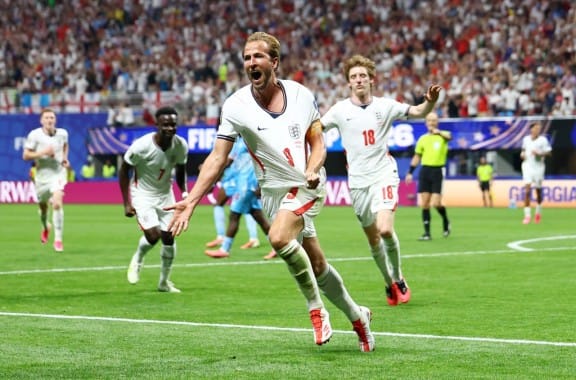
But true world-class quality cannot be suppressed forever. Cometh the hour, cometh the captain. With a stunning eleven-minute brace late in the second half, Kane single-handedly dragged a woeful, sluggish England kicking and screaming into the World Cup Round of 16. It finished two-one to England, but let nobody tell you this was comfortable.
It was a proper, full-blooded American horror story with a dramatic Hollywood ending.
Thomas Tuchel’s tactical blueprint was left in absolute tatters after just seven minutes. England began the match attempting to control the tempo, stringing passes across a heavily populated midfield.
But the rhythm was brutally shattered by a lightning-fast Congolese counter-attack. A magnificent, deep crossfield ball from the right flank was smartly flicked onward by the towering Chancel Mbemba.
What happened next will give Djed Spence nightmares for weeks. The full-back was caught entirely cold, completely detached from his positioning, leaving Brian Cipenga absolutely solitary on the left side of the penalty area.
Cipenga did not hesitate. He latched onto the ball and unleashed a clinical, low drive that flashed past a sprawling Jordan Pickford at his near post. Cue absolute bedlam among the vibrant Congolese supporters in Georgia, and total, paralyzed silence from the English contingent. It was Cipenga’s first-ever international goal, and it felt like a dagger to the heart of the Three Lions.
Instead of an immediate, ferocious response, England looked utterly shell-shocked. The midfield engine room of Declan Rice and Elliot Anderson looked stuck in third gear. The passes were heavy, the movement was rigid, and the build-up play was painfully predictable.
Whenever Jude Bellingham tried to spark a bit of magic, he was surrounded by a ferocious, disciplined swarm of blue shirts. The Real Madrid superstar’s frustration boiled over in the nineteenth minute when he was deservedly flashed a yellow card for a cynical, late challenge during another dangerous Congolese breakout.
The Congolese defense, marshaled by a collection of names very familiar to English fans, fought like lions. Aaron Wan-Bissaka, Axel Tuanzebe, and Arthur Masuaku put on a masterclass in low-block resilience.
They limited England’s creative pathways and drew tactical fouls perfectly, with young midfielder Noah Sadiki earning himself a booking just before the half-hour mark for a calculated rugby tackle on an advancing Spence.
When England did manage to carve out a rare opportunity, they met a human brick wall in Congolese goalkeeper Lionel Mpasi. Around the thirty-minute mark, Bellingham rose highest to meet a Noni Madueke cross, but his powerful header was spectacularly clawed away by Mpasi.
Minutes later, Marcus Rashford looked certain to score at the far post, only for the sliding, elastic frame of Wan-Bissaka to miraculously clear the ball off the goal line.

Just before the halftime whistle blew, a scramble from a corner saw the ball fall to Kane just yards out. He struck a fierce volley, but Mpasi pulled off another blinding, reaction stop to preserve the underdogs’ lead. At the break, England trotted off down the tunnel to a chorus of well-deserved boos.
History was firmly against them; never in their illustrious World Cup history had England successfully overturned a halftime deficit to win a match.
As the clock ticked past the hour mark, a desperate Tuchel knew he had to throw caution to the wind. Off went the ineffective Rashford and a fading Madueke; on stepped Bukayo Saka and Newcastle’s electrifying winger, Anthony Gordon. Later, Eberechi Eze was thrown into the mix as England committed body and soul to the attack.
The gamble completely transformed the tempo of the tie. Suddenly, England were overloading the flanks, stretching the exhausted Congolese backline to its absolute limits. Yet, as the clock hit seventy-four minutes, the scoreboard still read an ominous one-nil.
Then came the moment that changed everything. Declan Rice, showing immense versatility, drifted out wide to deliver a pinpoint, looping ball into the penalty area. Gordon gathered it with supreme composure and chipped a delightful, teasing cross right into the danger zone.
Rising above a sea of defenders, Harry Kane met it with the ferocity of a man possessed, planting a thumping header past the helpless Mpasi.
The equalizer broke the Congolese resistance. The African side tried to make substitutions to steady their buckling midfield, but the momentum was an unstoppable white tide. With just four minutes of normal time remaining, England struck the decisive blow.
Gordon, a persistent thorn in the Congolese side, drove forward again and slipped a sublime pass into Kane’s path. The captain turned away from his marker with supreme elegance and unleashed an absolutely unstoppable, venomous right-footed strike inside the near post.
While the relief across the nation is palpable, the underlying match statistics tell a tale of complete, yet frustratingly inefficient, dominance.
Thomas Tuchel’s men enjoyed an overwhelming seventy-one percent of total match possession, forcing the underdogs to chase shadows for long stretches of the evening. England’s territorial dominance resulted in a staggering total of nineteen shots over the ninety minutes, though a combination of wayward finishing and desperate defending meant only eight of those efforts managed to test the goalkeeper on target.
By contrast, the incredibly efficient DR Congo side managed just five shots in total throughout the entire contest, but three of those were directly on target, illustrating just how vulnerable England remained on the counter-attack.
The Three Lions also dominated the set-piece count, earning nine corners compared to just two for their opponents. Defensively, it was a physically grueling encounter, with England committing eleven fouls and receiving one yellow card, while the highly disciplined yet robust Congolese side committed fourteen fouls and also saw one player cautioned.
The historic comeback ensures that England’s proud unbeaten record against African opposition at the World Cup remains firmly intact. More importantly, it secures a date with destiny against tournament co-hosts Mexico in Mexico City this Sunday.
But let this be a stern warning to Tuchel and his squad: if we play like this in the altitude of Mexico, not even King Kane will be able to save us.
