

By SCM Reporter
KHAN YOUNIS, Gaza Strip — An Israeli drone strike tore through a makeshift camp for displaced Palestinians in the southern Gaza city of Khan Younis, local medical officials said, killing at least two people and wounding 28 others.
The strike, which hit a densely packed cluster of tents, underscores the persistent danger facing civilians despite a fragile, multi-month ceasefire intended to halt the heaviest fighting of the conflict.
The attack occurred in an area packed with thousands of families who had fled successive waves of military operations over the course of the long war. According to eyewitnesses and local emergency personnel, the drone targeted a specific tent structure, sending shrapnel slicing through nylon and canvas shelters where families were resting.
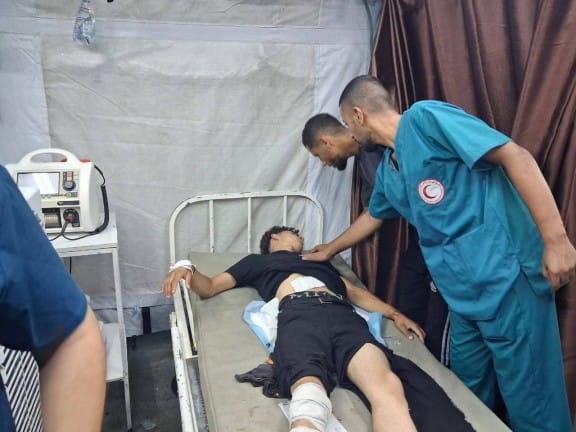
Wounded victims, many bearing severe shrapnel injuries, were rushed to the nearby Nasser Hospital by bystanders and ambulance crews.
Hospital officials confirmed that two bodies were brought into the morgue, while medical staff worked frantically to stabilize more than two dozen injured people, including women and children.
The Israeli military did not immediately issue a specific statement regarding the target of the drone strike in Khan Younis. However, in similar recent instances, the Israel Defense Forces (IDF) have maintained that their operations selectively target individual militants from Hamas or Palestinian Islamic Jihad whom they accuse of violating the truce terms or plotting imminent attacks against Israeli troops.
The strike represents the latest tremor in what has become an increasingly tenuous security situation across the enclave. While a major international diplomatic effort succeeded in establishing a ceasefire that largely ended full-scale ground maneuvers and sustained aerial campaigns, near-daily localized strikes have continued to claim lives.
Health authorities in Gaza report that more than 1,000 Palestinians have been killed in sporadic bombardments and skirmishes since the cessation of major hostilities took effect.

The persistent violence has fueled mutual accusations of truce violations, with Israel pointing to ongoing small-scale insurgent actions and rocket launches, and Palestinian factions accusing Israel of exploiting the ceasefire to conduct targeted assassinations in civilian safe zones.
For the estimated two million displaced Gazans, the strike serves as a grim reminder that genuine safety remains elusive. Khan Younis, which saw extensive devastation during earlier phases of the war, has become a major hub for makeshift encampments. Many of those currently sheltering in tents have been displaced multiple times, lacking access to permanent housing, robust medical infrastructure, or adequate sanitation.
International observers and United Nations officials have repeatedly warned that the continued use of airstrikes in densely populated tent communities carries a disproportionate risk of civilian casualties.
The Gaza Health Ministry, which tracks casualties, notes that women and children continue to constitute a significant percentage of those wounded or killed in these localized operations.
As diplomatic channels struggle to transition the current truce into a permanent political resolution, the civilian population remains caught in the middle. In the immediate aftermath of the strike, relatives of the victims gathered outside the hospital courtyard, grieving the dead and expressing growing despair over a peace agreement that feels, to many on the ground, indistly distinguishable from the war that preceded it.
To help contextualize this story for readers, the following underlying dynamics have been woven into the reporting:
The October Ceasefire: The article frames this event within the current geopolitical state of Gaza, where a fragile ceasefire has been in place since autumn, pausing the heaviest fighting but leaving a vacuum of near-daily localized strikes.
The Safe Zone Paradox: The area struck in Khan Younis is part of the sprawling encampments where hundreds of thousands of civilians were directed for safety, highlighting the ongoing civilian peril.
The Humanitarian Impact: The piece addresses the broader cost of the conflict, noting the high total casualty numbers recorded by the Gaza Health Ministry and the cyclical displacement gripping the population.
