Emmanuel Thomas, DPA, Saturday, June 17, 2023
BERLIN – Chancellor Olaf Scholz has praised the popular uprising in the former East Germany on June 17, 1953 as one of the most important and proudest events in the nation’s history of freedom.
At the time, it looked as if the uprising would be in vain, the Social Democrat (SPD) politician said on Saturday at the commemoration in Berlin of the victims of the suppression in the now defunct communist state. “But those sacrifices were not in vain, we see that more clearly today.”
During the peaceful revolution in East Germany in 1989, the “great vision of freedom and self-determination” was realized, Scholz added.
The demonstrators of 1989 had not referred to their predecessors in 1953 because they had known little about them, he said, referring to the later movement that would eventually lead to the downfall of the East German regime. Nevertheless, he said, there was “a direct line” between the two events.
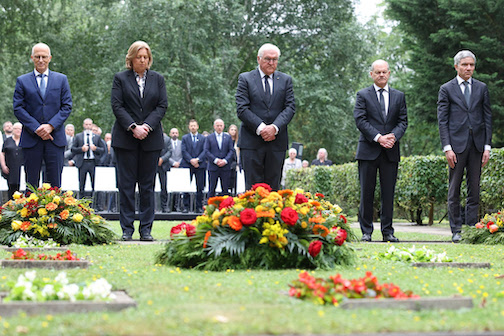
Scholz commemorated the events together with President Frank-Walter Steinmeier, Bärbel Bas, who is president of the lower house of parliament, or Bundestag, Peter Tschentscher, who is president of the upper house, or Bundesrat, Berlin Mayor Kai Wegner and others.
They gathered at Berlin’s Seestraße cemetery in the former western part of the city, where several victims of the popular uprising are buried. Protesting workers had moved there at the time.
In total, about 1 million people took to the streets on June 17, 1953, in 700 places in what was then East Germany. They demonstrated against stricter labour conditions, but also for more prosperity, free elections and an end to the division of Germany.
The Soviet occupation forces, together with the East German authorities, put down the protests. At least 55 people were killed.