

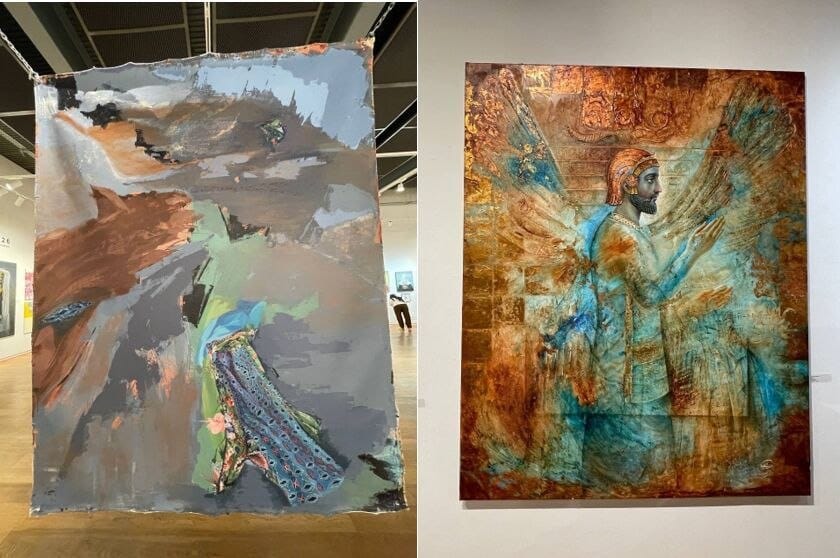
By SCM Art writer
LONDON – The concept of “home” is rarely static, but for contemporary Iranian artists, it is an ongoing, borderless conversation. This week, London’s Mall Galleries—tucked elegantly between the institutional majesty of Trafalgar Square and Buckingham Palace—becomes the epicentre of that dialogue.
The sixth Iranian Contemporary Art Biennial, poignantly titled “With My Roots,” is a sweeping survey of artistic resilience. Running from May 22 to May 30, 2026, the exhibition functions less like a traditional regional showcase and more like a global atlas.
It gathers 182 distinct works crafted by 127 Iranian artists who, while bound by a shared cultural lineage, are currently living and working across 17 different countries.
What emerges is a profound exploration of identity in exile, memory, and the unseen threads that tie a scattered diaspora back to its origin.
To view contemporary Iranian art in 2026 is to witness a creative community navigating the complexities of the modern world. For decades, geopolitical tensions and shifting domestic landscapes inside Iran have catalyzed waves of artistic migration.
Yet, as “With My Roots” vividly demonstrates, distance has neither dulled the sharpness of their critique nor diluted the richness of their visual language.
By bringing together artists separated by oceans but united by heritage, the biennial highlights how Iranian art adapts to its surroundings.
An artist working in Berlin might experiment with industrial materials or digital mediums to process memories of Tehran, while another in Toronto might lean into traditional Persian calligraphy or miniature painting, subverting ancient forms to comment on displacement.
The sheer volume of the exhibition—182 pieces—ensures that no single narrative dominates. Visitors are treated to an intricate mosaic of styles, spanning from stark political commentary and abstract expressionism to deeply personal explorations of gender, nostalgia, and belonging.
For a British public accustomed to viewing Iran through the narrow lens of nightly news cycles and geopolitical friction, the biennial offers a crucial intervention.
It strips away the monolithic representations often imposed on the region, replacing them with a complex, polyphonic reality told by the creators themselves.

There is an intentional irony to the setting. Nestled within the Mall Galleries, surrounded by the physical architecture of the British establishment, these 127 artists are carving out a space that belongs entirely to them.
The title, “With My Roots,” reads not as a lamentation of what was lost, but as a statement of mobile strength. It suggests that roots are not anchor weights keeping a creator tied to a single plot of land; rather, they are something carried within, capable of feeding new creative life wherever the artist happens to land.
As the exhibition draws to a close this May, it leaves behind a vital reminder of art’s unique superpower: its ability to build bridges where diplomacy fails, and to map a homeland that exists beyond physical borders.
Iranian contemporary art operates within a fascinating, bittersweet duality. Since 1979, waves of migration have created a profound global diaspora.
Today, some of the most innovative and critical Iranian art is produced not in Tehran, but in studios across Europe, North America, and beyond.
By staging the sixth iteration of the biennial at the Mall Galleries—right in the heart of British institutional power near Buckingham Palace—the organizers are performing a radical act of cultural mapping.
The exhibition explores how “roots” operate when planted in foreign soil, offering British audiences an intimate look at Iranian identity that transcends geopolitical headlines.
