

By Our Football Correspondent
SAN FRANCISCO — The beautiful game has an unmatched scriptwriting ability, frequently pairing nations separated by vast geographies and disparate footballing histories on the grandest stage of all.
On a crisp, brisk evening at the San Francisco Bay Area Stadium, the narrative arc of Group J bent toward drama as Ralf Rangnick’s Austria celebrated their long-awaited return to the FIFA World Cup stage.
Ending a painful twenty-eight-year tournament hiatus, the Central European side overcame a fiercely brave and tactically organized tournament debutant in Jordan, securing a hard-fought 3-1 victory that was far closer than the final scoreline suggests.
The pre-match atmosphere was charged with a mixture of historical romance and modern anxiety.
For Austria, guided by the tactical blueprint of Ralf Rangnick and captained by the evergreen David Alaba, this was a moment of generational redemption. For Jordan, it was an unprecedented leap into the footballing stratosphere.
The Asian underdogs, spearheaded by the electrifying Mousa Al-Tamari—the first Jordanian to ever grace the fields of France’s Ligue 1—did not arrive to simply make up the numbers.
They arrived to shock the world, and for long stretches of this captivating encounter, they threatened to do exactly that.
The match ignited with a frenetic, chaotic energy right from the referee’s opening whistle. Jordan, far from being awed by the magnitude of their World Cup debut, chose to attack with unbridled audacity.
Just two minutes into the contest, a lightning-fast counter-attack engineered by Al-Tamari sliced open the Austrian midfield, culminating in Jordan’s captain, Ehsan Haddad, blasting a low, stinging effort into the side-netting.
It was an immediate warning shot that shattered any illusions of an easy night for Rangnick’s men. Minutes later, Jordan’s offensive momentum grew as midfielder Odeh Al-Fakhouri left his marker stranded, launching a dipping, speculative strike from distance that required a fingertip save from Austria’s custodian, Alexander Schlager, to prevent an early catastrophe.
Sensing the danger, Austria’s established stars began to impose their technical authority on the pitch. Marcel Sabitzer, acting as the primary orchestrator in the engine room, began dictating the tempo, shifting the ball wide and using Saša Kalajdžić as an imposing target man.
The tactical adjustment paid immediate dividends in the twenty-first minute through a moment of pure, unadulterated individual brilliance.
Receiving a routine, short lay-off from midfield partner Xaver Schlager, Werder Bremen’s prized asset Romano Schmid took one look at the goal from the edge of the eighteen-yard box.
With technical precision, Schmid unleashed an unstoppable, curling rocket that soared past Jordan’s goalkeeper, Yazeed Abulaila, and nestled directly into the top-right corner of the net.
It was a goal worthy of any World Cup stage, validating Schmid’s reputation as one of the nation’s brightest modern talents and giving Austria a crucial one-goal cushion to take into the halftime interval.
If Austria believed the opening goal would break Jordan’s spirit, they drastically miscalculated the resilience of their opponents. Whatever instructions Jordan’s coaching staff imparted at halftime worked like a charm, as the debutants emerged for the second period with renewed tactical discipline and vertical aggression.
Just five minutes after the restart, history was made. Noor Al-Rawabdeh intercepted a loose pass deep within his own half and spotted the explosive run of Ali Olwan. Splitting the Austrian defense with a perfectly weighted, defense-dissecting through ball, Al-Rawabdeh sent Olwan sprinting into open space down the left flank.

The Al-Sailiya forward advanced with clinical composure, cut inside the retreating Austrian defenders, and unleashed a sumptuous, curling finish that kissed the inside of the far post before rippling the net. The stadium erupted as Olwan scored Jordan’s first-ever goal in a men’s FIFA World Cup tournament, dragging his side level at 1-1 and sending a shockwave through the Austrian dugout.
Olwan almost turned the game completely on its head just moments later. Rising highest during a beautifully flighted corner, the Jordanian talisman executed a glancing header that beat Schlager but crashed agonizingly against the crossbar. Austria was rocking, their twenty-eight-year homecoming suddenly turning into a desperate defensive rearguard action.
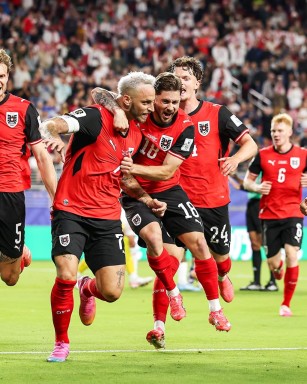
Faced with a tactical crisis, Ralf Rangnick turned to his bench, unleashing the enigmatic and veteran presence of Marko Arnautovic at the interval. At thirty-seven years old, the seasoned striker proved that class remains permanent, ultimately transforming the entire complexion of the match. Arnautovic brought an immediate physical edge and psychological swagger to an Austrian attack that had grown passive.
In the sixty-seventh minute, the veteran thought he had restored the lead, prodding home a loose ball after Abulaila miscued a punch under heavy aerial pressure. However, a lengthy and tense Video Assistant Referee (VAR) review cut the celebrations short, ruling that Stefan Posch had handled the ball in the chaotic buildup.
Undeterred by the referee’s decision, Austria continued to lean heavily on their talismanic substitute. The crucial breakthrough arrived in the seventy-sixth minute via a set-piece delivered by the magical right boot of Marcel Sabitzer.
Sabitzer’s wicked, inswinging corner whipped across the face of the six-yard box, evading the leaping Arnautovic but creating enough panic to force a catastrophic error.
The ball struck the back of Jordan’s star defender, Yazan Al-Arab, taking a cruel, deflecting trajectory and nestling into the far corner of the net. It was an incredibly harsh blow for Al-Arab, who had otherwise put in a heroic defensive shift, but it handed Austria a precious 2-1 advantage.
As the match bled into a staggering twelve minutes of injury time due to multiple VAR interventions and substitutions, Jordan threw caution to the wind, committing numbers forward in a desperate bid to rescue a point.
This left gaping voids in their defensive third, which Austria’s experienced stars ruthlessly exploited. Deep into the final minute of added time, Arnautovic turned provider, driving down the flank and crossing into the box, only for the ball to hit an outstretched Jordanian arm.
The referee pointed directly to the penalty spot. Stepping up to the twelve-yard mark with absolute ice in his veins, Marko Arnautovic sent the goalkeeper the wrong way, burying his penalty into the corner to add late gloss to the scoreline and put the result beyond any mathematical doubt at 3-1.
When the dust settles on this captivating Group J encounter, the final statistics paint a picture of a game defined by territorial dominance meeting clinical transitional play. Austria controlled the lion’s share of possession, retaining the ball for sixty-two percent of the match and completing eighty-four percent of their passing sequences.
This territorial dominance translated into fifteen total shots, with seven finding the target.
Conversely, Jordan’s counter-attacking blueprint was remarkably efficient despite their lower possession share of thirty-eight percent.
The debutants registered nine total shots, hitting the woodwork once and forcing Alexander Schlager into three crucial saves. Jordan’s physical commitment was evident in their defensive workload, winning fifty-five percent of the contested ground duels and recording twenty-two clearances across the ninety minutes.
Ultimately, it was Austria’s elite pedigree and the decisive impact of stars like Schmid, Sabitzer, and Arnautovic that allowed them to join reigning champions Argentina at the summit of Group J with three valuable points.
For Jordan, despite leaving the pitch empty-handed, their fearless performance proved they belong on the world stage, setting up a tantalizing path forward in the tournament.
