

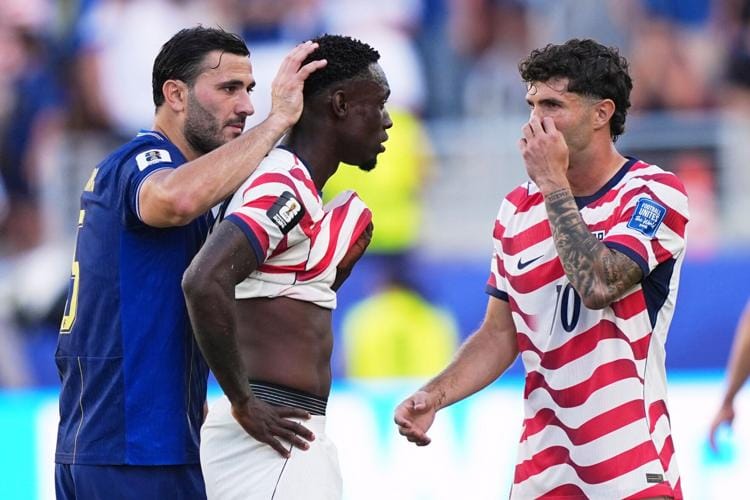
FIFA’s surrender to executive pressure from the White House represents a watershed moment where the boundary between sport governance and geopolitical leverage collapsed entirely.
By Emmanuel Ukudolo I Monday, July 06.2026
WASHINGTON – On July 5, 2026, the global football ecosystem was rocked by an announcement that fundamentally altered the relationship between political power and sport governance, following FIFA’s decision on the Nigerian American star, Folarin Balogun.
Under standard international football regulations, a straight red card carries an unappealable, mandatory one-match suspension. Yet, in an extraordinary move that marks the first time since 1962 that a World Cup red card did not result in an immediate match ban, FIFA essentially deferred the punishment into a one-year probationary period. What transformed this regulatory anomaly into a raging international firestorm, however, was the revelation of what happened behind closed doors: the reprieve came directly after multiple personal phone calls from United States President Donald Trump to FIFA President Gianni Infantino
On the eve of a highly anticipated FIFA World Cup Round of 16 clash between the United States and Belgium in Seattle, FIFA’s Disciplinary Committee revealed it had suspended the automatic one-game ban of US men’s national team star striker Folarin Balogun.
The 25-year-old Monaco forward had received a straight red card just days prior during a grueling 2-0 Round of 32 victory over Bosnia and Herzegovina.
Under standard international football regulations, a straight red card carries an unappealable, mandatory one-match suspension. Yet, in an extraordinary move that marks the first time since 1962 that a World Cup red card did not result in an immediate match ban, FIFA essentially deferred the punishment into a one-year probationary period. What transformed this regulatory anomaly into a raging international firestorm, however, was the revelation of what happened behind closed doors: the reprieve came directly after multiple personal phone calls from United States President Donald Trump to FIFA President Gianni Infantino.
While battling for position to receive a pass, Balogun collided awkwardly with Bosnian defender Tarik Muharemović. Replays showed Balogun’s studs sliding down the defender’s leg and catching his ankle. While Brazilian referee Raphael Claus did not immediately signal a dismissal, a subsequent Video Assistant Referee (VAR) review led him to brandish a straight red card for a “serious foul.”
Though the ten-man American squad managed to survive the final half-hour and secure advancement via a late Malik Tillman goal, the immediate narrative was one of devastation. Balogun, the USMNT’s leading scorer with three goals in the tournament, was seemingly out of the tournament’s knockout opener against Belgium.
Then came the political intervention. According to reports from the Associated Press and The New York Times, the White House initiated rapid contact with FIFA leadership. President Donald Trump placed up to three direct phone calls to Gianni Infantino, urging the governing body to review the dismissal and providing what administration officials termed “additional evidence” regarding the accidental nature of the collision.
Shortly after FIFA’s official announcement, President Trump took to Truth Social to celebrate the decision, posting: “Thank you to FIFA for doing what was right, and reversing a great injustice!
President DONALD J. TRUMP.” While the American locker room and head coach Mauricio Pochettino celebrated the sudden reinstatement of their star frontman, the rest of the footballing world reacted with unbridled fury.
Global Uproar and Belgium’s Fury
The reaction from Brussels and the broader European football community was instantaneous and scathing. The Royal Belgian Football Association (RBFA) released a strongly worded communique stating it was “astonished” by the ruling and was actively exploring all potential legal avenues to safeguard the sporting integrity of the tournament.
Belgium’s head coach, Rudi Garcia, open-ended his pre-match press conference with biting sarcasm, comparing the announcement to an April Fool’s Day prank.
“I didn’t know that in the offices of FIFA the fifth of July was the first of April in Europe,” Garcia remarked. He further emphasized that the RBFA was not merely defending its own tactical interests, but rather “football in general, its integrity and its ethics.”
Critics across international sports media quickly pointed out the blatant hypocrisy and double standards embedded in the ruling. Hundreds of players have missed defining World Cup matches due to controversial, harsh, or arguably accidental red cards throughout the tournament’s history.
None enjoyed the luxury of an executive pardon from a superpower’s head of state. Social media platforms erupted with accusations of corruption, with fans and pundits noting that Infantino’s long-standing, cozy relationship with Donald Trump had compromised the foundational equity of the world’s biggest sporting event.
The Legal Loophole and the 1962 Precedent
To justify its unprecedented U-turn, FIFA invoked Article 27 of its own Disciplinary Code. The article stipulates that a judicial body reserves the right to fully or partially suspend the implementation of a disciplinary measure, subjecting the individual to a probationary period.
FIFA clarified that Balogun’s red card was not erased; rather, his ban was suspended for twelve months. Should he commit a similar infraction during this timeframe, the original ban will be instantly triggered alongside any new sanctions.

Historically, FIFA has used this probationary mechanism for qualifiers—such as deferring a portion of Cristiano Ronaldo’s multi-match ban following an incident against Ireland—but applying it mid-tournament to an automatic red card suspension is virtually unheard of in the modern era.
The only comparable World Cup precedent dates back to 1962, when Brazilian icon Garrincha was sent off in a semifinal against Chile but was mysteriously cleared to play in the final against Czechoslovakia.
In that instance, the linesman who witnessed the alleged infraction failed to show up for the disciplinary hearing, allowing Brazil to successfully argue that the dismissal lacked sufficient evidence. In 2026, however, the entire incident was captured on high-definition VAR cameras, leaving FIFA with no technical justification to claim the foul didn’t occur. By bending the rules under political pressure, FIFA opened a Pandora’s box.
Implications for Football Development and Governance
The long-term ramifications of this decision on the development of football are profound and potentially devastating. For decades, FIFA’s most fiercely guarded principle has been the absolute separation of sport and politics.
Article 15 of the FIFA Statutes strictly prohibits government interference in the affairs of member associations, a rule so rigid that nations like Nigeria, Kuwait, and Peru have previously faced total international suspension when their governments attempted to intervene in local football federations.
By capitulating to a phone call from the President of the United States, FIFA has completely undermined its own moral authority. The implications for football development can be broken down into three critical areas:
Area of Impact, Core Consequence, Long-Term Risk to the Sport,
Institutional Credibility, Bends the rules for powerful host nations while punishing smaller federations.
Complete erosion of trust in FIFA’s judicial independence.
On-Pitch Regulatory EquityCreates a tiered justice system where certain players are exempt from standard red-card bans; undermining the authority of referees and the universal enforcement of the Laws of the Game.
1. The Death of the “Level Playing Field”
The cornerstone of football’s global popularity is its democratization; on the pitch, a powerhouse nation is bound by the exact same rules as an underdog.
The Balogun incident shatters this illusion. If geopolitical influence can dictate player eligibility at a World Cup, the sport risks transitioning into an arena where wealthy and politically dominant nations operate under a separate legal framework.
Developing football nations in Africa, Asia, and South America—who lack the diplomatic leverage to pressure Zurich—will permanently view global tournaments through a lens of suspicion.
2. The Weaponization of Disciplinary Deferrals
By establishing that Article 27 can be used to pause tournament suspensions, FIFA has created a highly dangerous legal mechanism.
Moving forward, every major football association will demand that their star players receive probationary deferrals for red cards received in knockout rounds.
If a French, Argentine, or Egyptian striker is sent off in a future semifinal, their respective federations will point directly to the Folarin Balogun precedent of 2026, threatening legal action or administrative revolt if they are not granted the same leniency.
3. Undermining On-Field Officiating
Referees already operate under immense pressure, compounded by the microscopic scrutiny of VAR. By overturning a field decision validated by video review due to external political dialogue, FIFA has actively castrated its refereeing corps.
If a referee knows that their disciplinary choices can be overridden by a head of state’s telephone diplomacy, it compromises their sub-conscious independence on the pitch, particularly when officiating matches involving geopolitically powerful nations.
A Dark Shadow Over 2026
While Folarin Balogun’s presence on the pitch in Seattle undoubtedly injects massive star power and tactical dynamism into the United States’ frontline, it comes at an catastrophic cost to the soul of the sport.
Mauricio Pochettino may view the decision as a victory for “common sense,” but the reality is far more cynical.
FIFA’s surrender to executive pressure from the White House represents a watershed moment where the boundary between sport governance and geopolitical leverage collapsed entirely.
As the tournament progresses, the matches will inevitably be played, goals will be scored, and millions will watch. However, the ghost of this telephone call will linger long after the final whistle of the 2026 World Cup.
FIFA has sent a clear message to the world: the Laws of the Game are absolute, unless you have the right phone number.
