

By SCM Staff Writer I June 8, 2026
TEL AVIV — Israel has launched a series of active military strikes against targets inside Iran, with the nation’s highest-ranking military officials personally directing operations from an underground command center, the Israel Defense Forces confirmed Monday morning.
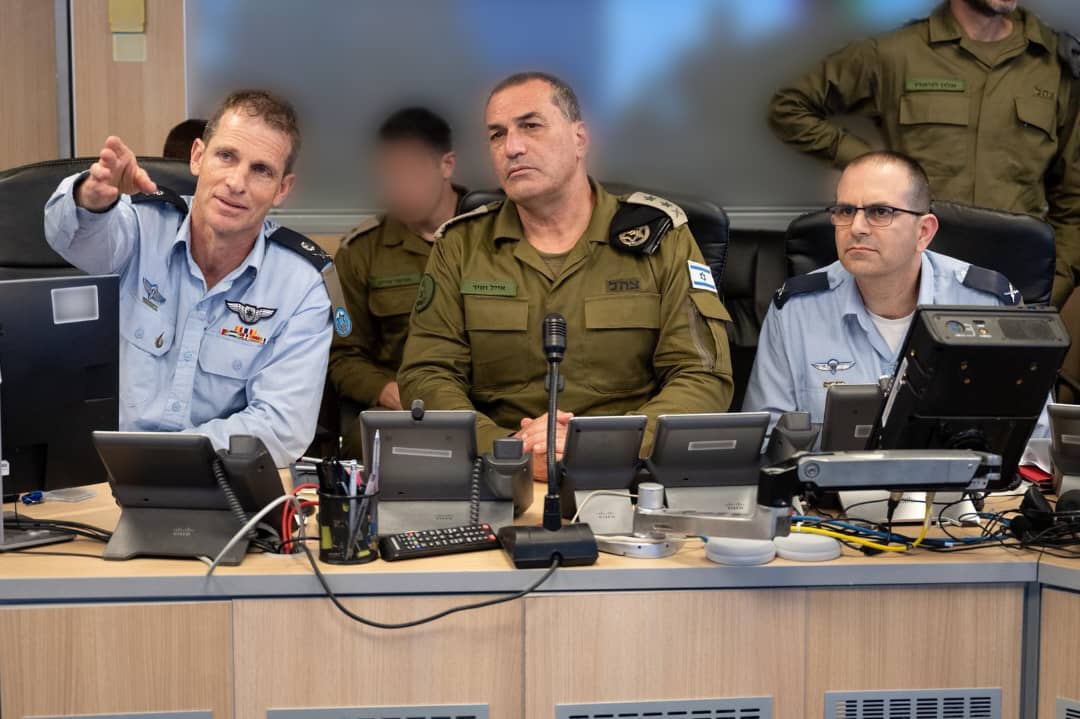
In a rare operational update issued while regional actions were still underway, the IDF disclosed that Chief of the General Staff, LTG Eyal Zamir, alongside Israeli Air Force Commander Maj. Gen. Omer Tishler, are currently stationed at the IAF command center, actively steering the complex aerial offensive.
“Over the past hours, the IDF Chief of the General Staff, LTG Eyal Zamir, and senior IDF commanders conducted situational assessments and are currently commanding the IDF strikes in Iran from the Israeli Air Force command center,” the military said in a public statement.
Military officials emphasized that the state remains at maximum operational posture, prepared for both prolonged offensive campaigns and potential large-scale retaliatory responses from Tehran or its regional proxies.
“The IDF remains at full readiness, both offensively and defensively,” the military statement continued.
“The IDF remains on high alert and is fully prepared to continue operations across all arenas against those who threaten the State of Israel.”
Inside the Air Force Command Center
The IDF also released official documentation showing LTG Zamir and Maj. Gen. Tishler closely monitoring tactical readouts and live telemetry alongside a array of specialized staff officers.
The released images underscore the gravity and strategic scale of the direct confrontation, highlighting a highly centralized command structure coordinating long-range sorties flying thousands of kilometers from Israeli airspace.
Military analysts note that publishing visual evidence of top commanders leading an operation in real-time serves a dual purpose: reinforcing public confidence within Israel while projecting a clear psychological message of institutional resolve directly to the leadership in Tehran.
A Deepening Regional Conflict
The unfolding operation marks a critical inflection point in the long-running shadow war between Jerusalem and the Islamic Republic. For decades, the conflict was fought primarily through asymmetric means, cyber warfare, and regional proxies—most notably Hezbollah in Lebanon, the Houthis in Yemen, and various militias operating throughout Syria and Iraq.
However, direct state-to-state military engagements have broken those historical boundaries.

Tensions have intensified progressively over the past two years following a series of direct ballistic missile exchanges and drone swarms launched by Iran toward Israeli population centers, forcing a fundamental shift in Israel’s defense doctrine.
Jerusalem has repeatedly warned that it will no longer tolerate the “ring of fire” strategy orchestrated by Iran’s Islamic Revolutionary Guard Corps (IRGC) without directly holding the regime accountable on its own soil.
The current strikes follow weeks of intelligence warnings regarding imminent threats to Israeli infrastructure. Security sources indicate that the IAF’s targets likely focus on strategic assets, which historically include drone manufacturing plants, ballistic missile storage facilities, air defense batteries, and command-and-control hubs tied directly to the IRGC.
By explicitly stating that the military is “fully prepared to continue operations across all arenas,” the IDF signaled that it is bracing for multi-front escalation.
Security protocols across Israel have been heightened, with air defense systems—including the Iron Dome, David’s Sling, and the Arrow-3 multi-layered interceptor networks—placed on absolute standby.
The Home Front Command has urged citizens to remain vigilant and strictly adhere to emergency directives, though no immediate changes to civilian routine were officially mandated at the onset of the strikes.
As the Israeli Air Force operations continue deep within Iranian territory, regional allies, including the United States, are reportedly tracking the developments closely.
The current escalation places the entire Middle East on a knife-edge, with the ultimate scope of the conflict heavily dependent on the damage assessment of the current waves and Tehran’s impending strategic calculations.
