

By Emmanuel Thomas, Staff Writer I April 29, 2026
VIENNA — The world’s leading nuclear watchdog warned on Wednesday that it remains “blind” to the status of Iran’s most dangerous nuclear stockpiles, nearly a year after the regional conflict of 2025 severed international oversight of the Islamic Republic’s atomic program.
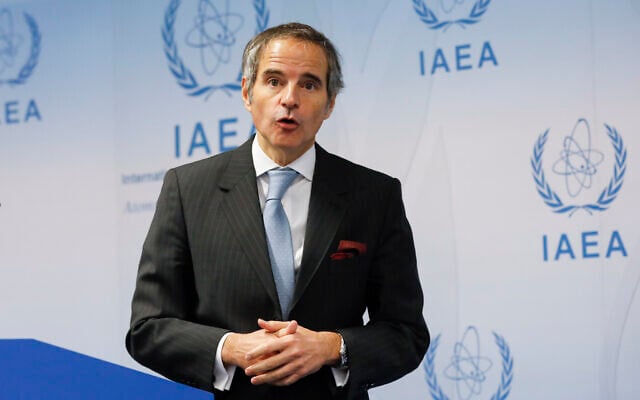
Rafael Grossi, the Director General of the International Atomic Energy Agency (I.A.E.A.), told the Associated Press that the agency believes the majority of Iran’s highly enriched uranium is still being stored at the sprawling Isfahan nuclear complex.
However, he admitted that since the conclusion of the 2025 war, inspectors have been unable to step foot inside the facility to verify the security or volume of the material.
“Our assessment is that a large share of the material remains there, including uranium enriched to near weapons-grade levels,” Mr. Grossi said. “But there is a significant difference between an assessment and a verification. We cannot say with certainty what has happened to that stockpile.”
The disclosure underscores the fragility of the post-war landscape in the Middle East. While major combat operations ended last year, the diplomatic architecture intended to prevent Iran from developing a nuclear weapon remains in a state of collapse.
The Isfahan facility has long been a focal point of international concern. It houses the technology to convert uranium into metal—a key step in fabricating the core of a nuclear warhead—and serves as a primary storage hub for uranium enriched to 60 percent purity.
Experts note that 60 percent enrichment is a short technical step away from the 90 percent “weapons-grade” threshold. Without I.A.E.A. cameras or physical inspections, Western intelligence agencies are left to rely on satellite imagery and signals intelligence to track whether Iran is attempting to move the material to clandestine locations.
Mr. Grossi’s comments were seen by diplomats as a calculated plea for Iran to re-engage with the agency. “We need renewed access,” he stressed. “The continuity of knowledge is broken. Every day that passes without eyes on the ground increases the risk of miscalculation.”
The current crisis dates back to the 2025 war, a conflict that saw widespread strikes on Iranian military infrastructure. During the height of the hostilities, Tehran suspended its cooperation with the I.A.E.A., citing security concerns and accusing the agency of being a conduit for Western intelligence.

Before the war, Iran had steadily increased its nuclear activities in response to the collapse of the 2015 nuclear deal and subsequent rounds of international sanctions.
By early 2025, Tehran possessed enough highly enriched uranium to produce several nuclear devices if it chose to pursue further enrichment.
Since the ceasefire, the Iranian government has maintained a stance of “strategic ambiguity.” While Tehran continues to insist its program is for peaceful purposes—such as medical research and energy—the lack of transparency has fueled fears in Jerusalem and Washington that the Islamic Republic may be utilizing the post-war chaos to cross the nuclear finish line.
The Biden administration and its European allies have signaled a willingness to negotiate a new monitoring framework, but Tehran has linked the return of inspectors to the lifting of crippling economic sanctions and a formal end to war-related reparations claims.
For now, the I.A.E.A. finds itself in a precarious position: knowing where the material likely is, but unable to prove it hasn’t been diverted.
”The shadow cast over Isfahan is a shadow over the entire region’s security,” said one senior European diplomat, speaking on the condition of anonymity.
“If the I.A.E.A. can’t get back in, the assumption will eventually become that the material is no longer where we left it.”
