

By SCM Staff Writer
NEW YORK — For years, the public’s relationship with advanced robotics has been defined by a mix of awe and skepticism.
We watched humanoid machines perform backflips for TikTok likes and dance to Motown hits in choreographed laboratory videos. But as New Yorkers stepped over icy slush and navigated blocked curb cuts this week, a new kind of machine quietly went to work—one that prefers labor over likes.
While Silicon Valley has often focused on the “spectacle” of AI, Reflex has deployed a fleet of utilitarian bots designed for the grit of a Northeast winter.
These aren’t the agile, tumbling gymnasts of years past; they are rugged, functional laborers focused on one of the city’s most perennial headaches: sidewalk snow removal.
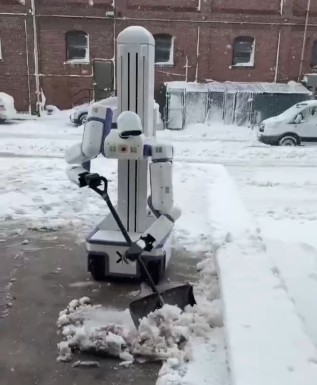
In recent footage released by the company, the Reflex bot can be seen methodically clearing paths with a precision that manual crews often struggle to maintain during peak blizzard conditions.
Unlike human shovelers who face the bite of sub-zero temperatures, these bots operate with a tireless, mechanical indifference to the cold.
”It’s finally ‘useful’ AI,” says one tech analyst. “We’ve moved past the era of robots doing tricks to justify their venture capital. Now, we’re seeing robots doing the chores no one else wants to do.”
The deployment comes at a critical time for New York City. With labor shortages and tightening municipal budgets, the “snow problem” has become a litmus test for urban tech integration.
The Reflex bots navigate complex pedestrian environments, using onboard sensors to distinguish between a snowbank and a sleeping pet or a discarded trash bag.

For the average New Yorker, the sight of a robot on the sidewalk is becoming less of a sci-fi novelty and more of a welcome relief.
After all, a robot that clears your path to the subway is significantly more impressive than one that can do a standing tuck.
To understand why the Reflex Robotics rollout matters, one has to look at the “Viral Era” of robotics (roughly 2016–2024).
During this time, companies like Boston Dynamics became household names by showing robots conquering obstacle courses and dancing. While these were triumphs of engineering, they lacked a clear return on investment (ROI) for daily civic life.
The shift we are seeing today is defined by:
Purpose-Built Design: Moving away from “general purpose” humanoids toward task-specific utility.
Labor Supplementation: Targeting “Dull, Dirty, and Dangerous” jobs (the 3 Ds) where human labor is increasingly scarce.
Edge Computing: Improved AI that allows bots to operate in the chaotic, unpredictable environment of a NYC sidewalk without a constant tether to a human handler.
By focusing on the mundane—the simple act of moving snow from point A to point B—Reflex Robotics may have found the “killer app” for humanoid tech: actually being helpful.
