



By London Sun Political Correspondent
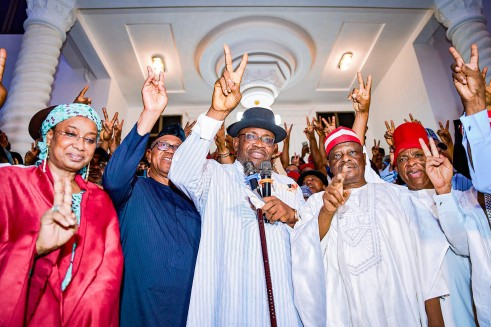
In a move that has sent shockwaves through the West African political landscape, Henry Seriake Dickson (HSD) has officially signaled the charge for a new era in Nigerian governance.
With the formal unveiling of the National Democratic Coalition (NDC), Dickson is not merely launching a political party; he is attempting to construct a lasting ideological fortress designed to mirror the world’s most enduring political institutions.
Speaking with a palpable sense of momentum, Dickson expressed profound gratitude for the “growing support and confidence” Nigerians have shown in the NDC movement. While Dickson has long been known as a formidable “party organiser and builder,” the latest phase of the NDC’s rollout marks a significant escalation in its political firepower.
The recent addition of two “distinguished colleagues”—described by insiders as political heavyweights with immense grassroots machinery—has transformed the NDC from an ambitious project into a legitimate contender for national dominance.
”What we are witnessing is a powerful convergence,” Dickson stated. “My role as a builder, alongside leaders with immense popularity and political experience, is bringing the country together under one platform.”
Dickson’s vision for the NDC is remarkably global in its scope. Eschewing the traditional Nigerian model of “personality-driven” politics, he has set his sights on creating a structured, ideological entity that can stand the test of time.
He drew bold comparisons to some of the world’s most stable political machines, including:
The ANC (South Africa) during its foundational years.
The Communist Party of China (for its legendary stability and structure).
Established democratic parties across Europe, America, and India.
The goal, according to HSD, is to build a party that “endures beyond its founders for generations to come.” This long-term thinking is a direct challenge to the “here-and-now” cynicism that often plagues regional politics.
Transparency appears to be at the heart of the NDC’s current offensive. To silence critics who claim the party is a “overnight” creation, Dickson released documents (annexures) proving the registration process actually began as far back as 2017.
In a fascinating glimpse into the party’s branding history, the documents even include a Google search record from February 3, 2017, showing the leadership’s early deliberations on adopting the iconic “V-sign” as the party’s official logo.
Despite this evidence, Dickson admitted that an ambitious project of this magnitude will always attract “distractions, rumours, and propaganda.”
”I am fully aware of the terrain,” Dickson remarked with the grit of a veteran. “I urge Nigerians to discountenance the blackmail and remain focused on the bigger picture.”
The NDC’s manifesto leans heavily toward social inclusivity, specifically targeting women and young people. Dickson emphasized that the party is designed to be a “mentorship hub” that prepares citizens for service rather than just serving the interests of the “big and powerful.”
In a direct appeal to the “ordinary and vulnerable” Nigerians, Dickson issued a national rallying cry:
”I call on all Nigerians to join the NDC, register, participate, and contest elections. Together, let us reclaim and rebuild our country.”
As the 2027 electoral cycle begins to loom on the horizon, the NDC’s emergence suggests that the status quo in Abuja is about to be very uncomfortably challenged.