

By SCM Correspondent in Abuja
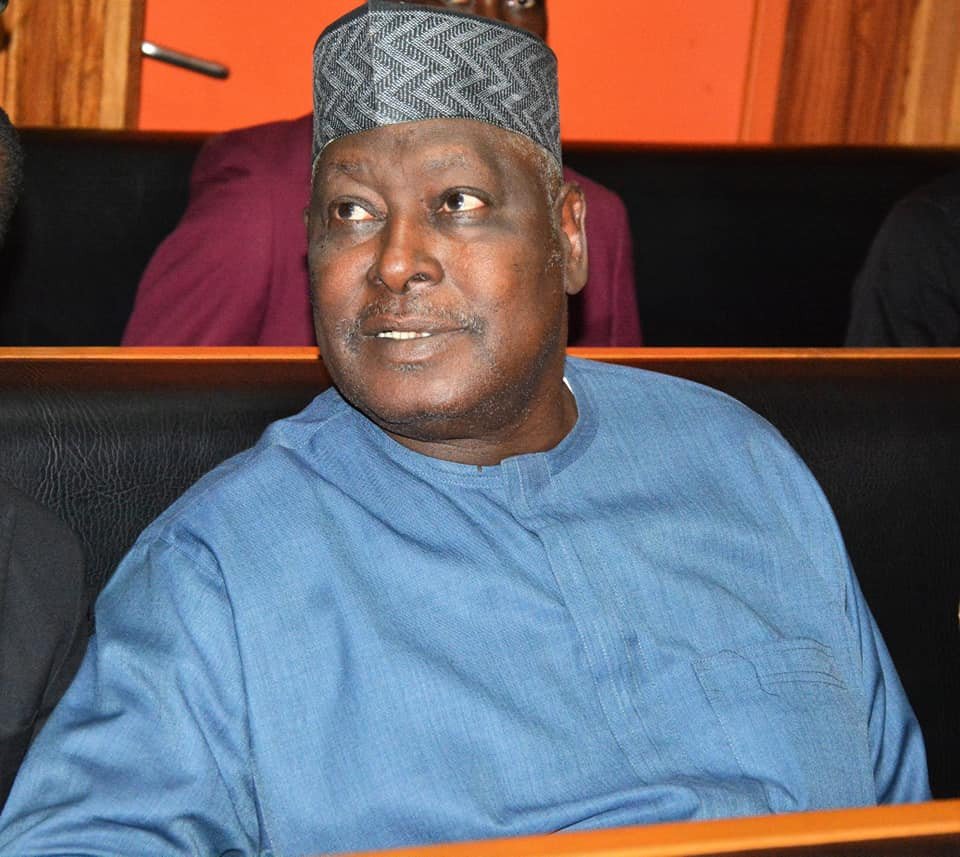
The political landscape ahead of the 2027 general elections was thrown into a tailspin on Monday when the former Secretary to the Government of the Federation (SGF), Engr. Babachir Lawal, announced his immediate resignation from the African Democratic Congress (ADC).
Lawal’s dramatic exit followed the controversial emergence of former Vice President Atiku Abubakar as the party’s presidential flagbearer for the 2027 polls. In a scathing, bare-knuckle assessment, the former SGF did not only discard his party membership but also took a swipe at Atiku, declaring that incumbent President Bola Ahmed Tinubu would be a far better option for the country than the former vice president.
In a strongly-worded statement released to newsmen, Lawal alleged that the recent ADC presidential primary election was nothing short of a scripted charade. He insisted that the results were heavily manipulated and pre-written to guarantee Atiku’s victory over other contenders, including former Minister of Transportation, Rotimi Amaechi, and businessman Mohammed Hayatu-Deen.
”The ADC presidential primary results were explicitly written to favor Atiku,” Lawal claimed. Expressing his refusal to compromise his political values, the Adamawa-born politician added, “I will not be part of the former vice president’s rigging machine in the 2027 presidential election.”
The former SGF pulled no punches as he heavily criticized Atiku’s character and leadership credentials. He described the former vice president as an incompetent politician whose leadership would endanger the fragile unity of the nation.
Going further, Lawal categorized Atiku as a “tribal and religious bigot” who possesses no progressive blueprint for Nigeria, warning that the former vice president “should not come anywhere close to the presidential office.”
In a surprising twist, Lawal—who has been a vocal critic of the current administration—admitted that despite the ongoing national challenges, President Tinubu’s governance and political structure remain vastly superior to anything Atiku has to offer. He predicted that Atiku’s current machinery would ultimately be “out-rigged and outperformed” by the ruling All Progressives Congress (APC) in 2027.
To fully appreciate the weight of Lawal’s resignation, one must look at the shifting political sands of the last few years.

Following the 2023 general elections, major opposition figures realized that fragmented campaigns played directly into the hands of the ruling APC.
Consequently, in mid-2025, a mega-coalition was formed, with the African Democratic Congress (ADC) serving as a primary vehicle to unify prominent opposition leaders, including Atiku Abubakar and Peter Obi, into a single, formidable front.
Babachir Lawal joined the ADC roughly ten months ago, viewing the party as a clean, credible platform capable of building a progressive alternative for Nigeria. His entry was seen as a major strategic boost for the opposition in the Northeast.
However, the inner peace of the ADC shattered during the recently concluded presidential primary election. While Atiku officially clinched the ticket with over 1.8 million votes, his closest rivals, Rotimi Amaechi and Mohammed Hayatu-Deen, openly complained about widespread irregular logistics, altered delegate lists, and a deeply compromised process.
Lawal’s departure highlights the deep-seated structural issues within Nigeria’s opposition coalition. For a politician who once served at the apex of the federal bureaucracy under the late President Muhammadu Buhari, his public condemnation of Atiku deals a heavy blow to the ADC’s efforts to portray itself as a reformed, transparent alternative to the ruling party.
As political alignment continues ahead of 2027, Lawal’s exit might just be the first of many high-profile casualties in the battle for the soul of Nigeria’s opposition.
