


Iran hits US bases in retaliation
By SCM Correspondent
WASHINGTON — United States warplanes launched precision airstrikes against military targets inside Iran on Friday, local time, significantly escalating regional tensions and threatening to collapse a fragile, days-old ceasefire agreement.
The military action, confirmed by U.S. Central Command (CENTCOM), came in direct retaliation for a Thursday drone strike on a commercial cargo ship transiting the strategic Strait of Hormuz.
American officials said six U.S. aircraft targeted four separate locations along Iran’s southern coastline and on Qeshm Island, a strategic outpost in the mouth of the strait. The strikes focused heavily on degrading Iran’s ability to threaten international maritime traffic, flattening missile and drone storage facilities as well as coastal radar installations.
The U.S. military action followed an incident on June 25, when the M/V Ever Lovely, a Singapore-flagged container vessel, was struck by a one-way attack drone while navigating near the Omani coast.
Though the ship sustained minor damage, no injuries to the crew were reported, and the vessel was able to continue its journey.
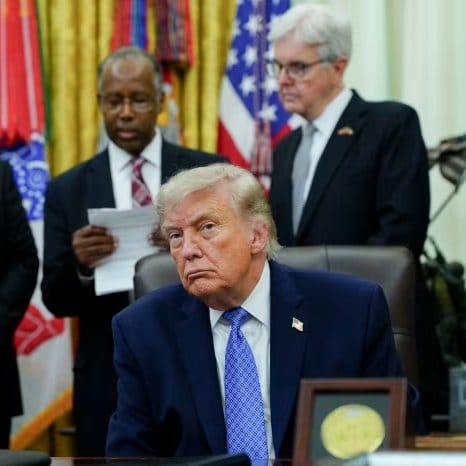
President Donald Trump, speaking to reporters shortly before the strikes were officially announced, described the drone attack as a “foolish violation” of the newly inked June 17 Memorandum of Understanding (MOU) between Washington and Tehran.
“I don’t like the fact that they took a shot yesterday,” Mr. Trump said. “They shouldn’t be doing that. So you’ll find out [our response].”
Vice President JD Vance echoed the administration’s hardline stance, warning Tehran on social media that Washington would not tolerate breaches of the maritime framework. “Iran signed a ceasefire agreement. We have honored it,” Mr. Vance stated. “Violence will be met with violence”.
The response from Tehran was immediate. Hours after the American bombardment, the Islamic Revolutionary Guard Corps (IRGC) Navy announced that it had targeted positions where U.S. forces are stationed across the Middle East.
The IRGC accused Washington of violating its own commitments and using the Ever Lovely incident as a pretext to strike sovereign Iranian territory.
The rapid exchange of fire marks the most severe crisis since a temporary diplomatic breakthrough earlier this month appeared to pull the two nations back from the brink of all-out war. Centcom stated that despite the strikes, U.S. forces would remain positioned in the region to enforce the maritime agreement.
To properly understand this escalation, it helps to look at the broader timeline of events that led up to Friday’s exchange of fire:
The Late February Flare-Up: Tensions originally exploded earlier this year when the U.S. and Israel launched deep airstrikes inside Iran, prompting heavy Iranian retaliation against regional American bases and Israeli targets.
The June 17 Ceasefire Agreement: After months of volatile conflict that effectively shut down commercial traffic through the Strait of Hormuz—sending global fuel and energy prices skyrocketing—diplomats brokered a breakthrough.
The June 17 MOU established a fragile ceasefire framework. Central to the deal was a 60-day window where Iran pledged its “best efforts” to allow international shipping to safely pass through the strait without interference or arbitrary tolls.
The Spillover from Lebanon: The truce was structurally unstable from the start. Over the past week, continued military friction between Israel and Lebanon severely strained the framework.
Citing those violations, Iranian officials explicitly warned last week that they considered the maritime rules void and threatened to shutter the Strait of Hormuz once again.
The geographic chokepoint is arguably the most vital trade corridor in the global economy. At its narrowest point, the shipping lanes are only two miles wide.
Because roughly 20% of the world’s petroleum passes through this tight corridor between Iran and Oman, even minor military frictions instantly trigger economic shockwaves across global energy and supply chains.