


By SCM Correspondent l July 13, 2026
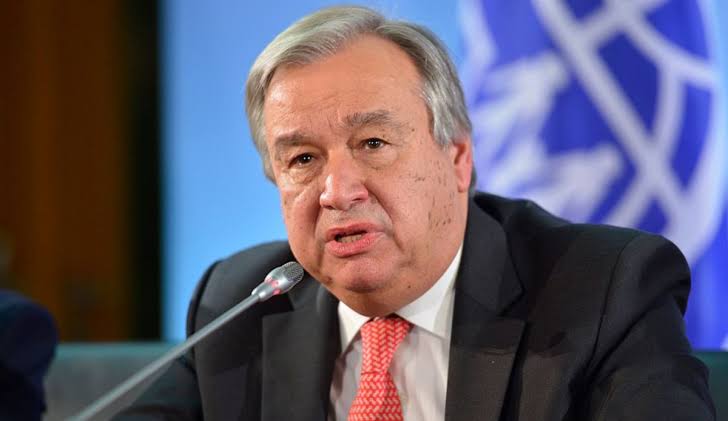
United Nations Secretary-General António Guterres issued a stark, urgent appeal on Monday, warning that the rapidly escalating military conflict between the United States and Iran in the Persian Gulf has brought the region to the precipice of a disastrous war.
In a strongly worded statement, Mr. Guterres implored both Washington and Tehran to halt their military actions immediately, cautioning that the collapse of recent diplomatic efforts could trigger a global economic and humanitarian crisis.
”I am deeply concerned by the serious escalation & renewed military confrontations in the Gulf, including the Iranian attacks on ships in the Strait of Hormuz, the attacks by the US on Iran, and the attacks by Iran on targets in the neighboring countries,” Mr. Guterres said. “These attacks must all stop.”
The Secretary-General’s intervention comes at an extraordinarily volatile moment. A fragile, 60-day interim ceasefire brokered just last month has all but disintegrated after a weekend of intense tit-for-tat military operations.
The renewed fighting has sent shockwaves through international energy markets and once again frozen transit through the Strait of Hormuz—the world’s most critical maritime choke point for oil.
The latest flare-up began over the weekend when Iranian forces targeted and disabled a merchant vessel navigating the Strait of Hormuz, claiming its transit had not been approved.
The United States responded rapidly and aggressively. U.S. Central Command (CENTCOM) launched a massive waves of strikes, hitting approximately 140 targets inside Iran, including drone sites, radar systems, and naval facilities.
In retaliation, Iran fired a barrage of missiles and drones. Rather than confining its response to U.S. naval assets, Tehran widened the geographic scope of the war, hitting targets in neighboring countries where U.S. forces are stationed or that are allied with Washington—including Jordan, the United Arab Emirates, Bahrain, Oman, Qatar, and Kuwait.
The escalation has drawn sharp condemnation from European allies, with France, Germany, and Britain releasing a joint statement denouncing Iran’s “heinous attacks on merchant shipping” and neighboring sovereign nations.
The economic stakes of a full-scale war in the Gulf cannot be overstated. Roughly a fifth of the world’s liquefied natural gas and oil passes through the narrow Strait of Hormuz daily.
Following the weekend’s strikes and President Trump’s subsequent announcement that the U.S. would reinstate a strict naval blockade on Iranian ports, global oil prices surged. Brent crude spiked by more than 3 percent on Monday morning, raising fears of renewed global inflation.
Furthermore, President Trump declared on social media that the U.S. military would take operational control of the waterway, acting as the “Guardian of the Strait of Hormuz” while threatening to levy a 20 percent tariff on all passing cargo to reimburse American military costs.
The declaration was met with confusion and concern by international maritime bodies. Currently, over 6,000 seafarers remain stranded aboard commercial vessels anchored near the conflict zone.
With the region locked in an escalatory spiral, U.N. officials are working behind the scenes to prevent a spark from lighting a wider theater of war. Mr. Guterres stressed that there is no military solution to the deeply rooted geopolitical grievances between the two nations.
”A return to full-scale hostilities would have catastrophic consequences – for the peoples of the region, for international peace & security & for the global economy,” Guterres warned, reiterating that the restoration of full freedom of navigation in the Strait is paramount. “I urge Iran & the U.S. to urgently resume negotiations & to address outstanding issues through diplomacy.”
Whether either side is willing to heed the U.N.’s warning remains highly uncertain. In Tehran, top negotiators have declared that “the era of one-sided deals is over”.
In Washington, the administration’s stance has hardened, signaling that they are prepared to keep the waterway open by force. As military assets continue to deploy to the region, the window for a diplomatic off-ramp is rapidly closing.