


BY OUR SPECIAL CORRESPONDENT
The text message arrived on a battered mobile phone, cold and absolute. Two young girls, stolen from the heart of their community under the cover of a suffocating tropical dusk.
The price for their beating hearts? A staggering ₦20 million—roughly ₦10 million (£5,000) for each life. To the wealthy elite in Nigeria’s bustling capital, it is a sum to be negotiated. To the rural, hard-working families of Ohaofia, it was an impossible fortune. An execution sentence disguised as a receipt.
The kidnappers were identified as a ruthless cell of Kachalla terrorists—hardened, heavily armed bandits who have turned the nation’s vast, unmapped forests into a lucrative industry of human flesh.
They expected the usual routine: agonizing silence, frantic fundraising, and eventually, a tearful drop-off of cash.
They didn’t account for the boys of Ohaofia.
What happened next in this quiet enclave is a story of raw defiance that has largely bypassed the world’s major news tickers, yet it strikes at the absolute center of a conversation a whole nation is now forced to have.
The youths of Ohaofia did not call a committee. They did not wait for the local governor to issue a hollow press release from his heavily guarded mansion. They did not wait for politicians to bicker over logistics, nor did they wait for standard security forces who are all too often stretched to a breaking point across a bleeding country.
Instead, they looked at each other, tightened their boots, gripped whatever weapons they could find, and marched directly into the mouth of the beast.
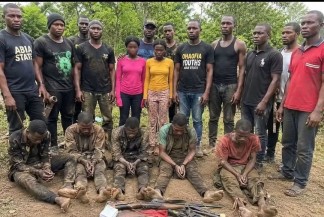
Using tracking skills passed down through generations, a makeshift army of local youths flooded the thick, unforgiving bush.
They knew every ravine, every hidden canopy, and every trick of the terrain. They were outgunned, outmatched by terrorists who survive on brutality, but they possessed a weapon the mercenaries could never understand: an unyielding love for their stolen sisters.
Hours bled into a tense standoff deep within the jungle. Against all statistical odds, the gamble paid off. In a lightning burst of local coordination and sheer bravery, the youths ambushed the camp.
They didn’t just scatter the terrorists—they overpowered them, safely rescuing both girls and apprehending the heavily armed kidnappers on the spot.
The image of the two young girls being walked back into the village square—terrified, exhausted, but miraculously alive and unharmed—sent a shockwave through the community. Women wept; elders bowed their heads in disbelief.
Yet, curiously, this sweeping epic of communal heroism barely made a dent in the national headlines. In a country increasingly desensitized to the daily drumbeat of security failures, a successful rescue by ordinary citizens is often treated as a footnote.
But for the people of Ohaofia, it is a blueprint. They stood up for their own when the system completely vanished.
Now, the dust has settled, but a burning question remains. Is this dangerous, vigilante self-reliance the inevitable future for communities left behind by the state? It is a terrifying, necessary debate.
Letting civilians fight terrorists risks absolute anarchy—but when the alternative is losing your children, the youths of Ohaofia have shown that courage leaves no room for debate.
In recent years, the West African nation has been plagued by an epidemic of mass kidnappings for ransom. Historically concentrated in the northeast by Islamist insurgencies like Boko Haram, the crisis has mutated.
Today, fragmented criminal syndicates—often loosely referred to in northern and central regions as “bandits” or under local leader titles like “Kachalla”—operate heavily armed networks.
However, the naming of “Kachalla terrorists” operating in Ohaofia (a region historically located in southeastern Nigeria’s Abia State) underscores a terrifying new reality: the violent spread of highly organized, nomadic, or opportunistic bandit cells deeper into Southern territories. In these rural enclaves, vast, unpoliced forests become fortresses for criminals.
With statutory security forces stretched thin, response times are often agonizingly slow. This vacuum has given rise to deep civic frustration, pushing communities to an architectural tipping point: choosing between helpless submission or perilous, armed self-defense.
This is based on the story published by GRV on his X