


By SCM International Desk I Friday, Sept 25, 2026
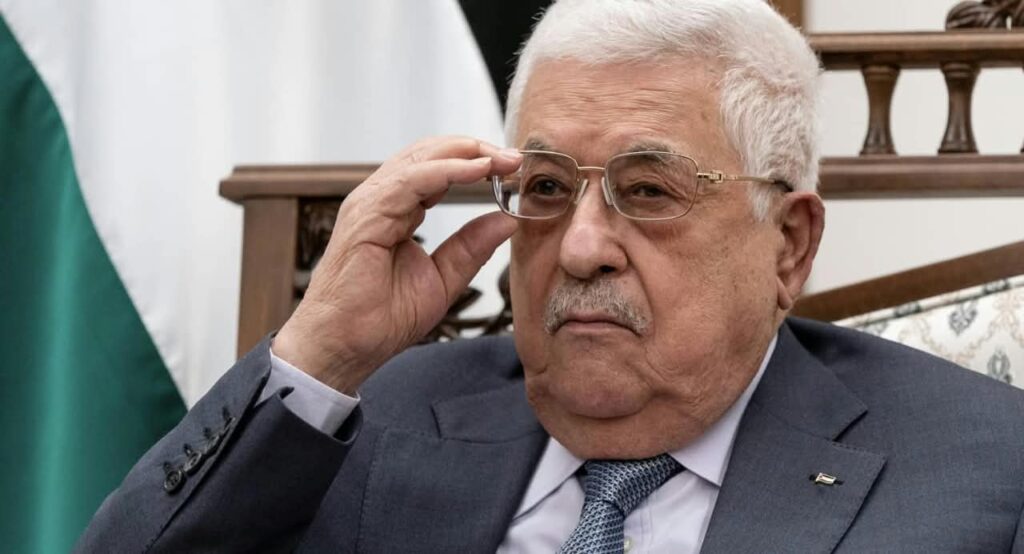
RAMALLAH, West Bank — Delivering a fierce, wide-ranging address to the United Nations General Assembly via video link after being denied a entry visa by the United States for the second consecutive year, Palestinian Authority President Mahmoud Abbas forcefully rejected Israeli control over the fate of his people, declaring that Israel has “no right to decide for us” and warning that long-term regional peace remains impossible under conditions of military rule.
Speaking from his presidential compound in Ramallah, the 90-year-old leader offered an uncompromising critique of Israeli military actions in Gaza and expanding settlement policy in the West Bank. He framed the current geopolitical crisis not merely as a dispute over borders, but as a fundamental threat to Palestinian existence.
”They have no right to decide for us,” Mr. Abbas said during the 22-minute address broadcast to world leaders gathered at UN Headquarters in New York. “We won’t remain in waiting, nor will we accept whatever the governments of the Israeli occupying state decide for us. No lasting security can be built upon the occupation of another people and the denial of their legitimate rights.”
A Crisis Point for the Two-State Solution
Mr. Abbas warned that Israeli settlement expansion, land seizures, and military operations had moved beyond simply damaging the framework of a sovereign Palestinian state—they were actively imperiling the population itself.
”The danger is no longer limited to undermining the two-state solution and preventing the realization of the Palestinian state,” Mr. Abbas said. “It has now come to threaten the very life and existence of the Palestinian people on their homeland.”
The address comes at an acutely sensitive moment for Palestinian leadership. The Palestinian Authority (PA), established under the Oslo Accords in the 1990s to administer limited self-rule in parts of the West Bank, has seen its political leverage dramatically eroded.
The ongoing conflict in Gaza following the October 7, 2023 attacks, combined with rampant settlement growth across the West Bank, has left the PA increasingly sidelined in international negotiations over post-war governance.
In his speech, Mr. Abbas asserted that the PA had fulfilled all international commitments, including carrying out internal administrative reforms and maintaining adherence to a peaceful path toward statehood alongside Israel. He strongly rejected displacement proposals, assuring Palestinians that “we will not leave our homeland”.
The address highlighted lingering diplomatic friction between the Palestinian leadership and Washington. Mr. Abbas lambasted the U.S. State Department’s decision to withhold visas for the Palestinian delegation, calling the travel restrictions “unlawful punitive measures”.
The U.S. administration defended the visa denial, citing the Palestinian leadership’s ongoing efforts to prosecute claims against Israel at international bodies like the International Criminal Court (ICC) and the International Court of Justice (ICJ). Mr. Abbas, however, defended those efforts, characterising recourse to international tribunals as a “peaceful choice” grounded in international law.
Despite those obstacles, Mr. Abbas pointed to growing diplomatic support elsewhere, noting that over 160 nations now formally recognize the State of Palestine.
He urged remaining nations—particularly in Western Europe—to follow suit and called on the UN Security Council to enforce existing resolutions restricting settlement activity.
First elected in 2005 to what was intended as a four-year presidential term, Mr. Abbas has led the PA through two decades marked by diplomatic stagnation, deep internal divisions, and escalating Israeli settlement activity.
Parliamentary elections have not been held since 2006, when Hamas won a legislative majority before violently taking control of the Gaza Strip in 2007, dividing Palestinian governance between Gaza and Ramallah.
During his address, Mr. Abbas signaled a desire to reset domestic legitimacy, reiterating plans to hold long-overdue national legislative and presidential elections. However, similar pledges in the past have repeatedly faltered over logistical disputes with Israel regarding voting access in East Jerusalem, as well as political friction with Hamas.
As world leaders debated regional security in New York, Mr. Abbas’s remarks served as a stern reminder from Ramallah: while international powers attempt to map out transition plans for the Middle East, any arrangement that bypasses Palestinian self-determination will lack stability and legitimacy.