


By SCM International Desk I Friday, August 07, 2026
MECCA, Saudi Arabia — In a major realignment of regional security, Saudi Arabia, Turkey, and Pakistan signed a comprehensive mutual defense treaty on Friday, pledging collective deterrence against external aggression at a time of severe volatility across the Middle East.
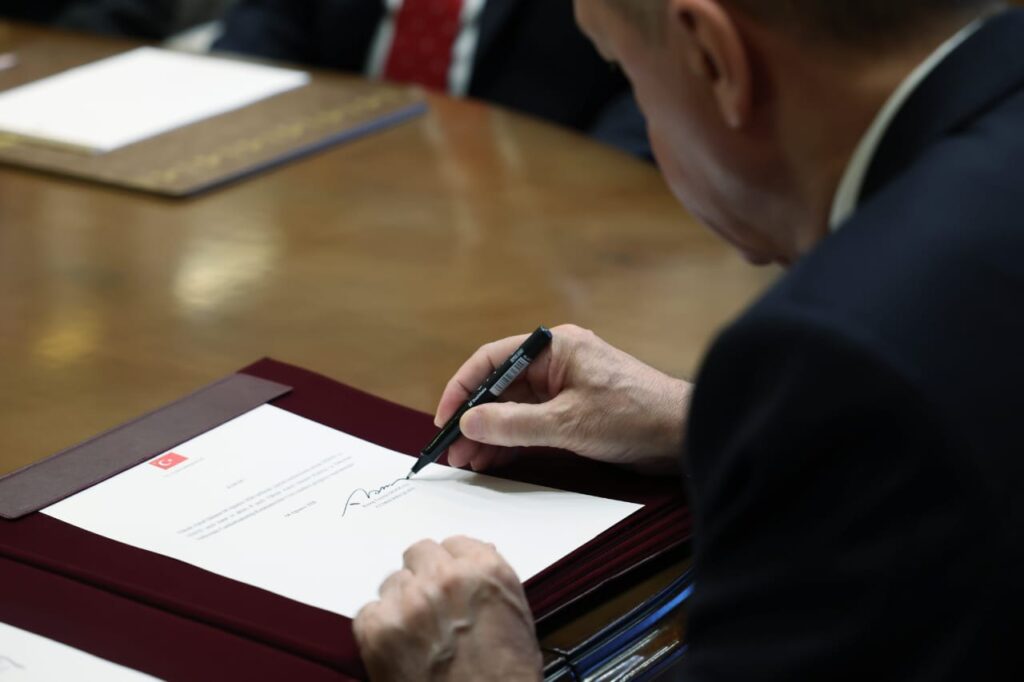
The agreement, officially designated as the Mecca Joint Defense Agreement, was finalized during a high-level summit at the Al-Safa Palace overlooking the Grand Mosque. The pact was signed by Saudi Crown Prince Mohammed bin Salman, Turkish President Recep Tayyip Erdoğan, and Pakistani Prime Minister Shehbaz Sharif. Pakistan’s powerful military chief, Field Marshal Asim Munir, was also present for the proceedings.
According to official statements issued simultaneously by Riyadh, Ankara, and Islamabad, the accord binds the three major Muslim-majority nations into a shared security architecture. Most notably, the pact includes a collective defense clause stipulating that “an armed attack against any one of the three states shall be regarded as an attack against them all”.
”The agreement reflects our shared commitment to reinforcing our collective security, building on longstanding historical ties, common strategic interests, and Islamic solidarity,” Turkey’s Communications Directorate said in a statement released after the ceremony.
While a Turkish official emphasized that the treaty was “purely defensive in nature” and not directed at any specific state or non-state actor, diplomats and regional analysts viewed the summit as a direct response to cascading regional security crises.
The signing comes against the backdrop of heightened tensions stemming from the broader US-Israeli military confrontation with Iran, which has spilled into the Gulf and disrupted critical shipping lanes through the Strait of Hormuz and the Red Sea. Simultaneously, Saudi Arabia has faced renewed cross-border threats from Iranian-backed Houthi forces in Yemen, who have launched drone and missile attacks against energy installations and commercial vessels.
By bringing Turkey—a NATO member with a rapidly growing domestic defense industry—and Pakistan—the world’s only nuclear-armed Muslim nation—into a formal triad with Saudi Arabia, the alliance creates a formidable security block. The partnership effectively marries Saudi Arabia’s immense capital capabilities with Ankara’s advanced military technology and Islamabad’s vast manpower and nuclear umbrella.
”This is a major structural shift,” said Burcu Ozcelik, a senior fellow at the Royal United Services Institute (RUSI) in London. “It fits a broader trend toward regional burden-sharing, allowing these powers to insulate themselves against external shocks while creating a local mechanism to maintain stability.”
Deep Background & Geopolitical Context
1. Escalating Regional Drivers
The Mecca summit represents the culmination of nearly a year of discreet tripartite talks. Saudi Arabia has sought to broaden its security guarantees beyond traditional reliance on Washington, especially as regional proxy warfare has intensified. Last September, Riyadh signed a bilateral defense deal with Islamabad, which led to the deployment of Pakistani air defense systems and fighter squadrons to Saudi airbases. Incorporating Turkey expands this bilateral foundation into a broader multi-domain alliance.
2. Marrying Defense Capabilities
Turkey: Provides high-tech hardware, including Bayraktar combat drones, naval assets, and electronic warfare systems, alongside tactical experience from a NATO force.
Pakistan: Offers a standing military force of over 600,000 active troops, deep intelligence cooperation, and a nuclear deterrence posture that adds significant strategic weight to the coalition.
Saudi Arabia: Provides financial backing, joint procurement funding, and strategic depth across the Arabian Peninsula.
3. Implications for the Broader Middle East
The agreement introduces a new dynamic into the Middle Eastern security landscape. For Iran and its regional network, the treaty signals that aggression against Gulf energy networks or red lines could trigger responses involving Turkish and Pakistani assets. For Western allies, including the United States, the pact demonstrates a shift toward self-reliant regional coalitions capable of managing local security without direct Western intervention.
The signatories indicated that the Mecca Joint Defense Agreement remains open to other regional states seeking to join, raising the prospect of a expanding defense alliance across the Middle East and South Asia.