


By Emmanuel Thomas
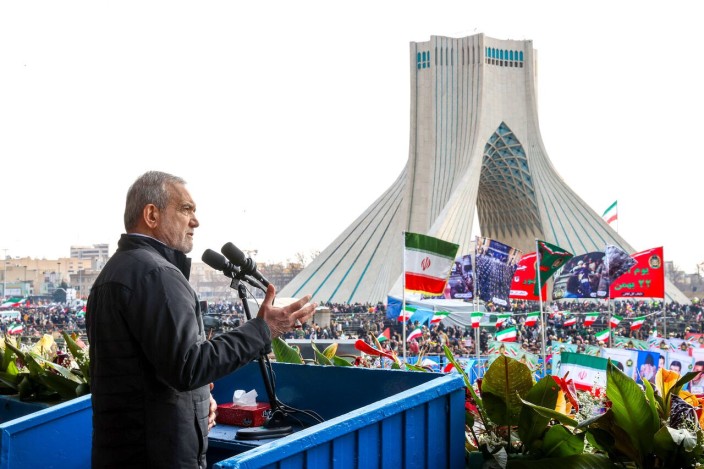
TEHRAN — Addressing a massive crowd at Azadi Square on Wednesday, President Masoud Pezeshkian struck a delicate balance between defiance and diplomacy, declaring that while Iran is ready to negotiate its nuclear program, it will never surrender its fundamental national rights.
The speech, delivered to mark the 47th anniversary of the Islamic Revolution, comes at a high-stakes moment for the Islamic Republic.
With indirect talks with the United States recently resuming in Oman, Pezeshkian used the national stage to outline Tehran’s terms for a “fair and balanced” deal.
President Pezeshkian emphasized that the path to a successful nuclear agreement is currently blocked by a “high wall of distrust” built by Western powers.
He directed his remarks toward Washington, asserting that progress is only possible if the West abandons what he termed “excessive demands.”
”Our Iran will not yield in the face of aggression,” Pezeshkian told the chanting crowd.
“We are treading the path of diplomacy with sincerity, but we will not give in to coercion.”
Key Highlights of the Speech
The President’s address touched on several critical pillars of Iran’s current foreign and domestic policy:
Nuclear Verification: Reaffirming that Iran does not seek nuclear weapons, Pezeshkian stated the country is “ready for any verification” to prove the peaceful nature of its program.
Regional Autonomy: He argued that Middle Eastern problems should be solved by regional countries alone, explicitly rejecting the intervention of “foreign states.”
National Unity: Amid recent internal unrest and economic pressure, the President called for domestic solidarity, describing internal unity as the nation’s strongest defense against “imperial conspiracies.”
Economic Ambition: He highlighted the need for Iran to gain greater access to international markets, specifically aiming to strengthen ties with neighboring Muslim nations to bypass Western-led sanctions.
The anniversary celebrations took place under a shadow of renewed regional tension. In his speech, Pezeshkian acknowledged the “great sorrow” of recent domestic protests, even offering a rare apology to those affected by the state’s crackdown, while simultaneously blaming “Western propaganda” for fueling the unrest.
The geopolitical climate remains volatile.
As Pezeshkian spoke, U.S. President Donald Trump has reportedly increased the American military presence in the region, including the deployment of aircraft carrier groups. Despite this “maximum pressure,” Pezeshkian insisted that Iran’s missile program remains a “red line” and is not up for negotiation.
The President concluded by inviting the international community to engage in “dignified dialogue” based on mutual respect.
He maintained that while Iran is prepared for peace, the responsibility for the success of nuclear talks now lies with the United States and its willingness to respect Iran’s sovereignty under the Non-Proliferation Treaty (NPT).
Signaling Strength from a Position of Pressure
President Masoud Pezeshkian’s address at the 47th anniversary of the Islamic Revolution was more than a commemorative speech; it was a carefully calibrated opening gambit for the high-stakes nuclear negotiations set to resume in Muscat.
As the “Muscat II” round approaches, Pezeshkian’s rhetoric offers a roadmap for Iran’s diplomatic strategy, which appears to be focused on leveraging regional stability against Western military and economic pressure.
1. The “Red Line” Strategy: Setting the Scope
By explicitly mentioning the “Non-Proliferation Treaty (NPT)” and the “right to enrichment,” Pezeshkian is signaling that Iran will fight to keep the talks narrow.
The Clash: While U.S. President Donald Trump and Secretary of State Marco Rubio have expressed a desire for a “comprehensive” deal that includes ballistic missiles and human rights, Pezeshkian is reinforcing the Iranian “red line.”
The Impact: Expect the Muscat talks to begin with a procedural deadlock. Iran will likely refuse to discuss anything beyond technical nuclear caps and sanctions relief, using Pezeshkian’s public “mandate” from the rally as justification for their rigidity.
2. Verification as a Bargaining Chip
One of the most significant pivots in the speech was the President’s stated readiness for “any verification” to prove the program is peaceful.
The Play: This is a direct appeal to the International Atomic Energy Agency (IAEA) and European observers. By offering transparency on their own terms, Tehran is trying to split the Western coalition—portraying itself as the “reasonable” actor against “excessive” American demands.
The Risk: If Iran allows snap inspections in exchange for immediate, partial sanctions relief, it could create a “freeze-for-freeze” momentum that delays the threat of U.S. military action.
3. Internal Unity vs. External Pressure
The President’s emphasis on “internal unity” and his rare acknowledgment of domestic “unrest” suggests that the Iranian leadership is acutely aware of its economic vulnerability.
Economic Desperation: The drive to access “international markets” is not just a goal; it’s a survival mechanism. Pezeshkian needs a win in Muscat to stabilize the Rial and quiet domestic dissent.
Negotiating Hand: The West will likely interpret his call for unity as a sign of weakness.
However, Pezeshkian is using it to warn that “coercion” will only make the Iranian public rally around the flag, potentially making it harder for the U.S. to use its “maximum pressure” tactics effectively.
The Verdict: A Narrow Window for a “Win-Win”
Pezeshkian’s “win-win” framing suggests that Iran is ready to make technical concessions on its uranium stockpile (potentially addressing the 440kg of 60% enriched material) provided the U.S. acknowledges Iran’s “dignity” and lifts core banking sanctions.
However, with the U.S. military presence in the region at its highest in years, the Muscat talks are less about finding a permanent solution and more about buying time.
Pezeshkian’s speech was designed to ensure that if the talks fail, the blame—in the eyes of the Global South and regional neighbors—falls squarely on Washington’s “excessive demands.”