


By Emmanuel Thomas l Monday, Oct. 12, 2026
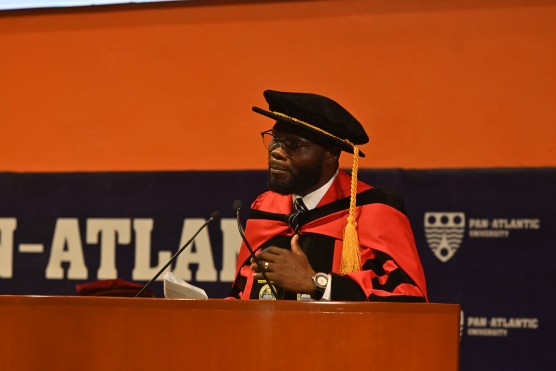
LAGOS, NIGERIA — Pan-Atlantic University (PAU) recently hosted its 26th Inaugural Lecture, delivered by Professor Ekundayo Peter Mesagan, Professor of Energy and Environmental Economics at the School of Management and Social Sciences (SMSS). The event took place at the Honeywell Group Auditorium, Lagos Business School.
Formally introducing the inaugural lecturer, PAU Vice-Chancellor Professor Enase Okonedo described Professor Mesagan as “an economist, researcher, and policy advisor whose work spans energy and environmental economics, industrial policy, natural resources, and sustainable economic development.”
She highlighted his key contributions to national development, including his service on the drafting committee for Nigeria’s Agenda 2050 under the Federal Ministry of Budget and Economic Planning, as well as his work with the Nigerian Economic Summit Group (NESG) and the Nigerian Institute of Social and Economic Research (NISER).
“Through his research, teaching, and engagement with policy and industry, Professor Mesagan continues to contribute significantly to the understanding of critical economic and environmental issues shaping Nigeria and the wider African continent,” Professor Okonedo said.
Delivering the lecture titled “Making Lemonade from Lemons: The Fossil Energy & Sustainability Puzzle,” Professor Mesagan examined the tension between the global push for environmental sustainability and the developmental realities of oil-rich, energy-deficient nations.
He framed the discussion around a fundamental dilemma: “In recent decades, the global argument for environmental sustainability has been that we should deemphasise fossil energy while scaling up lower-carbon alternatives. Is this realistic? What becomes of oil-rich developing nations? Should they shut down operations, or seek alternative revenue sources to fund their development?”
Professor Mesagan argued that the energy transition is far more complex than simply swapping fossil fuels for renewables, noting that technological and cost constraints mean fossil energy will remain a part of the global energy mix for the foreseeable future. He stressed that Africa’s pathway cannot merely mirror Europe’s, as expanding energy access and driving economic growth must remain urgent priorities alongside climate goals.
Furthermore, Professor Mesagan emphasized that natural resource endowments alone do not dictate a nation’s destiny; rather, outcomes hinge on governance quality, policy choices, innovation, and strategic investment.
“The future belongs to countries that can transform challenges into opportunities,” he noted, reinforcing the central metaphor of his lecture.
He underscored the vital role of technology—including cleaner industrial processes and carbon capture and storage—alongside financial systems aligned with sustainability priorities. Concluding his address, Professor Mesagan asserted that energy transition cannot be decoupled from poverty alleviation and expanded energy access, calling for genuine collaboration among economists, engineers, policymakers, and environmental scientists to achieve lasting progress.
The lecture attracted University principal officers, Senate members, faculty, students, alumni, industry leaders, policymakers, and members of the general public.