


oooBy Iyiola Oludotun
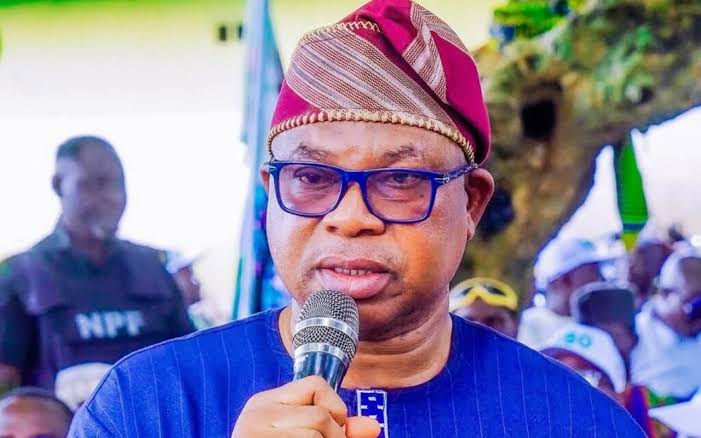
IBADAN, Oyo- As the pendulum of politics swings towards the August 15, 2026, governorship election in Osun State, the political atmosphere is charged with intense calculations. At the center of this gathering storm is Asiwaju Munirudeen Bola Oyebamiji, popularly known as AMBO.
If Oyebamiji wins the August 15, 2026 election, it will not just be a change of tenant in the Bola Ige House; it will be a foundational reset of the direction of Osun State. It will mark the transition from a populist, emotive model of governance to a calculative, system-driven, and technocratic administration. While this promises institutional growth, fiscal sustainability, and greater federal synergy, its success will ultimately depend on human factors
A seasoned banker, the immediate past Managing Director of the National Inland Waterways Authority (NIWA), and a former Osun Commissioner for Finance, Oyebamji represents the
All Progressives Congress (APC) vanguard attempting to reclaim the state from the incumbent Peoples Democratic Party (PDP)/Accord Party administration of Governor Ademola Nurudeen Jackson Adeleke.
Analyzing the potential trajectory of an AMBO victory requires moving past superficial partisan celebrations. No doubt about it, an AMBO victory would trigger structural shifts in governance ideology, alter internal power alignments, reset state-civil service dynamics, and redefine Osun’s economic template.
The most immediate casualty or beneficiary – depending on one’s perspective – of an AMBO victory would be the governance style of the state. An AMBO governorship would pivot the state sharply towards a core technocratic model. Given his background as a veteran of the banking sector and his previous management of the state’s treasury under both Rauf Aregbesola and Gboyega Oyetola, AMBO’s victory would introduce an era of institutional
discipline and fiscal conservatism.
This would mean an emphasis on expanding Internal Generated Revenue (IGR) through structural reforms rather than aggressive direct taxation, maximizing efficiency in capital
expenditure, and prioritizing state-backed investment portfolios over short-term political handouts. For the average citizen, the immediate atmosphere would shift from the celebratory, accessible ambiance of the current dispensation to a corporate, systemic and
perhaps more rigid bureaucratic environment.
In Osun State, the civil service is not just an arm of government; it is the economic engine of the state. Because Osun is largely an agrarian and public-sector-driven economy, how a governor handles civil servants determines the stability of his tenure. AMBO, having served as Finance Commissioner during the state’s turbulent fiscal years, carries both institutional memory and inherited political baggage.
If he wins, his primary challenge will be managing the expectations and anxieties of the state workforce. However, his deep familiarity with the structural design of the Osun civil service could also act as an advantage. He is uniquely positioned to implement institutional reforms without triggering immediate industrial friction, provided he leverages his financial expertise to
guarantee timely promotions, wage adjustments and pension settlements.
An AMBO victory would likely usher in a highly organized, merit-driven civil service re-engineering process, moving away from patronage towards performance metrics. An election is a struggle for space among various segments of the elite. Oyebamiji’s
emergence as a major contender has already catalyzed unexpected alliances, as seen in his recent high-profile consultations with political stakeholders across party lines, including
former Governor Olagunsoye Oyinlola.
An APC victory led by AMBO would signify the return of the progressive political elite to the seats of power in Osogbo. It would inevitably realign local power balances within the
three senatorial districts, particularly bolstering the influence of Osun West, AMBO’s home zone originating from Ikire in Irewole Local Government Area.
Furthermore, AMBO’s deep-rooted alignment with the centre – exemplified by the open backing of President Bola Ahmed Tinubu’s administration – means that his victory would seamlessly integrate Osun State into the federal grid of political patronage. This federal
alignment would likely translate to increased collaboration in marine, blue economy, and inland waterway infrastructural investments, areas where AMBO has built direct national
expertise.
One of the most defining features of contemporary Osun politics is its vibrant, hyper-aware youth demographic. AMBO’s entry into the arena shifts the conversation from cultural
resonance to economic capacity. His campaign has deliberately engaged youth groups, tasking them with voter mobilization and promising structural inclusion.
If Oyebamiji wins, the contract between the government and the youth will be rewritten. Instead of focusing on entertainment and immediate political appointments, the expectation
will shift towards technological empowerment, digital economy integration, standardized agricultural value-chain creation for young agropreneurs, and formal employment pipelines
driven by public-private partnerships. The critical question will be whether a highly technocratic administration can maintain the enthusiasm of a youthful populace that has grown accustomed to a highly visible, emotionally engaging style of leadership. If AMBO
fails to match his institutional policies with clear, empathetic communication, he risks facing a detached or disillusioned youth base.
Osun has historically been one of the safest states in Nigeria, but recent spikes in localized cult clashes, land disputes, and the overarching threat of regional banditry mean that security
will remain a core index in 2026. AMBO’s banking and corporate background hints at a reliance on data-driven, heavily monitored security architectures.
A victory for him would likely mean increased investments in localized surveillance, institutionalized support for the Amotekun Corps, and tighter synergy with federal security agencies. By viewing security through the lens of economic risk management, his administration would treat regional peace as a non-negotiable prerequisite for attracting the private capital needed to develop the state.
If Oyebamiji wins the August 15, 2026 election, it will not just be a change of tenant in the Bola Ige House; it will be a foundational reset of the direction of Osun State. It will mark the transition from a populist, emotive model of governance to a calculative, system-driven, and technocratic administration. While this promises institutional growth, fiscal sustainability, and greater federal synergy, its success will ultimately depend on human factors.
To govern Osun successfully, AMBO must temper his corporate efficiency with an understanding of the deeply emotional, community-oriented nature of the good people of
Osun.
If he can bridge the gap between financial spreadsheets and the lived realities of the ordinary citizen on the streets of Osogbo, Ilesa, Ile-Ife, and Iwo, his victory could provide the template for a modern, self-sustaining subnational state.
●Oludotun lives in Ibadan, Oyo State.