By SCM Foreign Desk
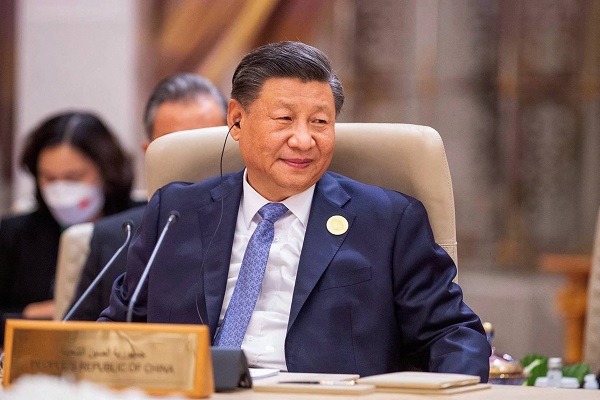
BEIJING has snubbed international calls to join a new nuclear arms treaty—just hours after the final peace pact between the US and Russia went up in smoke.
Chinese officials today confirmed they have no intention of sitting at the negotiating table “at this stage,” sparking fears of a terrifying new global arms race.
The defiant move comes as the New START treaty—the last remaining agreement limiting the world’s two biggest nuclear arsenals—officially expired on February 5, 2026.
Speaking from Beijing, Foreign Ministry spokesman Lin Jian insisted China’s stockpile is “not on the same level” as the massive arsenals held by Washington and Moscow.
”China will not participate in nuclear disarmament negotiations at this stage,” Lin told reporters, adding that the country maintains its nukes at the “minimum level needed for national security.”
The snub is a massive blow to President Donald Trump, who has repeatedly insisted that any future nuclear deal must include the Red Dragon to be effective.
Global Risk
United Nations chief Antonio Guterres warned the world is entering a “grave moment,” with no binding limits on strategic nukes for the first time in over 50 years.
Experts fear that without a deal, the “Big Three” powers will now be free to build and deploy as many warheads as they like.
While Russia and the US still hold the lion’s share of the world’s atomic weapons, China’s arsenal has been growing at a lightning pace, with reports suggesting they now possess over 600 warheads.
US Secretary of State Marco Rubio hit back, stating it is “impossible” to have true arms control in the 21st century without Beijing.
But China remains unmoved, calling on Washington to instead fix its broken relationship with Russia and resume “strategic stability” talks with the Kremlin.

As the old treaty hits the scrapheap, the world is left watching and waiting to see who will blink first in this high-stakes nuclear standoff.
The New Strategic Arms Reduction Treaty (New START) was first signed in 2010 by Barack Obama and Dmitry Medvedev.
It limited both the US and Russia to 1,550 deployed strategic warheads and 700 deployed missiles and bombers.
The 2026 Crisis: After a five-year extension in 2021, the treaty officially hit its legal limit today.
Russia had previously “suspended” its participation in 2023 following the invasion of Ukraine, but the final expiration marks the total legal collapse of the framework.
The China Factor: Historically, China was a minor nuclear player.
However, recent satellite imagery and intelligence reports show Beijing is rapidly building hundreds of new silos.
Washington argues that a bilateral deal (US-Russia) is now obsolete because it ignores China’s rising threat.
The Trump Stance: President Trump has consistently pushed for a “trilateral” (three-way) agreement. China argues this is unfair because the US and Russia still possess roughly 90% of the world’s nukes, making Beijing’s “minimal” arsenal a different category of concern.