
Projects N23.9tn Deficit as Debt Service Costs Mount
By SCM Business Team
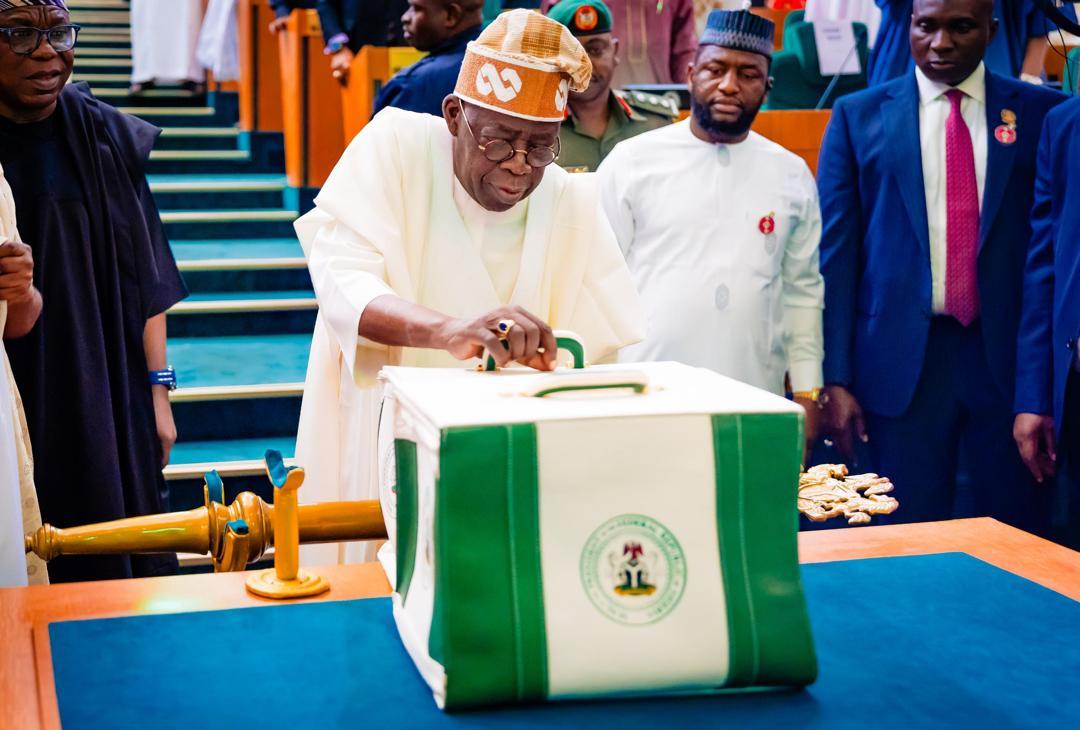
ABUJA — President Bola Tinubu on Friday presented a N58.18tn ($41.5bn) federal budget for 2026 to the National Assembly, framing the ambitious spending plan as a pivot toward “national renewal” despite a widening fiscal deficit and significant debt pressures.
The 2026 “Budget of Realism” represents a significant increase in nominal spending, as the administration seeks to navigate a complex macroeconomic landscape marked by currency volatility and high inflation.
The proposal is underpinned by a N34.33tn revenue target, leaving a projected fiscal deficit of N23.85tn—roughly 4.28% of Nigeria’s GDP.
In his address, President Tinubu emphasized that the budget is anchored on the 2026–2028 Medium-Term Expenditure Framework (MTEF), utilizing what he described as “conservative” benchmarks to insulate the economy from global shocks.
The fiscal plan assumes:
Oil Price: $64.85 per barrel.
Oil Production: 1.84 million barrels per day (mbpd). Exchange Rate: N1,400 to the US Dollar.
While the production target of 1.84 mbpd is optimistic given recent years of technical challenges and oil theft in the Niger Delta, the administration insists these figures are necessary to drive the “Renewed Hope” agenda.
Debt and Defense
A stark feature of the proposal is the N15.52tn earmarked for debt servicing, nearly 27% of the total expenditure.
This underscores the tightening fiscal noose facing Africa’s largest economy as it balances international obligations with domestic needs.
To counter internal security threats that have long hampered agricultural output and foreign investment, Defence and Security received the largest sectoral allocation at N5.41tn.
”These numbers are not mere accounting lines,” Tinubu told lawmakers.
“They are a statement of national priorities. Without security, investment will not thrive. Without infrastructure, jobs and enterprises will not scale.”
Strategic Allocations
The budget prioritizes capital development, with N26.08tn allocated to infrastructure and growth-linked projects—surpassing recurrent non-debt expenditure of N15.25tn. Key social pillars also received significant tranches:
Infrastructure: N3.56tn
Education: N3.52tn
Health: N2.48tn
Analysts note that the N1,400/$ exchange rate benchmark suggests the government expects a period of relative currency stabilization after the heavy devaluations seen in 2024 and 2025.
However, the 4.28% deficit-to-GDP ratio may raise eyebrows among fiscal hawks, as it exceeds the 3% threshold typically mandated by Nigeria’s Fiscal Responsibility Act, though the law allows for exceptions in times of national transition or insecurity.
President Tinubu concluded by pledging a crackdown on fiscal leakages, promising that “every naira borrowed or spent” would deliver measurable value to a population weary of rising costs of living.
A High-Stakes Bet on Stability Amid Fiscal Fragility
Nigeria’s 2026 budget proposal represents a bold attempt by the Tinubu administration to solidify its “Renewed Hope” agenda, but the underlying figures reveal an economy walking a precarious fiscal tightrope.
At N58.18tn, the expenditure target is a significant leap from the 2025 “Budget of Restoration” (initially proposed at N47.9tn – N49.7tn). However, the administration’s most significant challenge remains a persistent “credibility gap” between revenue projections and actual receipts.
1. The Revenue Reality Check
The N34.33tn revenue target for 2026 is ambitious, especially considering the performance of the 2025 budget. As of Q3 2025, the Federal Government had realized only N18.6tn in revenue—roughly 61% of its target.
The Overlap Issue: The admission that 2024 capital projects were still being funded as late as mid-2025 suggests a “budgetary pile-up.”
The Revenue Miss: In previous cycles, Nigeria has struggled to hit even 40% of its total revenue targets, leading to a heavy reliance on the very debt the President now seeks to manage.
2. Debt: The N15.5tn Elephant in the Room
Debt servicing remains the single largest constraint on Nigeria’s development.
The N15.52tn allocation for debt service is nearly equivalent to the entire recurrent non-debt expenditure (N15.25tn).
Deficit Concerns: The N23.85tn deficit is roughly 118% higher than the deficit levels seen in 2022.
Borrowing Mix: While the government aims for an 80:20 domestic-to-external borrowing split to minimize currency risk, this strategy threatens to “crowd out” the private sector from local credit markets, potentially stifling the job-rich growth the budget aims to promote.
3. Benchmarks: Realism vs. Optimism
The budget’s reliance on a 1.84 mbpd oil production target is a high-stakes gamble.
While security spending of N5.41tn is intended to protect oil infrastructure, Nigeria has consistently fallen short of the 1.8 mbpd mark due to technical aging and persistent theft.
Exchange Rate: The N1,400/$ peg reflects a belief in the long-term stabilization of the Naira, which saw its official rate hover around N1,500+ for much of 2025.
Inflationary Winds: With inflation moderating to 14.45% in November 2025, the administration is betting that its “conservative” benchmarks will keep the economy on a disinflationary path toward single digits by mid-2026.
4. Sectoral Shifts
The allocation of N26.08tn to capital expenditure is a signal to investors that the government is prioritizing long-term growth over short-term consumption.
By tying security, infrastructure, and health together, the administration is attempting to create a “virtuous cycle” of productivity.
However, with only 17.7% of the 2025 capital budget released as of Q3 2025, the true test will not be the allocation on paper, but the cash backed by the Treasury.