


By Our Reporter
PORT HARCOURT — The Niger Delta Development Commission (NDDC) has restated its unwavering commitment to human capacity development, flagging off an intensive training initiative aimed at equipping the personnel of its Directorate of Project Monitoring and Supervision (PMS) with modern skills and technical knowledge required for effective service delivery across the region.
The intervention comes as part of the interventionist agency’s broader strategy to eliminate project abandonment, check contractor sharp practices, and ensure that infrastructural developments in the Niger Delta meet global quality standards.
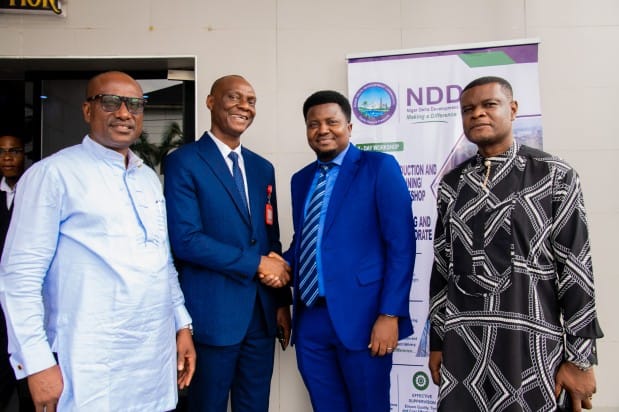
Speaking at a two-day specialized workshop organized for the staff of the directorate, the Director of Project Monitoring and Supervision, Engr. Gbenga Omowanle, described the session as a critical refresher course and induction programme designed to synchronize the operations of both veteran and newly deployed personnel.
According to Omowanle, the training was meticulously structured to acquaint participants with the fundamental principles of PMS operations, as well as the contemporary monitoring procedures authorized by the Commission’s leadership.
Engr. Omowanle emphasized that for the NDDC to achieve its core mandate of sustainable regional development, every staff member within the PMS Directorate must master a standardized, step-by-step approach to project oversight. He maintained that the training would significantly strengthen the pillars of integrity, professionalism, and strict confidentiality expected of field officers during execution of their duties.
The Director explicitly extended his appreciation to the Managing Director and Chief Executive Officer of the NDDC, Dr. Samuel Ogbuku, praising his forward-thinking leadership and for approving the workshop, which was themed: “Building Competence for Effective Project Oversight and Development Outcomes.”
Corroborating these views, the Lead Consultant for the training programme, Mr. Dagogo Tolofari, reminded the participants that the PMS staff serve as the eyes and ears of the Commission regarding infrastructural development.
He noted that in an era of rapid technological advancement, engineers tasked with field supervision must be constantly updated with modern tools and the technical know-how necessary for high-quality monitoring.
Tolofari further remarked that the workshop was uniquely packaged to expose participants to stark field realities, including some of the subtle maneuvering and strategies commonly deployed by regular contractors to bypass specifications.
“This training is designed to match those challenges by arming our staff with contemporary monitoring techniques, ensuring that the structural integrity and quality of all NDDC projects are never compromised,” Tolofari stated.
The Battle Against Unethical Conduct
A major highlight of the technical sessions was a lecture titled “Ethical Issues in Supervision,” delivered by renowned resource person, Dr. Dada Joseph. Identifying unethical conduct as one of the most stubborn bottlenecks militating against successful project delivery in Nigeria, Dr. Joseph called on the PMS personnel to act as bulwarks of transparency.
”Corruption exists everywhere in the world, but for us as a developing country, it remains a serious challenge,” Dr. Joseph lamented. “As staff of the PMS Directorate, your job is simple but sacred: document exactly what you observe in the field and submit your findings appropriately. Do not compromise.”
He warned the supervisors to expect inducements and pressure from compromised contractors but urged them to remain resolute. “Contractors may attempt to influence you, but once you understand that your first loyalty is to the NDDC and the people of the Niger Delta, you will always do the right thing,” he counselled.
Digital Transition: Enter the PMIS
Resource optimization and technological adoption also took center stage during the feedback sessions. One of the participants, Engr. Akpekpe Jairus, expressed optimism that the training would radically transform field operations.
He disclosed that prior to the current reforms, PMS staff stationed at various state offices frequently endured the logistical nightmare of travelling all the way to the Commission’s headquarters in Port Harcourt just to access basic project files and information.
However, Engr. Jairus revealed that with the recent deployment of the Project Monitoring Information System (PMIS), a cloud-based tracking infrastructure, supervisors can now access technical data, input field reports, and track project milestones in real-time from any location across the country.
Industry observers believe that this renewed focus on internal capacity building and digital tracking under the Dr. Samuel Ogbuku-led administration signals a departure from past administrative lapses, positioning the NDDC to deliver value for money on its regional mandates.