


By Our Special Correspondent in Atlanta
ABSOLUTE, unadulterated madness in Atlanta. For seventy-eight agonizing minutes, the soccer world was preparing to write the final, tragic obituary of Lionel Messi’s international career. The script wasn’t just torn up; it was set on fire and scattered across the pitch of the Mercedes-Benz Stadium.
Yet, when the dust settled on a sweltering Georgia evening, the defending world champions had somehow pulled off a heist for the ages, escaping a majestic, heroic Egyptian side with a 3-2 victory that will be talked about as long as the game is played.
This Round of 16 clash was billed as a showdown between the traditional heavyweights of South America and the Pharaohs’ vanguard led by Mohamed Salah. What transpired was a relentless, five-goal rollercoaster.
Egypt, playing with the fearless tactical freedom of men who had nothing to lose and a continent to carry, left La Albiceleste completely shell-shocked.
The nightmare began after just fifteen minutes for Lionel Scaloni’s men. Egypt’s Marwan Attia delivered a beautifully judged, deep cross to the back post, finding Yasser Ibrahim. The central defender rose with immense power, completely outjumping the Argentine backline to hammer a ferocious header past a helpless Emiliano Martínez.
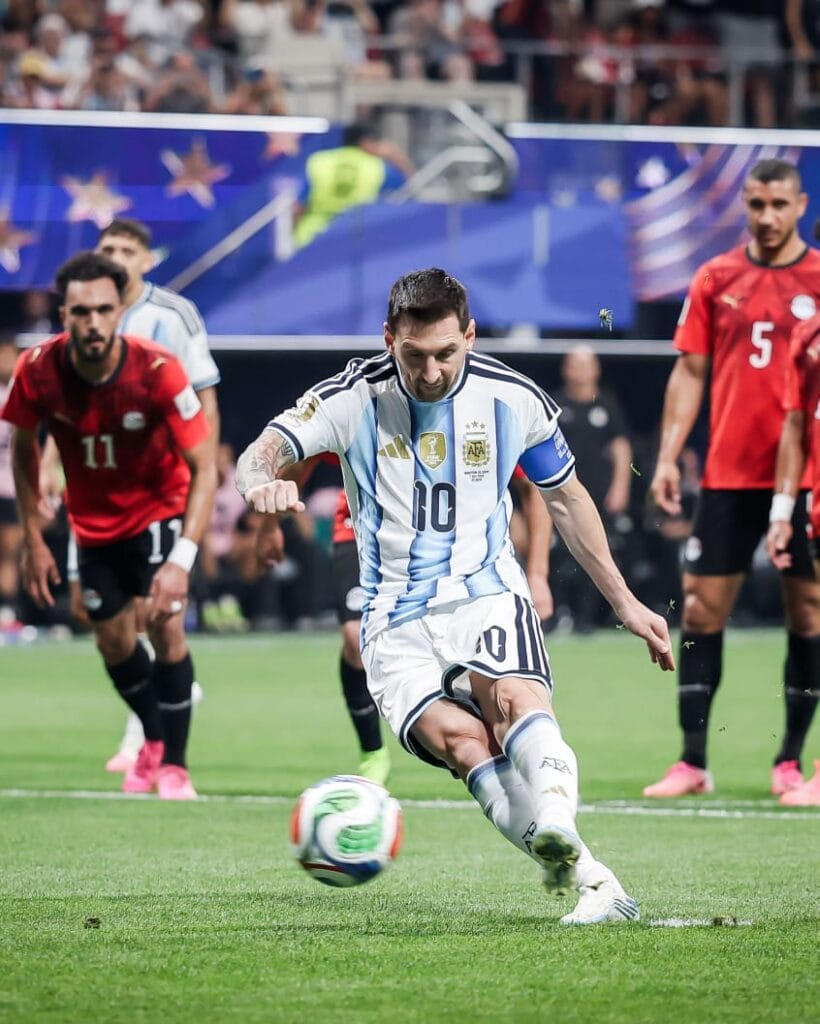
Minutes later, Argentina were handed a lifeline when the referee pointed to the penalty spot. Up stepped Messi, the golden boy, the holder of the crown. But the script took its second bizarre twist. Egypt’s magnificent young goalkeeper, Mostafa Shobeir, divined Messi’s intentions, diving full-stretch to block the penalty kick.
It was Messi’s second missed spot-kick of the tournament and his fourth in World Cup history. Shobeir instantly became a national hero, pulling off string after string of miraculous first-half saves to deny Julian Alvarez and Alexis Mac Allister, leaving the champions trailing at the break.
When Mostafa Ziko doubled Egypt’s lead in the sixty-seventh minute, finishing off a lightning-fast, devastating counterattack with a clinical strike into the corner, the giant stadium fell into an eerie silence. At 2-0 down, Argentina looked dead, buried, and thoroughly exhausted after their previous grueling encounter with Cape Verde.
But true champions do not bleed out quietly. The final eleven minutes plus stoppage time belonged to footballing folklore. The fightback began in the seventy-ninth minute when Cristian Romero, pushed forward in desperation, managed to bundle the ball home from close range after a goalmouth scramble.
With the deficit halved, the Argentine faithful found their voices, and the suffocating pressure finally broke the Egyptian wall. Just four minutes later, redemption arrived for the maestro.
As Egypt failed to properly clear their lines under an unyielding high press, the ball broke to Messi in the center of the box.
Showing the ice-cold composure that has defined his two-decade reign at the pinnacle of the sport, he shifted the ball onto his magical left foot and lashed a crisp half-volley past Shobeir. The equalizer marked a historic milestone, seeing Messi score in his ninth consecutive World Cup match and moving him clear at the top of the 2026 Golden Boot standings with his eighth goal of the summer.
The drama, however, was far from finished. As the clock ticked into seven minutes of nerve-shredding injury time, the game degenerated into an end-to-end basketball match.
Leandro Paredes had to make a spectacular, last-man intervention to halt a dangerous three-on-two breakaway orchestrated by Mohamed Salah.
Then came the history-maker. In the ninety-second minute, Alvarez sprayed a pass out wide to Lautaro Martínez on the right wing. The Inter Milan striker floated a sumptuous cross into the heart of the box.
Arriving perfectly on cue was Chelsea’s Enzo Fernández, who threw himself at the ball, planting a powerful header into the top-right corner.
It was a goal of monumental significance—not only did it complete a breathtaking comeback, but it was officially registered as the 3,000th goal scored in FIFA World Cup history.
Egypt were left absolutely furious, their technical bench erupting in protest over earlier controversial decisions, including a disallowed goal for an alleged foul in the buildup, resulting in a red card for an Egyptian coaching staff member in the chaotic aftermath.
Mostafa Shobeir and Hamdy Fathy were both booked in the frantic final moments as Egypt desperately looked to salvage something from the wreck.
When the final whistle blew, Messi fell to his knees, weeping tears of pure joy before being swamped by his teammates. They had survived the ultimate scare.
The final match data paints a picture of utter dominance met by lethal efficiency. Argentina dictated the tempo, controlling sixty-two percent of total possession and moving the ball with short, sharp combinations.
Their offensive intent was clear, unleashing twenty-four shots over the ninety minutes, with eleven of those finding the target, forcing the heroic Shobeir into eight world-class saves. In contrast, a disciplined Egypt functioned on a razor-sharp counterattacking blueprint, registering just eight shots in total, but demonstrating lethal precision by hitting the target with five of them.
The physical intensity of the knockout tie was reflected in the foul count, with Argentina committing fourteen infractions while Egypt committed nineteen, a tally that ultimately resulted in five yellow cards for the African nation as they tried to halt the late Argentine onslaught.
Argentina’s territorial dominance was further illustrated by their eight corner kicks compared to Egypt’s three.
La Albiceleste march on to the quarterfinals where a date with Switzerland or Colombia awaits on Saturday.
For Egypt, it is a heartbreaking departure, but they leave with their heads held high after pushing the greatest to the absolute brink.