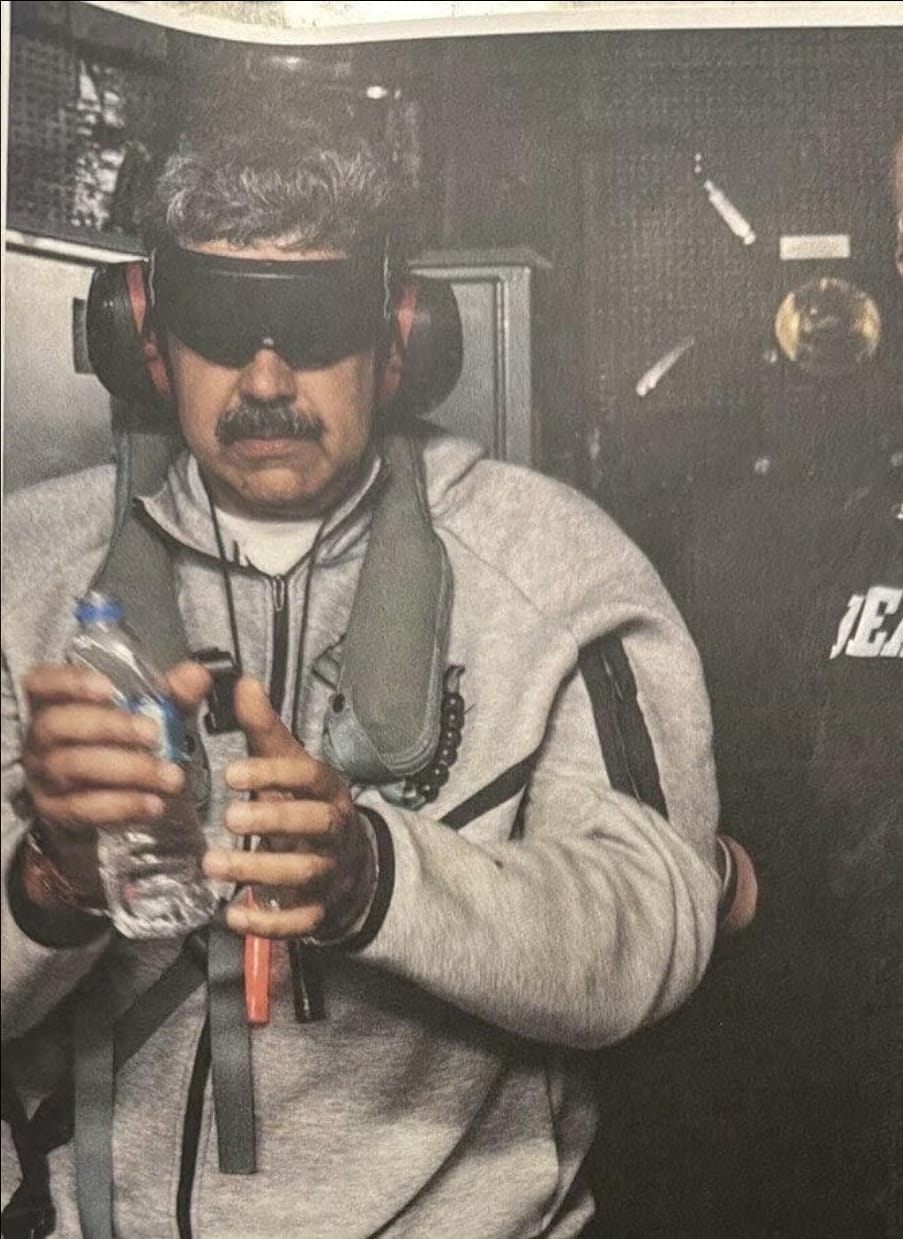
The Energy Factor: With the U.S. announcing plans to temporarily oversee Venezuela’s oil infrastructure, the global energy market is bracing for volatility. Any attempt to “run” the oil industry could be viewed as a neo-colonial resource grab, complicating U.S. relations with OPEC
By Emmanuel Thomas l Saturday, January 03.26
WASHINGTON – The capture of Nicolás Maduro by U.S. Special Forces on January 3, 2026, represents a watershed moment in 21st-century geopolitics.
By forcibly removing a sitting head of state from foreign soil to face domestic criminal charges, the United States has executed its most aggressive intervention in Latin America since the 1989 invasion of Panama.
1. The Legal Framework: Law Enforcement vs. Act of War
The U.S. justification for the raid rests on a 2020 federal indictment charging Maduro with narco-terrorism, conspiracy to import cocaine, and leadership of the Cartel de los Soles.
The “Noriega” Precedent: The trial, slated for the Southern District of New York, mirrors the 1992 conviction of Manuel Noriega.
However, legal scholars note a critical difference: Maduro was the internationally recognized (if disputed) leader of a sovereign nation at the time of capture.
Constitutional Dispute: Domestically, the raid has sparked a firestorm.
The administration authorized the “large-scale strike” without Congressional approval, citing national security threats. Critics argue this bypasses the War Powers Resolution, while supporters claim the executive has the authority to pursue indicted “narco-terrorists” who threaten American public health.
2. Global Impact: A Shift in the World Order
The international community has reacted with a mix of celebration and “deep concern” regarding the violation of national sovereignty.
Geopolitical Friction: Russia and China have condemned the capture as a “flagrant violation of international law.”
For Moscow and Beijing, this sets a precedent where any leader opposed to U.S. interests could be subject to “extradition by force.”
Regional Instability: While some Latin American neighbors (like Argentina) have lauded the end of the Maduro regime, others (like Brazil and Mexico) warn of a power vacuum.
The potential for a “Libya-style” collapse or a protracted insurgency by pro-Maduro colectivos remains a high risk.
The Energy Factor: With the U.S. announcing plans to temporarily oversee Venezuela’s oil infrastructure, the global energy market is bracing for volatility. Any attempt to “run” the oil industry could be viewed as a neo-colonial resource grab, complicating U.S. relations with OPEC.
3. Implications for America
For the United States, the capture of Maduro is a high-stakes gamble with three primary consequences:
A. The “Strongman” Doctrine
The operation signals a return to the Monroe Doctrine, asserting that the U.S. will unilaterally enforce its will in the Western Hemisphere. This may deter other regional adversaries but risks alienating allies who favor multilateralism and the UN Charter.
B. Security Risks
The capture places a target on U.S. assets and personnel globally. Retaliatory strikes from Maduro-aligned paramilitary groups or asymmetrical responses from his international backers (Iran, Russia) are now a significant concern for the Department of Defense.
C. The Trial as Theater
The coming trial will not just be about drug trafficking; it will be a trial of the Maduro regime’s legitimacy.
If the U.S. fails to provide “smoking gun” evidence linking Maduro directly to the 7 tons of cocaine mentioned in the indictment, the operation could be perceived as a politically motivated kidnapping rather than a legal arrest.
Key Statistic: The U.S. has placed a $50 million bounty on information leading to Maduro’s arrest, which was doubled shortly before the January 3rd operation.
The success of this intervention will not be measured by the capture itself, but by the stability of the transition that follows.
If Venezuela descends into civil war or the U.S. becomes mired in long-term “nation-building,” the capture of Maduro may be viewed by history as a tactical victory but a strategic failure.
As of January 2026, Venezuela is in a state of rapid political flux following a dramatic escalation in U.S. intervention.
Below is an analysis of the specific legal details regarding the narco-terrorism indictments and the current status of the transitional authority.
1. The Narco-Terrorism Indictments (2020 & 2026 Updates)
The legal framework for the current U.S. actions stems from a series of indictments unsealed in the Southern District of New York (SDNY).
Original 2020 Indictment: In March 2020, the U.S. Department of Justice (DOJ) charged Nicolás Maduro and 14 other officials with narco-terrorism conspiracy.
The core allegation was that Maduro led the “Cartel de los Soles” (Cartel of the Suns), a group of high-ranking military and political figures who allegedly conspired with the FARC to use cocaine as a weapon to “flood” the U.S. market and undermine American health and security.
Charges:
Narco-terrorism conspiracy.
Cocaine importation conspiracy.
Possession and conspiracy to possess machine guns and destructive devices (used to protect drug shipments).
The 2026 Superseding Indictment: On January 3, 2026, following a U.S. military operation to extract Maduro from Caracas, Attorney General Pam Bondi unsealed updated charges.
This new indictment adds Maduro’s wife, Cilia Flores, and his son, Nicolás Maduro Guerra (“Nicolasito”), to the list of defendants, alleging their direct involvement in the laundering of drug proceeds and the protection of trafficking routes.
Bounty: The reward for Maduro’s capture was increased from $15 million in 2020 to $50 million by mid-2025, just months before his capture.
2. The Current Makeup of the Transitional Government
The political situation in Caracas is currently bifurcated between a de facto U.S.-led administration and a contested domestic leadership.
U.S. Provisional Oversight: President Donald Trump has stated that the United States will “run” Venezuela temporarily with a special group to stabilize the country and its oil assets.
Secretary of State Marco Rubio has been designated to lead the coordination of this transition.
The Opposition Leadership: María Corina Machado: Recognized internationally (and a 2025 Nobel Peace Prize winner), Machado is the primary moral and political leader of the opposition.
She has called for the immediate recognition of Edmundo González Urrutia as the legitimate president.
Edmundo González Urrutia: The opposition’s candidate from the 2024 elections. Machado and her allies contend he is the “President-Elect” who should immediately assume the constitutional mandate.
The Maduro Remnant: Vice President Delcy Rodríguez remains in Venezuela and has claimed interim authority under the Venezuelan constitution. However, the U.S. and the primary opposition parties do not recognize her claim, viewing her as part of the indicted criminal structure.