Emmanuel Thomas I Friday, June 23, 2023
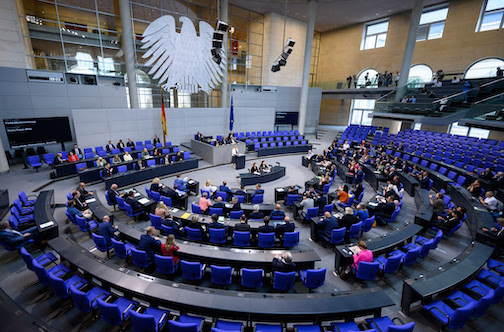
BERLIN – Lawmakers worked on a final debate in the German parliament on a contentious immigration bill to make the country more skilled labour friendly.
Germany stood to get “the most modern immigration law in the world” by passing the bill, Interior Minister Nancy Faeser told the 736-seat Bundestag in Berlin.
The next step must be to “significantly reduce bureaucracy” in order to make the path to Germany less burdensome for qualified workers, Faeser said.
A sticking point of the draft law is the so-called opportunity card based on a points system. This takes into account a prospective migrant’s language skills, professional experience, age and connection to Germany.
For example, IT specialists would be allowed to come to Germany even without a university degree, provided they can prove that they have certain qualifications.
It would also become easier for asylum seekers who entered the country before March 29, 2023, who are in qualified employment or have it in prospect.

Andrea Lindholz, deputy chair of the opposition conservative CDU/CSU parliamentary group, criticised the reform as a “sham”. Instead of paving the way for skilled workers, it lowered the level of education and language required of migrant workers, she said.
With the new points system, the coalition government was creating a “bureaucratic monster,” Lindholz added. Konstantin von Notz, deputy leader of the Green Party – one of the three coalition partners – called Lindholz’s objections “far-fetched”.
Speaking for the pro-market Free Democratic Party (FDP), also a coalition party, lawmaker Johannes Vogel said Germany was taking its cue from successful immigration countries such as Canada, New Zealand and Australia. “With new minds come new ideas,” Vogel said.
Gökay Akbulut of the hard-left Die Linke (The Left) party said it was good that skilled workers would be able to bring their parents and parents-in-law to live with them in future, even without proof of residence.
However, the fact that working migrants without special qualifications are not allowed to do so
was, according to Akbulut, “a two-class migration policy,” which her party rejects.
Norbert Kleinwächter of the far-right Alternative for Germany (AfD) told the assembly that Germany is not a country of immigration, but a “homeland.” There are not too few people coming to Germany, but too many people who do not want to integrate, he said.