


By SCM Foreign Desk
BEIRUT, Lebanon — An Israeli dawn airstrike slammed into a southern Lebanese town on Sunday, killing at least eight people, including three women, according to the Lebanese Health Ministry.
The attack adds to a mounting civilian toll as Israel aggressively widens its operations north of a strategic boundary river, effectively leaving a fragile, U.S.-brokered ceasefire in tatters.
The strike targeted a building in Deir Zahrani, a town nestled within the rugged hills of the Nabatieh district, long considered a political and military stronghold for the militant group Hezbollah. In addition to those killed, the ministry reported that 19 others were wounded, a toll that underscores the steep civilian cost of the renewed aerial campaign: five children and six women were among those rushed to regional hospitals, many with severe blast injuries.
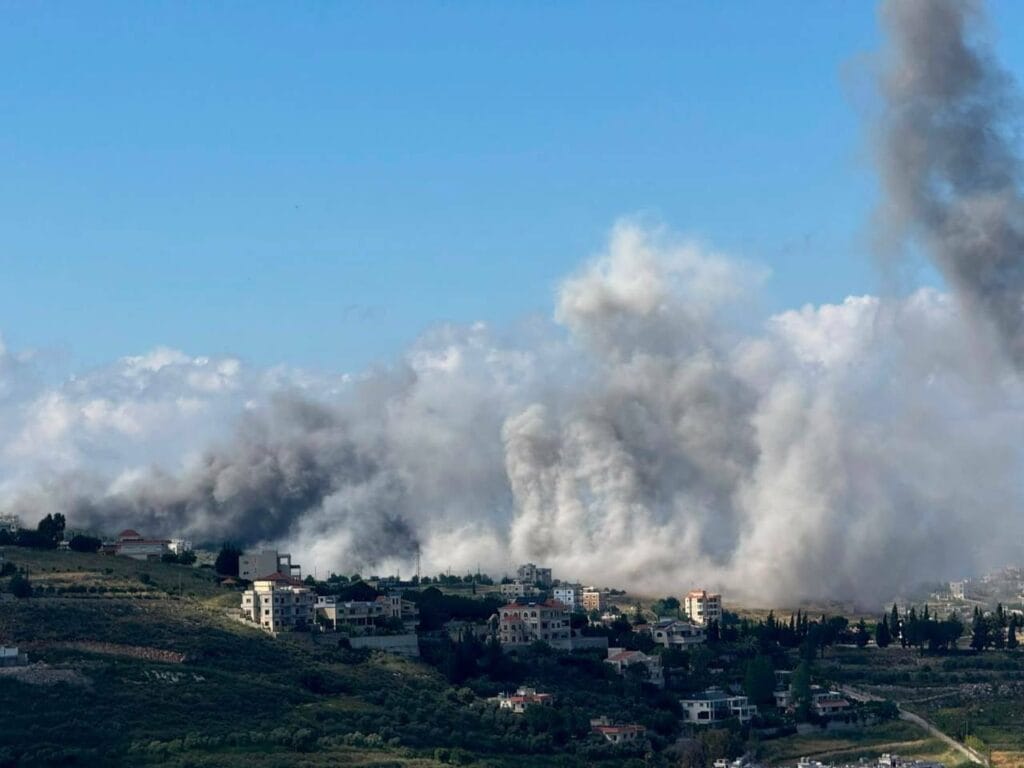
The dawn bombardment capped a fierce 24-hour window of intensified conflict. A compilation of video footage circulating across Lebanese media networks and authenticated by security analysts tracked a relentless rhythm of strikes blanketing southern Lebanon over the past day.
Plumes of dark grey smoke were captured rising from residential neighborhoods, historic districts, and main arterial roads spanning from the coastal city of Tyre to the interior valleys.
By midday Sunday, Israel’s military confirmed it was conducting a “large-scale” offensive in the nearby Beaufort Ridge and Wadi al-Salouqi areas, deploying massive ground forces and expanding its operations deep into Nabatieh.
The attack represents a critical benchmark in a conflict that has stubbornly refused to quiet down. On paper, Lebanon and Israel are bound by a U.S.-brokered ceasefire agreement that initially went into effect on April 17 and was recently extended for an additional 45 days.
The diplomatic framework was intended to halt a devastating war that erupted on March 2, when Hezbollah launched an intensive rocket campaign against northern Israel.
That baseline escalation followed heavy American and Israeli joint strikes against Iran, Hezbollah’s primary geopolitical benefactor, in late February.
However, the truce has unraveled day by day, observed almost exclusively in breach. Israel has maintained a steady rhythm of airstrikes, targeted demolitions, and sweeping evacuation orders, asserting that its actions are necessary preemptive measures against Hezbollah infrastructure.
Hezbollah, meanwhile, has countered with a steady drumbeat of drone and rocket attacks targeting Israeli forward positions inside southern Lebanon and cross-border civilian towns, claiming its actions are legitimate resistance to an occupying force.
The operational reality changed dramatically over the weekend. Prime Minister Benjamin Netanyahu of Israel formally announced that Israeli forces had pushed past the Litani River—a geographical line roughly 20 miles north of the border that has historically served as the benchmark for security negotiations.
“Our forces have crossed the Litani,” Mr. Netanyahu declared on Friday. “We are hitting Hezbollah head-on.”
That push deeper into sovereign Lebanese territory has drawn sharp condemnation from Beirut. In a joint statement, Lebanon’s President Joseph Aoun and Prime Minister Nawaf Salam condemned what they termed “destructive practices,” which have increasingly imperiled historic heritage sites, including the medieval-era Beaufort Castle, and forced a new wave of displacement.
More than a million Lebanese have been driven from their homes since the March iteration of the conflict began, turning parks, schools, and seaside boardwalks in Beirut into makeshift refugee encampments.
The civilian casualties in Deir Zahrani have added acute urgency to a landmark round of high-stakes security talks scheduled to take place on June 2 and 3, where military delegations from both nations are expected to meet with international mediators.
Yet on the ground, the diplomatic maneuvering feels increasingly detached from the reality of the front lines.
According to official data compiled by the Lebanese Health Ministry, the total death toll since March 2 has now surpassed 3,370 people, a chilling testament to a war that diplomatic channels seem entirely unable to contain.